
ISTG is a short slang term used in texts and chats. It stands for “I swear to God.” People use it to show they are being honest. It adds strong emotion to a message. You will see it a lot in casual chats.
You might see it in a message like “istg I didn’t take your charger.” It shows the person really means what they say. It can also show shock or frustration. Most people type it in lowercase. It feels more real than just saying “I promise.”
ISTG can be used in many moods. Someone might use it when they are angry, like “istg if you do that again.” Someone might use it when they are amazed, like “istg this is the best food ever.” The tone depends on the rest of the message. The words around it give the real meaning.
ISTG is common on social media and group chats. Teens and young adults use it the most. It is not right for work emails or school papers. In formal writing, say “I swear” or “honestly” instead.
What Does ISTG Mean in Chat
What Does ISTG Mean in Texting?
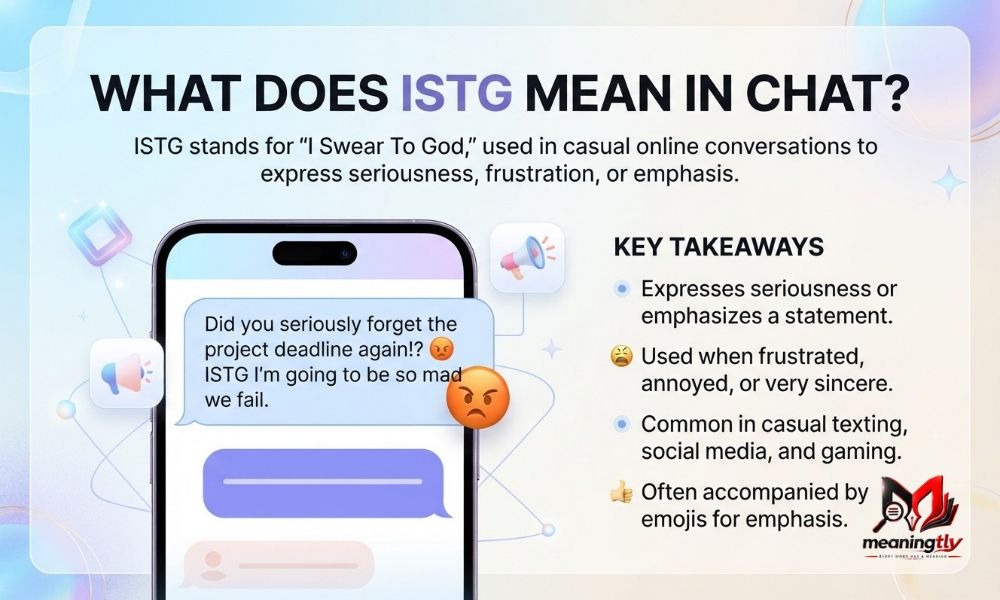
In chat, ISTG stands for “I swear to God.” It is texting slang. It is written in capitals or lowercase, and both are fine.
The istg meaning does not change across apps. The tone does. It can show honesty, anger, shock, or humor.
Here is what it usually signals:
- “I am telling the truth.”
- “I am serious about this.”
- “I am really annoyed.”
- “I promise I will do it.”
The phrase is short and quick to type. That is why it spread across chats, comments, and captions.
Most top explainers agree on the istg meaning. They all point to “I swear to God” as the main definition.
The full phrase can feel strong to some people. Because of the religious word in it, some users think it sounds heavy. Online, though, the short form is mostly casual.
Here is a quick look at the phrase:
| Item | Detail |
| Full form | I swear to God |
| Type | Internet slang / acronym |
| Tone | Serious, emotional, or playful |
| Common use | Texts, DMs, comments, captions |
| Age group | Popular with teens and young adults |
You will often see it at the start or end of a sentence. Both spots work.
Examples:
- “ISTG I did not eat your fries.”
- “I locked the door, istg.”
Knowing the istg meaning helps you read chats faster. It also stops you from missing the emotion behind a message.
How Is ISTG Used in a Conversation?
Think of ISTG as a promise. You use it to say, “Trust me on this.”
It works like a spoken oath. People say “I swear to God” when they want to be believed. ISTG is the typed version.
Here is the istg meaning in one line: it is a way to stress that you are being honest or serious.
There are two main moods behind it.
Mood one: sincerity. You want the other person to believe you.
- “ISTG I will call you back.”
- “I am not lying, istg.”
Mood two: frustration. You are annoyed and want to show it.
- “ISTG if he is late again, I am leaving.”
- “This app crashes every time, istg.”
The words around ISTG tell you which mood it is. Read the whole message before you decide.
Here is another way to see it:
| Situation | What ISTG shows |
| Making a promise | Commitment |
| Defending yourself | Honesty |
| Venting about something | Anger or stress |
| Sharing a funny moment | Playful exaggeration |
| Warning someone | Serious intent |
The istg meaning stays the same in every row. Only the feeling changes.
Some people use ISTG as a filler. They add it without much thought. In that case it is just emphasis, like saying “seriously” or “honestly.”
You do not need to be religious or non-religious to use it. In text, it is treated as a casual expression. Still, some people dislike phrases with “God” in them. If you are unsure, pick a softer option.
A few easy swaps:
- “I promise”
- “Honestly”
- “I am serious”
- “No joke”
These carry a similar feeling with less edge.
The main point is simple. When you see ISTG, read it as strong emphasis. The sender wants you to take the message seriously.
Where Is ISTG Used?
ISTG appears on almost every platform. It is most common where people type fast and casually.
Text messages.
This is the most common place. People use it in one-on-one chats and group chats. It fits well with quick replies.
- “I am on my way, istg.”
- “ISTG you always say that.”
WhatsApp.
Friends and family use it in daily chats. It shows up in voice-note captions and status replies too.
Snapchat.
Snapchat chats are quick and informal. ISTG fits that pace. It often appears with emojis and photos.
- “Best pizza ever, istg.”
Instagram.
You will see it in comments, captions, and DMs. Users add it to stress a reaction.
- “This song is stuck in my head istg.”
TikTok.
Creators and viewers use it in comments and captions. It often shows up in relatable or funny videos.
- “ISTG this happens to me every morning.”
X (Twitter).
People use it in short posts and replies. It suits venting and jokes.
Discord and gaming chats.
Gamers use it during matches. It shows frustration or excitement.
- “ISTG that lag cost us the game.”
Reddit and forums.
It appears in comments, though less often than on social apps.
Here is a quick platform table:
| Platform | Typical use | Common tone |
| Text / SMS | Promises, replies | Serious or casual |
| Daily chats | Casual | |
| Snapchat | Quick messages | Playful |
| Comments, captions | Expressive | |
| TikTok | Comments | Funny, relatable |
| X (Twitter) | Short posts | Venting |
| Discord | Gaming chat | Frustrated or hyped |
The istg meaning is the same everywhere. What changes is the style around it.
On some platforms people write it in lowercase. On others they use capitals for extra force. Both versions mean the same thing.
You will rarely see it in formal places. Emails to a boss, school essays, and official letters are not the right home for slang. Save it for casual talk.
This is why the istg meaning matters. If you do not know it, you may misread a friend’s message. You might think they are angry when they are only joking.
Why Do People Use It?
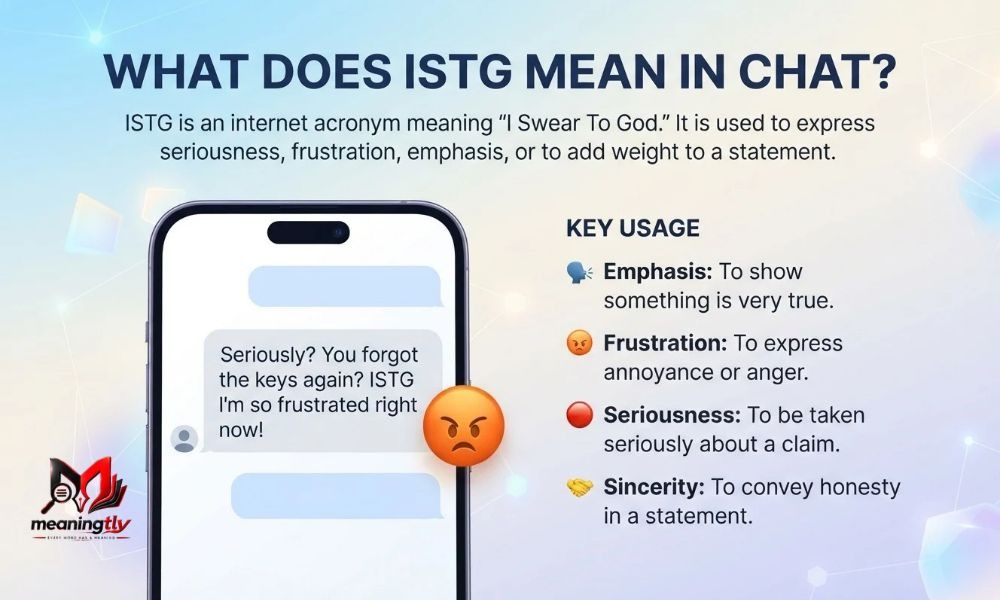
People use ISTG for several reasons. The first is speed. It is faster to type “istg” than “I swear to God.”
Here are the main reasons.
- It saves time. Four letters replace four words.
- It adds emphasis. Plain text has no voice. ISTG adds force.
- It builds trust. It signals that you mean what you say.
- It shows emotion. It carries anger, stress, or excitement.
- It sounds natural. Many people already say “I swear to God” out loud.
Let us look at each one.
Speed.
Chat is fast. People trim words to keep up. Acronyms like LOL, OMG, and BRB grew this way. ISTG follows the same path.
Emphasis.
In a real talk, you can raise your voice. In text, you cannot. Slang fills that gap. ISTG lets you add weight without capital letters or long sentences.
Trust.
When someone doubts you, ISTG helps you push back.
- “I did not take your charger, istg.”
It tells the reader you are being straight with them.
Emotion.
Text can feel flat. ISTG adds color. It can show that you are fed up, thrilled, or shocked.
- “ISTG this is the best day ever.”
- “ISTG if I hear that alarm again…”
Natural speech.
People type the way they talk. Since “I swear to God” is common in speech, ISTG feels normal in text.
There is also a social reason. Slang creates a sense of belonging. When friends share the same phrases, chats feel warmer and more relaxed.
Younger users helped ISTG spread. Gen Z chat culture loves short, punchy phrases. It sits alongside “fr,” “ngl,” and “no cap.”
A short list of feelings ISTG can carry:
- Honesty
- Promise
- Anger
- Stress
- Excitement
- Disbelief
- Humor
The istg meaning may look small. But it does a lot of work in a short space.
One more point. Some people use it as a habit. They add it to many messages without thinking. In this case it is like a verbal tic. It adds rhythm more than meaning.
Knowing why people use it helps you read the tone. It also helps you decide when to use it yourself.
Real-Life Examples (With Explanations)
Examples make the istg meaning easy to see. Here are common cases, each with a short note.
Example 1: A promise
“I will send the file tonight, istg.”
Explanation: The sender is making a firm promise. ISTG adds commitment.
Example 2: Defending yourself
“I did not read your messages, istg.”
Explanation: The sender wants to be believed. It works as a small oath.
Example 3: Frustration
“ISTG my phone dies every hour.”
Explanation: The sender is annoyed. The message is a vent, not a promise.
Example 4: Excitement
“ISTG this is the best burger in town.”
Explanation: The sender is thrilled. ISTG boosts the praise.
Example 5: A warning
“ISTG if you spoil the ending, I am done.”
Explanation: The tone is playful but firm. It warns the reader.
Example 6: Disbelief
“He said that to my face, istg.”
Explanation: The sender is shocked. They want the reader to know it really happened.
Example 7: Group chat joke
“ISTG you people never reply on time.”
Explanation: This is light teasing. It is not real anger.
Example 8: Gaming
“ISTG I saw him hiding behind the wall.”
Explanation: The player insists on their version of events.
Example 9: Work chat (casual team)
“I will fix the bug today, istg.”
Explanation: A relaxed promise among coworkers. Use it only if the team’s tone is casual.
Example 10: Social media caption
“Coffee first, istg.”
Explanation: A playful line. ISTG adds attitude.
Here is a table to sum up the tones:
| Example | Tone | Purpose |
| “I will call, istg.” | Serious | Promise |
| “I did not do it, istg.” | Defensive | Prove honesty |
| “ISTG my phone is dead.” | Annoyed | Vent |
| “Best day, istg.” | Happy | Show joy |
| “ISTG if you spoil it…” | Playful | Warn |
| “He really said that, istg.” | Shocked | Stress truth |
Here are two short chat scenes.
Scene one
- Sam: “Did you eat my leftovers?”
- Alex: “No, istg.”
- Sam: “Okay, I believe you.”
Alex uses ISTG to prove honesty.
Scene two
- Mia: “The bus is late again.”
- Zoe: “ISTG this happens every day.”
- Mia: “Same, I am so tired of it.”
Zoe uses ISTG to share frustration.
Notice how the istg meaning stays fixed. The mood changes with the sentence.
Try this quick test. Read the sentence out loud. Then ask, “Is the person promising, venting, or joking?” The answer usually shows up fast.
Context is everything. A smiley face, a laughing emoji, or an angry emoji all shift the feeling. Look at them before you reply.
ISTG vs Similar Terms
ISTG has many cousins in chat slang. Some are close in meaning. Others are only loosely related.
Here is a comparison table:
| Term | Full form | Meaning | Tone |
| ISTG | I swear to God | Strong promise or emphasis | Serious or annoyed |
| OMG | Oh my God | Surprise or shock | Excited or shocked |
| FR | For real | Honest or agreeing | Casual |
| NGL | Not gonna lie | Honest opinion | Casual |
| IKR | I know, right? | Agreement | Friendly |
| IDK | I don’t know | No answer | Neutral |
| TBH | To be honest | Honest view | Casual |
| No cap | No lie | Truthful | Gen Z casual |
| Deadass | Seriously | Very serious | Street slang |
Let us compare a few in detail.
ISTG vs OMG.
OMG shows surprise. ISTG shows honesty or intensity. You can use both in one message.
- “OMG, I passed! ISTG I studied all night.”
ISTG vs FR.
FR means “for real.” It is lighter. ISTG is stronger and more emotional.
ISTG vs NGL.
NGL introduces an honest thought. ISTG backs up a claim or shows annoyance.
ISTG vs TBH.
TBH signals honesty in an opinion. ISTG signals strong sincerity or frustration.
ISTG vs no cap.
Both stress truth. “No cap” feels more playful and trendy. ISTG feels more serious.
ISTG vs deadass.
Both stress that you mean it. Deadass is more regional slang. ISTG is widely understood.
Sometimes people stack them:
- “ISTG fr fr, I am not joking.”
This is a double dose of emphasis. It is popular in teen chat.
Here is how strong each phrase feels, from light to heavy:
- TBH
- NGL
- FR
- No cap
- Deadass
- ISTG
This ranking is a rough guide. Tone still depends on context.
The istg meaning sits near the strong end. That is why it works well for promises and venting. It is less suited to light opinions.
Pick the term that fits the mood. If you only want to share an opinion, “tbh” is enough. If you want to be believed or show real annoyance, “istg” does the job.
When Should You Use It?
Use ISTG when the mood is casual. It fits chats with friends, family, and peers.
Good times to use it:
- Making a firm promise
- Proving you are honest
- Sharing frustration
- Adding emphasis to a story
- Joking with friends
- Reacting to something surprising
Here are sample lines for each.
- Promise: “I will be there at six, istg.”
- Honesty: “I did not tell anyone, istg.”
- Frustration: “ISTG this traffic is endless.”
- Story: “He walked in wearing two different shoes, istg.”
- Joke: “ISTG you snore like a truck.”
- Surprise: “ISTG I just saw a peacock on the road.”
Now think about when not to use it.
Avoid it in:
- Job applications
- Emails to teachers or bosses
- Formal reports
- Talks with strangers you want to impress
- Messages to people who dislike religious phrases
Here is a simple guide:
| Setting | Safe to use? |
| Chat with close friends | Yes |
| Family group chat | Usually yes |
| Social media comments | Yes |
| Casual team chat | Sometimes |
| Formal email | No |
| Client message | No |
| School essay | No |
Ask yourself three quick questions before you type it:
- Is this chat casual?
- Will the reader understand slang?
- Could the phrase offend them?
If the answers are yes, yes, and no, go ahead.
Age and culture matter too. Older readers may not know the istg meaning. They might read it as rude. If you talk to someone who does not use slang, write the full phrase or choose a plain word.
Also think about the message itself. Do not use ISTG to back up a lie. Using it to defend something false can hurt trust. Use it when you mean it.
Use it sparingly. Too many ISTGs make your chat feel loud. One per message is plenty. It works best when it stands out.
A last tip: tone of voice. When you use it in a joke, add an emoji. This helps the reader see you are relaxed. Without it, a short “ISTG” can look harsher than you intend.
Common Misunderstandings
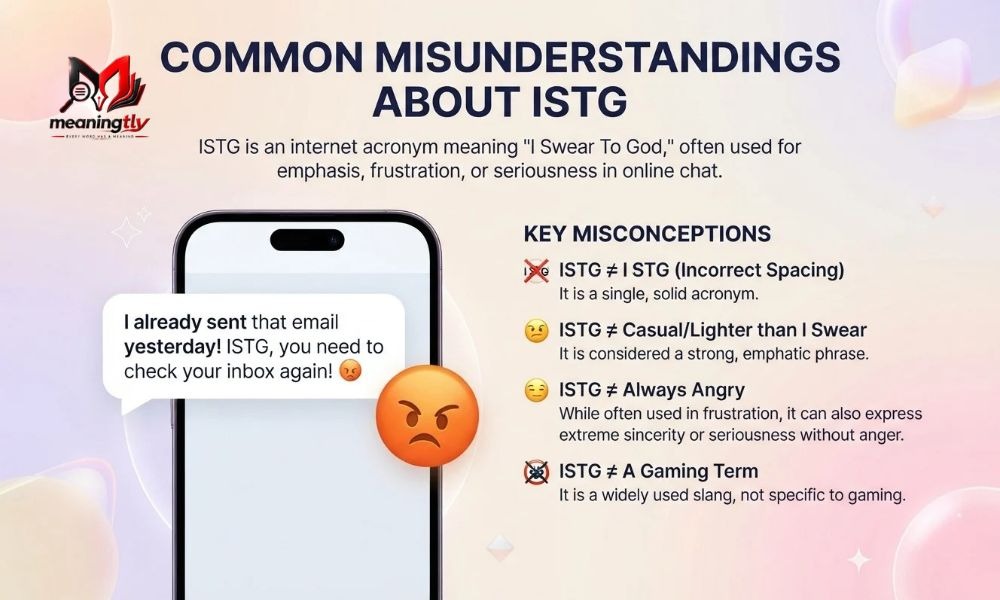
Slang causes confusion. ISTG is no exception. Here are the most common mix-ups.
Mix-up 1: “It is always angry.”
Not true. ISTG can be happy or funny. “ISTG this cake is amazing” is a joy, not a rant.
Mix-up 2: “It is a real religious oath.”
In chat, it is mostly casual. Most users do not mean it in a religious sense. It is an expression, not a formal vow.
Mix-up 3: “It has a different full form.“
You may find odd pages online that give ISTG other meanings. Some claim it stands for “I’m sitting through this.” Others suggest “I still think guys.” These claims are rare and poorly supported.
Reliable sources and everyday users agree on “I swear to God.” When you see it in a chat, that is almost always the intended istg meaning.
Here is how to check a strange claim:
- Look at how real people use the term in chats.
- Compare several trusted sources.
- Be careful with pages that repeat the same text across many sites.
Copied pages with unusual meanings are a red flag.
Mix-up 4: “It is only for teens.”
Teens use it a lot. But adults use it too. Many people in their twenties, thirties, and beyond type it daily.
Mix-up 5: “It is rude.”
It depends. Among friends it is normal. In formal places it can feel out of line. Some people find any “God” phrase impolite. Know your reader.
Mix-up 6: “It always means a promise.”
Sometimes it is only emphasis. “ISTG this song is fire” is not a promise. It is a strong opinion.
Mix-up 7: “Capitals change the meaning.”
Capitals only add volume. “ISTG” and “istg” mean the same. The capital version just feels louder.
Here is a myth-versus-fact table:
| Myth | Fact |
| Always angry | Can be happy or funny |
| Real religious oath | Casual expression |
| Many meanings | One main meaning |
| Only teens use it | Many ages use it |
| Always rude | Depends on context |
| Only a promise | Also emphasis or venting |
Another common error is spelling. Some people type “ISGT” or “ITSG.” The correct form is ISTG. The order is I, S, T, G.
The istg meaning is simple once you see the pattern. Read the context, note the emotion, and reply in a fitting tone.
If you are still unsure what a friend means, just ask. A quick “Are you joking?” clears things up fast.
CLFS Meaning: Complete Definition, Uses & Texting Examples
Pro Tips for Using ISTG Correctly
Want to use ISTG well? These tips will help.
1. Match the mood.
Use it when the moment fits. Do not add it to every line.
2. Keep it short.
It works best in short sentences.
- “I did it, istg.”
3. Place it well.
You can put it at the start or the end. Both work.
- “ISTG I will pay you back.”
- “I will pay you back, istg.”
4. Add emojis when joking.
A laughing emoji shows you are relaxed.
5. Know your reader.
Use slang with people who understand it.
6. Do not overdo it.
Too many uses weaken the effect. Save it for real emphasis.
7. Avoid it in formal writing.
Slang does not belong in official messages.
8. Do not use it for false claims.
Trust matters. Use it only when you are truthful.
9. Try alternatives.
When ISTG feels too strong, choose a gentler word.
- “I promise”
- “Honestly”
- “No joke”
10. Read the reply.
If the other person seems uneasy, tone it down.
Here is a quick do-and-don’t list:
| Do | Don’t |
| Use it with friends | Use it in job emails |
| Keep it once per message | Stack it in every line |
| Use it for real emphasis | Use it to back up a lie |
| Add emojis for humor | Use it with people who dislike it |
| Spell it ISTG or istg | Write ISGT or ITSG |
Here are some polished sample lines:
- “I will finish the report tonight, istg.”
- “ISTG this is my favorite song.”
- “I told you the truth, istg.”
- “If the Wi-Fi drops again, istg…”
You can also mix it with other slang to sound natural:
- “ISTG fr, I was there.”
- “NGL, istg this movie is great.”
Keep the mix light. Too much slang can feel forced.
If you write content for a blog or social page, use the istg meaning when you explain it. Give the full form, one clear example, and a short note about tone. That helps readers grasp it fast.
Finally, remember tone in text is fragile. A short message can sound harsh. When in doubt, add a friendly word or emoji.
Follow these habits and you will use ISTG with confidence.
Final Thoughts
ISTG is short for “I swear to God.” People use it to show they are serious. It adds strong emotion to a message. You often see it when someone wants to be believed. It can show anger, shock, or deep honesty.
This term is common in texts, DMs, and comments. Teens and young adults use it the most. It fits casual chats with friends or family. It is not meant for formal writing or schoolwork. In those places, avoid it and use clear, plain words instead.
The tone of ISTG can change based on the message. Sometimes it shows frustration, like a warning. Other times it shows excitement or pure shock. A few people use it just as a habit. The feeling around it depends on the full sentence.
In the end, ISTG is a simple way to add emphasis. It helps a message feel more real and personal. Knowing the context will help you read it right. Once you know it, the term is easy to spot. It is a small phrase with a big punch.
FAQ
What is the full form of ISTG?
The full form is “I swear to God.” It is a common piece of texting slang.
Is ISTG rude?
Not usually. It is casual slang. Avoid it in formal settings or with people who dislike such phrases.
What does ISTG mean in Gen Z slang?
In Gen Z slang, ISTG means “I swear to God,” used to stress honesty, promises, or annoyance.
What does STG mean?
STG means “swear to God,” a shorter version of ISTG with the same meaning.
What does ISTFG mean?
ISTFG means “I swear to f***ing God,” a stronger, more intense version of ISTG.
What does ISTG mean on Instagram?
On Instagram, ISTG means “I swear to God,” used in comments, captions, and DMs to add emphasis.
What does ISTG stand for?
ISTG stands for “I swear to God.”
