
NGL is a short slang term used in texts and chats. It stands for “not gonna lie.” People use it before they share an honest opinion. It often comes before something a bit blunt or personal. It is quick, casual, and easy to type.
You might see it in a message like “ngl, that movie was boring.” It shows the person is being real with you. It can also soften a hard truth. Most people write it in lowercase. It adds a tone of honesty to the message.
NGL can be used for good news or bad news. Someone might say “ngl, you did great today.” Others use it to admit something awkward, like “ngl, I forgot your name.” The phrase signals the speaker wants to be sincere. It often grabs attention right at the start.
NGL is common on social media and in texts. Teens and young adults use it the most. It is not a good fit for formal writing or work emails. In those places, write “honestly” or “to be honest” instead. Context always helps you read the tone correctly.
NGL Meaning Explained
What Does NGL Mean?
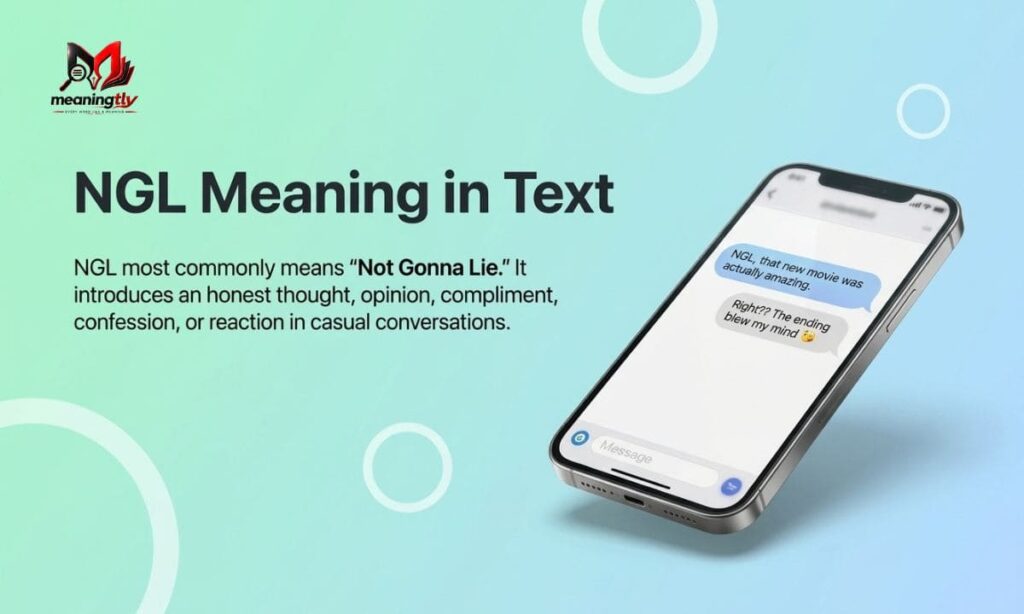
NGL means “not gonna lie.”
It is a short way to say, “I’m being honest with you.”
People type it before an opinion, a confession, or a compliment. It tells the reader the next part is real.
Quick answer for featured snippet:
NGL stands for “not gonna lie.” People use it in texts and on social media to introduce an honest opinion or a true confession.
The Full Form
- N – Not
- G – Gonna
- L – Lie
“Gonna” is casual speech for “going to.” So the full phrase is “not going to lie.”
How It Looks in Writing
You can write it in many ways:
- NGL
- ngl
- Ngl
- N.G.L.
Most people use lowercase. It looks relaxed and natural.
Where It Sits in a Sentence
NGL is flexible. You can place it:
- At the start: “NGL, that was funny.”
- In the middle: “That was, ngl, pretty good.”
- At the end: “That movie was great ngl.”
The meaning stays the same in all three spots.
Simple Meaning (In Easy Words)
Here is the NGL meaning in plain words: “To be honest.”
That is it. No hidden code.
Think of it as a small signal. It tells the reader, “I’m about to be real with you.”
Easy Ways to Understand It
NGL can replace many common phrases:
- To be honest
- Honestly
- Truthfully
- I won’t lie
- If I’m being real
A Quick Example
Text: “Ngl, I forgot about the party.”
Meaning: “Honestly, I forgot about the party.”
Short and simple.
What NGL Does Not Mean
NGL does not mean the person was lying before. It also does not mean they are about to lie.
It only adds honesty to the sentence. It sets the mood for a frank comment.
Where Did NGL Come From?
The NGL meaning is tied to the history of internet slang. People have shortened phrases in chats for decades.
Early Chat Culture
In the early days of online chat, typing was slow. People used short forms to save time. Think of LOL, BRB, and IDK.
NGL fits that same pattern. It trims a three-word phrase into three letters.
The Rise on Social Media
Slang spreads fast online. NGL grew as people started posting short, casual updates. Platforms like Twitter, Instagram, and TikTok pushed it into the mainstream.
Teens and young adults used it most. Then it spread to every age group.
Why It Stuck
Several reasons helped NGL last:
- It is short.
- It sounds natural.
- It fits many situations.
- It works in both serious and funny moments.
Spoken Roots
The phrase “I’m not gonna lie” is older than texting. People have said it out loud for years. The text version simply copied speech.
So NGL is not a brand-new idea. It is an old habit with a shorter spelling.
Where Is NGL Used?
You can find NGL almost anywhere people type casually.
Common Places
- Text messages
- WhatsApp and iMessage chats
- Instagram comments and DMs
- TikTok captions and comments
- Snapchat messages
- X (Twitter) posts
- Discord and gaming chats
- Reddit threads
Who Uses It?
Mostly:
- Teens
- College students
- Young adults
- Gamers
- Social media creators
Many older users now use it too. It is easy to pick up.
Where It Is Less Common
You rarely see NGL in:
- Business emails
- Job applications
- Legal documents
- School essays
- News articles
Formal writing needs full words. We cover this more below.
Other Meanings of NGL
Context matters. NGL can have other meanings outside texting:
- NGL (industry): Natural gas liquids.
- NGL (app): An anonymous question app that went viral in 2021.
In a chat or comment, though, the NGL meaning is almost always “not gonna lie.”
Why Do People Use NGL?
People use NGL for many reasons. Most come down to tone and speed.
1. To Sound Honest
Adding NGL makes a statement feel more sincere. It signals a real opinion.
“Ngl, I love your new haircut.”
2. To Soften a Hard Truth
Sometimes honesty stings. NGL can cushion the blow.
“Ngl, I didn’t love the ending.”
It sounds gentler than a flat criticism.
3. To Save Time
Three letters beat three words. Fast typing matters in chats.
4. To Sound Casual
NGL feels relaxed. It makes your message sound like real speech.
5. To Add Emphasis
It can make a compliment stronger.
“Ngl, you killed that presentation.”
6. To Admit Something
People use it to confess small things.
“Ngl, I haven’t started my homework.”
The Big Picture
The NGL meaning goes beyond the words. It adds a feeling of trust. The reader senses a real, unfiltered thought.
Real-Life Examples of NGL in Action
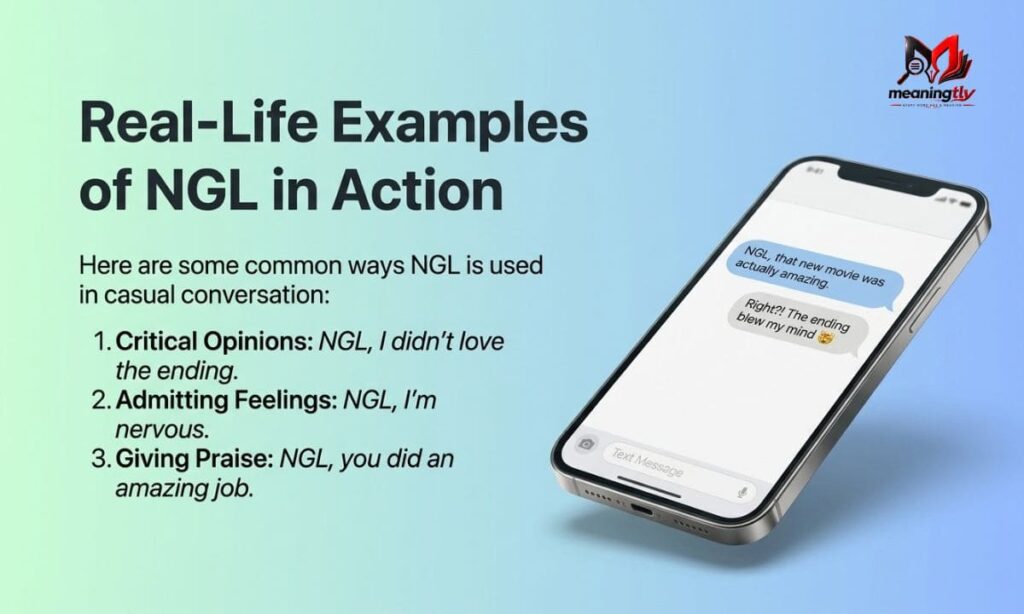
Examples make the NGL meaning easy to see. Here are common situations.
Example 1: Giving a Compliment
Friend A: “How do I look?”
Friend B: “Ngl, you look amazing.”
Meaning: Honestly, you look amazing.
Example 2: Sharing an Opinion
Friend A: “Did you like the movie?”
Friend B: “Ngl, it was kind of boring.”
Meaning: Honestly, it was a bit boring.
Example 3: Confessing Something
“Ngl, I fell asleep during the lecture.”
Meaning: Honestly, I fell asleep.
Example 4: Being Surprised
“Ngl, I did not expect that twist.”
Meaning: Honestly, I was shocked.
Example 5: Talking About Food
“This pizza is so good ngl.”
Meaning: The pizza is truly good.
Example 6: Saying Sorry
“Ngl, I should have called you back.”
Meaning: Honestly, I should have called.
Example 7: Gaming Chat
“Ngl, that was a lucky win.”
Meaning: Honestly, that was luck.
Example 8: Social Media Comment
“Ngl, this video made my day.”
Meaning: Honestly, I loved this video.
Example 9: A Mild Complaint
“Ngl, the service was slow.”
Meaning: Honestly, the service was slow.
Example 10: A Sweet Message
“Ngl, I miss you.”
Meaning: Honestly, I miss you.
Quick Pattern
Notice the pattern. NGL appears right where the honest part begins. It works for good news, bad news, and everything between.
Does NGL Change Meaning Depending On Tone?
Yes. The NGL meaning stays the same on paper, but tone changes how it feels.
Text has no voice. So the words around NGL, emojis, and punctuation matter a lot.
Positive Tone
NGL can show real praise.
“Ngl, you’re the best friend ever.”
Here, it feels warm and kind.
Negative Tone
NGL can also introduce criticism.
“Ngl, that was not great.”
Here, it feels blunt. It may sting.
Playful Tone
With emojis, NGL feels light.
“Ngl, I ate the whole cake 😂”
The laughing emoji shows it is a joke.
Serious Tone
Without emojis, NGL can sound heavy.
“Ngl, I’m worried about this.”
This feels sincere and calm.
Sarcastic Tone
Sometimes NGL is used with sarcasm.
“Ngl, I totally love waking up at 5 a.m.”
The context shows the person does not mean it.
How to Read the Tone
Look at these clues:
- The words after NGL
- Emojis
- Punctuation (! or …)
- Your past chats with that person
- The topic
Tone Table
| Message | Likely Tone | Feels Like |
| “Ngl, you look great!” | Positive | Warm compliment |
| “Ngl, I didn’t like it.” | Neutral to negative | Honest critique |
| “Ngl I’m so tired 😂” | Playful | Light and funny |
| “Ngl, that hurt me.” | Serious | Emotional honesty |
| “Ngl, great idea… not.” | Sarcastic | Mocking |
When unsure, ask. A quick “What do you mean?” clears things up.
NGL vs Similar Terms (Comparison Table)
NGL has many cousins. Each one works a bit differently. Knowing the difference helps you choose the right one.
Comparison Table
| Term | Full Form | Meaning | Tone |
| NGL | Not gonna lie | Honest opinion or confession | Casual |
| TBH | To be honest | Honest opinion | Casual |
| IMO | In my opinion | Personal view | Neutral |
| IMHO | In my humble opinion | Polite personal view | Polite |
| FR | For real | Strong agreement or truth | Casual |
| FRFR | For real, for real | Very strong truth | Emphatic |
| IDK | I don’t know | Unsure | Casual |
| SMH | Shaking my head | Disappointment | Negative |
| HONESTLY | – | Sincere statement | Neutral |
NGL vs TBH
These two are the closest.
- TBH means “to be honest.”
- NGL means “not gonna lie.”
Both introduce honesty. People use them almost the same way.
NGL often adds a feeling of admitting something. TBH feels a bit more neutral.
NGL vs IMO
IMO says, “This is my opinion.” It does not promise honesty. It only marks the idea as personal.
NGL says, “I’m being real with you.” It carries more emotion.
NGL vs FR
FR means “for real.” It agrees with or confirms something.
“That test was hard.” – “Fr.”
You cannot swap NGL here. NGL starts a statement. FR often answers one.
NGL vs Honestly
“Honestly” is the full word. It works anywhere, including formal writing. NGL is the casual, texting version.
Which One Should You Pick?
- Use NGL or TBH with friends.
- Use IMO when sharing a view.
- Use honestly in formal settings.
When Should You Use NGL?
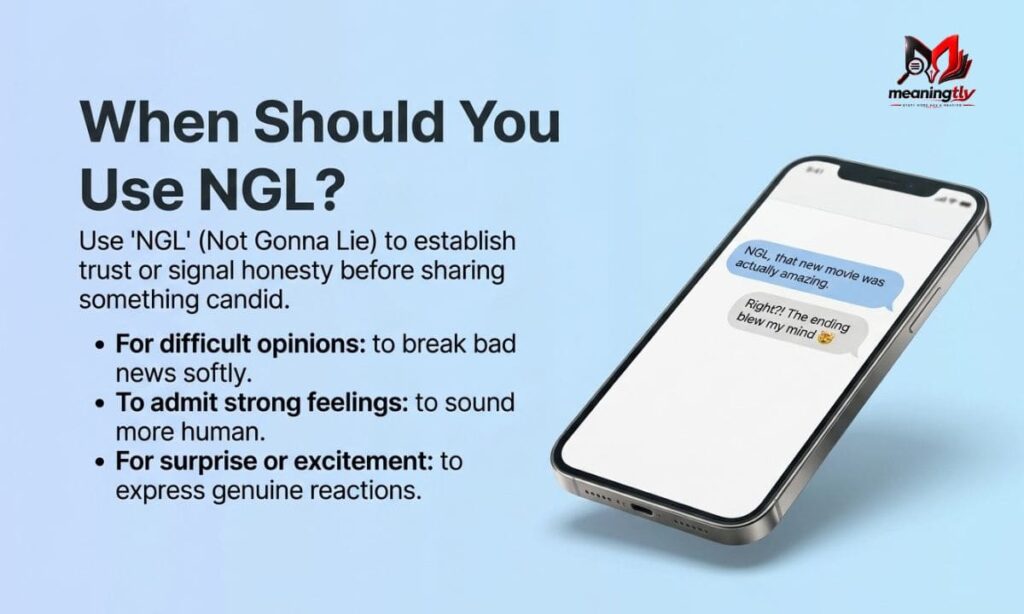
The NGL meaning is friendly, but timing matters. Use it where casual talk is welcome.
Good Times to Use NGL
- Chatting with friends
- Texting family
- Commenting on social media
- Gaming chats
- Sharing a light opinion
- Giving an honest compliment
- Admitting a small mistake
Bad Times to Use NGL
Avoid NGL in:
- Job emails
- Cover letters
- Messages to your boss
- Messages to a teacher
- Customer service replies
- Legal or official writing
- Serious apologies
Why Avoid It in Formal Settings?
NGL is slang. It can make you look careless. It may also confuse readers who do not know it.
Formal Swaps
Replace NGL with:
- “To be honest”
- “Frankly”
- “Candidly”
- “In truth”
Casual: “Ngl, I need more time.”
Formal: “To be honest, I need more time.”
A Simple Rule
Ask yourself one question: “Would I say this out loud to this person in a relaxed way?”
If yes, NGL is fine. If no, skip it.
Using NGL with New People
Be careful with people you do not know well. Blunt honesty may feel rude. A soft tone and a kind follow-up help.
Why NGL Fits Today’s Online Culture So Well
The NGL meaning matches how people talk online today. Several trends explain why.
1. Speed Matters
People type on phones. Short words win. NGL saves effort.
2. People Value Honesty
Online users like “real” talk. Polished, fake posts feel dull. NGL signals a raw, honest voice.
3. Casual Tone Is the Norm
Even brands now talk like friends. Slang like NGL helps them feel relatable.
4. Short-Form Content Rules
TikTok, Reels, and Shorts need quick captions. NGL fits in a few characters.
5. Trends Spread Fast
A phrase can go viral overnight. NGL rode this wave and stayed.
6. It Builds Connection
Honest words build trust. When someone says “ngl,” they invite you into their real thoughts.
7. It Works Across Topics
You can use NGL for food, music, school, work, love, and games. That range keeps it alive.
The Takeaway
Slang changes fast. Many terms vanish in months. NGL has lasted because it solves a real need. It adds honesty in a quick, friendly way.
NGL Meaning on Social Media
The NGL meaning stays the same on every platform. Still, each app has its own style.
On Instagram
People use NGL in:
- Captions: “Ngl, this was the best trip ever.”
- Comments: “Ngl, I’m obsessed with this.”
- DMs: “Ngl, I loved your story.”
On TikTok
NGL appears in:
- Video captions
- Comment sections
- Text overlays
Example: “Ngl, I did not think this would work 😂”
On Snapchat
Snap chats are quick and casual. NGL fits perfectly.
“Ngl, I’m bored.”
On X (Twitter)
Users post short opinions. NGL adds punch.
“Ngl, this update is actually good.”
On WhatsApp and iMessage
Here, NGL is used in personal chats.
“Ngl, I’m running late.”
On Discord and Gaming Platforms
Gamers use NGL often.
“Ngl, you carried that match.”
The NGL App
In 2021, an app called NGL became popular. It let people send anonymous messages to others through Instagram Stories. Many users shared a link that said “send me anonymous messages.”
The app drew attention to the three letters. But it is a separate thing from the slang.
The app also faced criticism. In 2024, US regulators took action against the company. They said it made misleading claims about anonymous messages. If you use anonymous apps, be careful. Protect your privacy and your mental health.
Social Media Tip
Use NGL in captions to sound real. Do not overuse it. Too many “ngls” can feel repetitive.
How to Reply When Someone Says NGL
A reply depends on what the person said. Match their tone.
If It Is a Compliment
Them: “Ngl, you look amazing.”
You: “Aw, thank you! That means a lot.”
If It Is Criticism
Them: “Ngl, I didn’t like the plan.”
You: “Thanks for being honest. What would you change?”
This keeps the talk open and kind.
If It Is a Confession
Them: “Ngl, I forgot to call you.”
You: “It’s okay. Let’s talk now.”
If It Is a Joke
Them: “Ngl, I ate your snacks 😂”
You: “Wow. I trusted you 😂”
If You Feel Hurt
Take a breath first. Then reply calmly.
“I appreciate your honesty. That one stung a bit.”
Quick Reply Ideas
| Situation | Sample Reply |
| Compliment | “Thank you, that’s sweet!” |
| Honest opinion | “I appreciate you telling me.” |
| Confession | “No worries, thanks for sharing.” |
| Criticism | “Good to know. Tell me more.” |
| Funny remark | “Haha, same!” |
Replying with Your Own NGL
You can answer in the same style.
Them: “Ngl, that exam was hard.”
You: “Ngl, I think I failed 😭”
If You Don’t Understand
Just ask.
“What do you mean?”
There is no shame in checking. Tone is easy to miss in text.
Common Misunderstandings About NGL
Many people get the NGL meaning slightly wrong. Let’s clear up the common mistakes.
Myth 1: NGL Means the Person Is Lying
Not true. It means the opposite. The person says they are being honest.
Myth 2: NGL Is Always Negative
Wrong. NGL introduces praise as often as criticism.
“Ngl, this is the best meal I’ve had.”
Myth 3: NGL Is Rude
Not by itself. The rudeness comes from the words after it. NGL only adds honesty.
Myth 4: NGL Is Only for Teens
Many adults use it too. It has become common slang.
Myth 5: NGL Is the Same as the App
The app borrowed the name. The slang is much older. They are different things.
Myth 6: NGL Always Needs a Comma
No strict rule exists. People write it with or without punctuation.
Myth 7: NGL Is Formal Enough for Work
It is not. Save it for casual chats.
Myth 8: NGL Means Something Secret
It does not. There is no hidden code. It is a plain phrase in short form.
Quick Reality Check
| Belief | Truth |
| NGL means lying | It means being honest |
| NGL is always negative | It can be positive too |
| NGL is rude | Tone depends on the message |
| NGL is for teens only | All ages use it |
IYKYK Meaning Explained: Origin, Usage, Best Examples & Viral Social Media Trend
Pro Tips for Using NGL Naturally
Want to use NGL like a pro? Follow these simple tips.
1. Keep It Casual
Use NGL in relaxed chats. It works best with friends.
2. Don’t Overuse It
One NGL per message is enough. Too many sound fake.
Bad: “Ngl, I like it, ngl, it’s good, ngl.”
Good: “Ngl, I like it.”
3. Match the Moment
Use NGL when you have something real to share. Do not toss it into every line.
4. Pair It with Kindness
If your honest thought is harsh, add a gentle follow-up.
“Ngl, it wasn’t my favorite, but the acting was great.”
5. Use Emojis Wisely
Emojis clarify tone.
- 😂 for jokes
- ❤️ for warmth
- 😅 for awkward honesty
6. Place It Where It Sounds Natural
Try the start of a sentence first. It is the most common spot.
7. Know Your Audience
Not everyone knows slang. Skip it with people who may not get it.
8. Stay Lowercase
Lowercase “ngl” feels relaxed. All caps can feel loud.
9. Be Honest for Real
If you write NGL, mean it. Do not use it for fake praise.
10. Read It Back
Before you hit send, read the message. Ask, “Could this hurt?” If yes, soften it.
Mini Practice Round
Try changing these:
- “I’m tired.” → “Ngl, I’m so tired.”
- “This is good.” → “This is so good ngl.”
- “I was nervous.” → “Ngl, I was really nervous.”
Small changes. Big difference in tone.
Final Thoughts
NGL is a short slang term used online. It stands for “not gonna lie.” People use it before sharing an honest thought. It often comes before a comment that feels blunt or personal. It signals that real honesty is coming next.
You might see it in a message like “ngl, that movie was boring.” It shows the person is being truthful. It can also soften a hard truth a little. Most people write it in lowercase. It feels casual and friendly, not rude.
NGL is common on Instagram, TikTok, and Twitter. Teens and young adults use it the most. It fits well in comments, captions, and quick chats. It is not a good fit for formal writing. In school papers or work emails, skip it.
In short, NGL means “not gonna lie.” It is used to share honest feelings fast. It fits casual chats, not formal writing. Context always helps you read it right. When in doubt, just ask what they mean.
FAQ Section
What does NGL mean in text?
NGL means “not gonna lie.” It introduces an honest opinion or confession.
What does NGL stand for?
It stands for “not gonna lie.”
Is NGL the same as TBH?
They are very close. Both mean you are being honest, though NGL feels slightly more like an admission.
Can I use NGL in formal emails?
No. Use “to be honest” or “frankly” instead.
How do you use NGL in a sentence?
Place it before or after your honest thought. Example: “Ngl, I loved that show.”
Is NGL only used by teens?
No. People of all ages use it in casual chats.
Does NGL mean the person is lying?
No. It means the person is being honest.
Is the NGL app the same as the slang?
No. The app is a separate product that borrowed the name.
