
Have you ever seen the word “luv” and wondered what it really means? Many people use it in texts and social media posts. The luv meaning is simple and warm at heart. It is just a short, casual way to say love.
People often ask about luv meaning when they see it online. This word shows care in a fun and easy way. It is not formal, but it feels personal and sweet. Friends and couples use it to express affection quickly.
Understanding luv meaning helps you use it the right way. This word fits casual chats, captions, and messages best. It carries the same feeling as love, just shorter. That’s why so many people love using it daily.
In this article, we will explore luv meaning in full detail. You will learn where it comes from and how it’s used. We’ll also look at examples from real conversations. By the end, you’ll understand luv completely.
Meaning & Definition of “Luv”
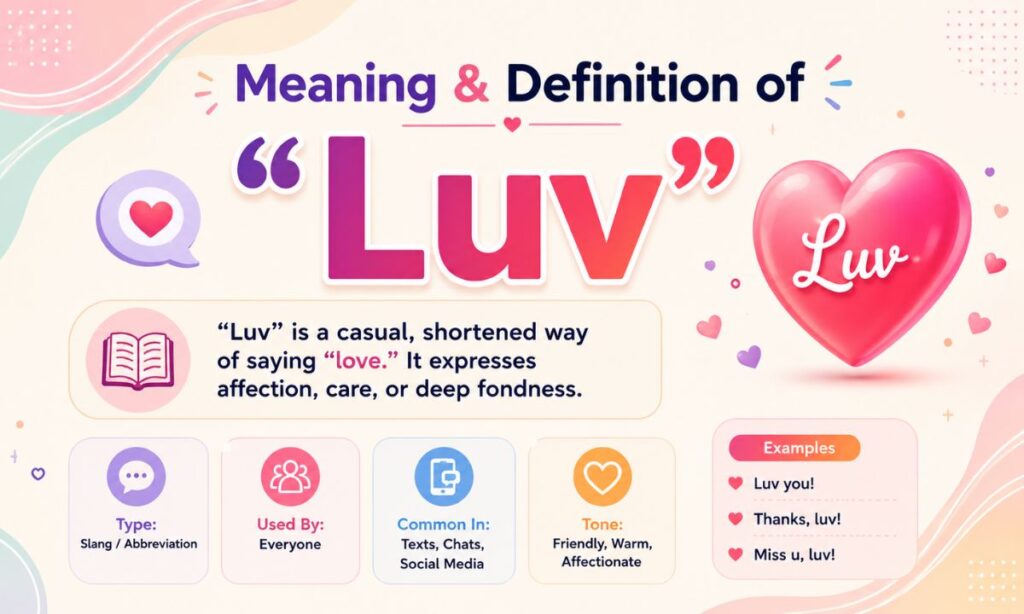
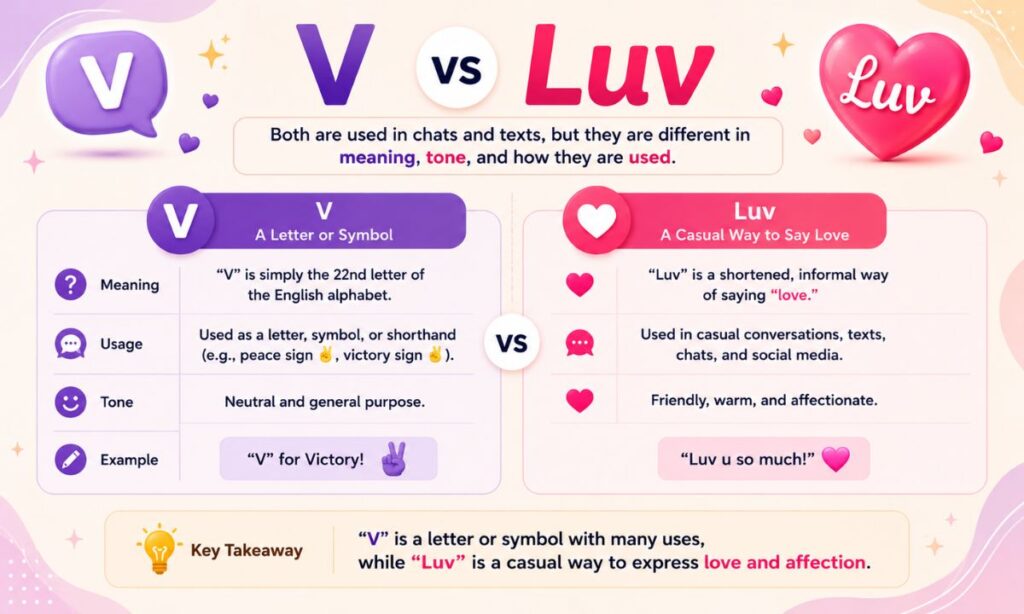
At its simplest, “luv” is an informal, phonetic spelling of the word “love.” It’s pronounced the same way but carries a lighter, more casual emotional weight than writing out “love” in full.
Primary Meaning
The primary luv meaning is a shortened, affectionate way of expressing warmth, liking, or fondness toward someone without necessarily declaring deep romantic love. People use it when they want to say something kind or sweet but aren’t ready (or don’t need) to use the heavier word “love.”
Think of it this way:
| Word | Emotional Weight | Common Use |
| Love | Strong, serious, deeply felt | Committed relationships, family, deep passion |
| Luv | Light, casual, friendly | Early dating, friends, social media, small talk |
Secondary Meanings
Beyond the romantic-adjacent sense, “luv” also carries a few secondary meanings depending on region and context:
- A term of address
In parts of the UK, “luv” is used the way Americans might use “hon” or “dear,” often by shopkeepers, bus drivers, or strangers being friendly. - A nickname or pet name
Couples sometimes use “luv” as a standalone term of endearment, similar to “babe” or “sweetheart.” - An abbreviation in branding or acronyms
Occasionally “LUV” appears as an acronym or shorthand in unrelated fields (covered later in this guide).
Background & Origin of “Luv”
To fully understand luv meaning, it helps to look at where the word actually came from — because it existed long before smartphones.
Linguistic Roots
“Luv” isn’t a modern invention. It’s a phonetic respelling that mirrors how the word “love” is naturally pronounced in casual speech. English speakers have always softened certain words in spoken conversation, and “luv” is simply that spoken sound written down.
Historically, informal or dialect writing — especially in working-class British English — used “luv” long before the internet existed. It reflected everyday speech patterns rather than formal written English.
Entry into Texting Culture
When mobile texting became mainstream in the late 1990s and early 2000s, character limits and typing speed mattered. Shorter spellings like “luv,” “u,” and “gr8” became popular simply because they were faster to type and took up less space.
“Luv” fit naturally into this shorthand culture. It was short, familiar, and instantly recognizable, so it spread quickly across text messages before moving into instant messaging apps and eventually social media.
Cultural Influence
British slang played a major role in shaping how “luv” is used today. In the UK, calling someone “luv” is a casual, friendly gesture — not necessarily romantic at all. As British media, music, and pop culture spread globally, this usage traveled with it, blending with American and internet-driven texting habits to create the more flexible, multi-context word we see now.
Usage in Different Contexts
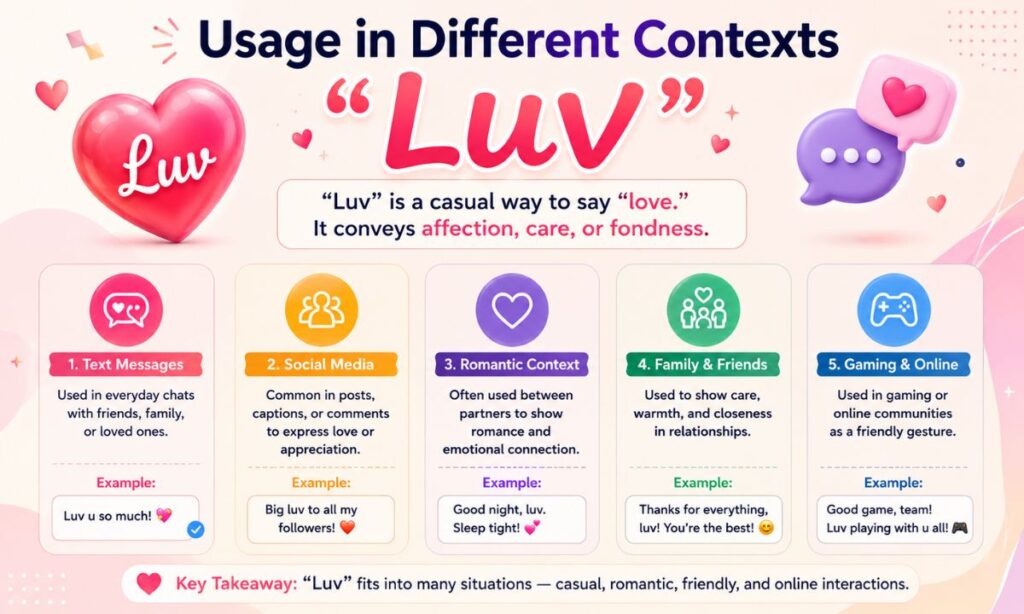
The luv meaning shifts depending on the setting. Here’s how it typically plays out.
Casual Chat
Among friends, “luv” is often just a warm sign-off or a lighthearted way to express appreciation.
- “Thanks for helping me move, luv you for that.”
- “Miss our chats, luv ya.”
Romantic Conversations
In early-stage dating or flirty texting, “luv” is a gentle way to express affection without the intensity of “I love you.” It signals genuine interest while keeping things light.
- “Had such a good time tonight, luv.”
- “Can’t stop thinking about you, luv.”
Social Media
On platforms like Instagram and TikTok, “luv” often appears in captions, comments, and bios to convey positivity, support, or general good vibes rather than romance.
- Commenting “luv this!” on a friend’s post
- Captioning a photo “sending luv to everyone today”
Professional or Semi-Formal
“Luv” is generally avoided in professional communication. It reads as too casual for emails, workplace chats, or client messages. In semi-formal settings, it’s best reserved for people you already know personally.
Meanings Across Platforms
The luv meaning in text can shift slightly depending on which app it shows up in. Here’s a quick platform-by-platform breakdown.
| Platform | Common Usage | Typical Tone |
| Personal messages, often with emojis | Warm, affectionate, personal | |
| Comments on photos/reels | Supportive, complimentary | |
| TikTok | Captions and comment replies | Upbeat, playful, trendy |
| Snapchat | Quick chats and captions | Casual, spontaneous |
On WhatsApp, “luv” usually appears in one-on-one chats between close friends, family, or partners. It’s often paired with heart emojis to reinforce the affectionate tone, such as “Goodnight luv 💕.”
On Instagram, “luv” shows up frequently in comment sections. Followers use it to show support for a post (“luv this outfit!”), and it’s common between friends complimenting each other’s content.
TikTok
TikTok culture favors short, punchy expressions, and “luv” fits right in. Creators use it in captions to sound relatable and friendly, and commenters use it to show quick appreciation for a video.
Snapchat
On Snapchat, “luv” tends to appear in fast, informal exchanges — a quick caption on a snap or a one-word reply that keeps the mood light and friendly.
Other Fields & Alternate Meanings
Outside texting and social media, “LUV” (in capital letters) sometimes stands for something entirely different:
- Southwest Airlines uses “LUV” as its stock ticker symbol on the New York Stock Exchange.
- Chevrolet LUV was a light pickup truck model, where LUV stood for “Light Utility Vehicle.”
- Light Utility Vehicle (LUV) is also a general term used for compact all-terrain or military vehicles.
These meanings are unrelated to the texting slang but occasionally show up in searches, so it’s worth knowing the difference.
Common Misconceptions & Mistakes
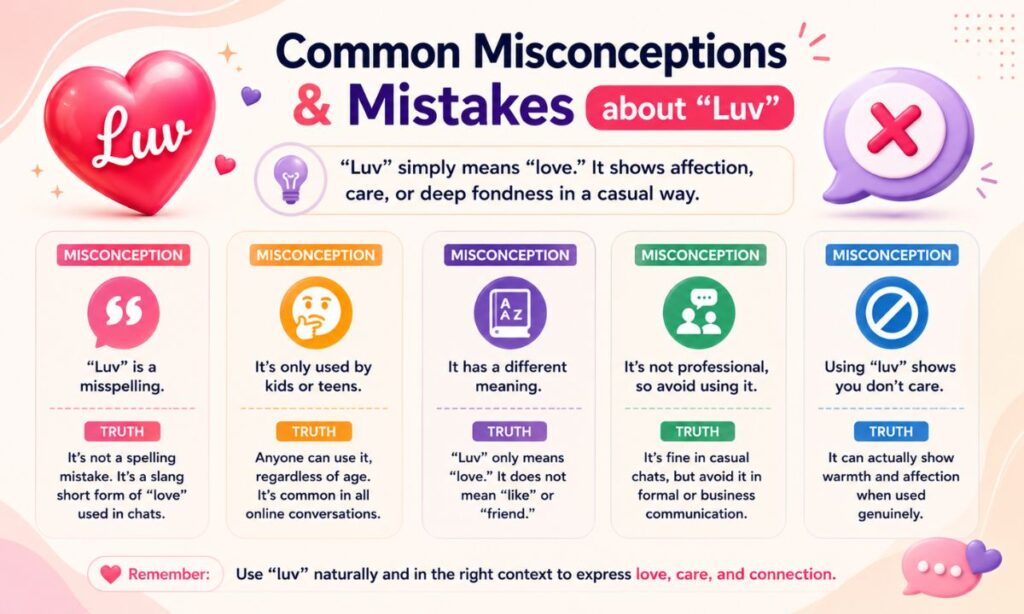
People often misread “luv” because they assume it always carries a specific emotional weight. Here are a few common mix-ups:
- Assuming it always means romantic love
In many cases, especially in UK slang or casual chats, it’s simply friendly. - Overthinking a stranger’s use of “luv”
In British English, it can be a generic, harmless term of address, not a personal statement. - Treating it as identical to “love”
While related, “luv” is deliberately softer and less intense. - Using it in professional settings
It can come across as unprofessional or overly familiar in formal writing.
Similar Terms & Alternatives
If you’re trying to place “luv” among other affectionate texting terms, here’s how it compares:
| Term | Meaning | Tone |
| Luv | Casual love/affection | Light, warm |
| Love | Deep, serious affection | Strong, sincere |
| Bae | “Before anyone else,” a partner | Playful, romantic |
| Xoxo | Hugs and kisses | Friendly or romantic sign-off |
| Hon/Hun | Term of endearment | Friendly, casual |
How to Respond to “Luv”
Not sure how to reply when someone sends you “luv”? Your response depends on the relationship and the vibe you want to set.
Friendly Replies
- “Aw, luv you too!”
- “You’re the best, thank you.”
- “Right back at ya.”
Romantic Replies
- “Luv you more.”
- “Can’t wait to see you again.”
- “You always know what to say.”
Neutral Replies
- “Thanks!”
- “That’s sweet of you.”
- “Appreciate it.”
Differences From Similar Words
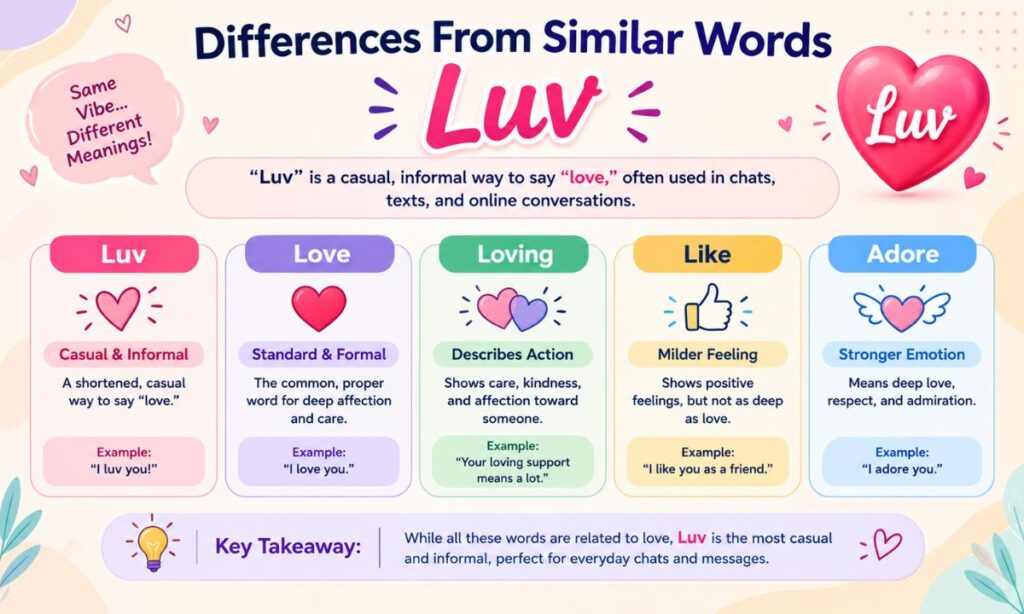
Understanding luv meaning also means knowing how it differs from nearby terms people often confuse it with.
What Does Luv Mean in a Text Message
In a text message, “luv” almost always signals informal affection, friendly warmth, mild romantic interest, or a casual sign-off rather than a serious declaration of love.
Luv Meaning UK Slang
In British slang, “luv” is commonly used as a general term of address, similar to “dear” or “love” used by strangers, shopkeepers, or acquaintances, regardless of gender or romantic interest.
Luv Meaning From a Guy
When a guy uses “luv” in texting, it often signals comfortable affection or budding romantic interest a way to show he cares without jumping straight to “I love you.”
LUV Full Form
There isn’t one universal full form. In texting, “luv” is simply short for “love.” In other contexts, LUV can stand for “Light Utility Vehicle” or serve as Southwest Airlines’ stock symbol.
Luv Meaning in English
In standard English, “luv” functions as an informal variant spelling of “love,” used in speech-like writing, texting, and casual British address.
Abbreviation For Love
“Luv” is essentially a phonetic abbreviation for “love” same core meaning, but delivered in a lighter, more casual tone suited for texting and everyday chat.
Relevance in Online Conversations & Dating Apps
On dating apps like Tinder, Bumble, and Hinge, “luv” plays a specific role. It lets users express warmth and interest early on without the pressure that comes with saying “love.” It signals approachability and a relaxed personality, which matters a lot in first conversations where tone is everything.
In group chats and online communities, “luv” also functions as a quick way to build rapport a small, friendly word that keeps conversations feeling personal rather than transactional.
Popularity & Trends Over Time
The word has moved through several waves of popularity:
- Pre-digital era
Used in British dialect speech and informal writing. - Early texting era
Adopted for its short length during the character-limited SMS days. - Instant messaging boom
Spread through MSN, AIM, and early chat platforms. - Social media era
Became a staple in comments, captions, and bios across Instagram, TikTok, and Snapchat. - Modern texting and dating apps
Continues to thrive as a low-pressure way to express affection digitally.
Search interest around luv meaning has stayed consistently high, largely because new generations keep encountering the word for the first time and want clarity on what it actually implies.
Conclusion
Luv Meaning is more than just a short word. It shows love in a simple way. People use it to sound casual and warm. It fits texts, chats, and social media posts.
The Luv Meaning changes based on who says it. Friends use it to show care. Couples use it to express deep love. Family members use it to feel close and warm.
Knowing the Luv Meaning helps you talk better. It helps you understand tone in messages. You won’t feel confused when someone uses it. You can reply in the right way too.
In the end, Luv Meaning is all about connection. It’s a small word with a big feeling. Use it when you want to show love. It keeps your relationships warm and simple.
Frequently Asked Questions
What does luv mean to a girl?
It usually signals warm, friendly affection or mild romantic interest, without the seriousness of saying “love.”
Is luv more than a friend?
Not necessarily it can be used between friends, family, or romantic partners depending on context.
Can luv be used platonically?
Yes, “luv” is commonly used platonically among friends and on social media as a friendly expression.
Is it okay to say luv to a coworker?
It’s best avoided in professional settings, since it can come across as too casual or overly familiar.
Does luv mean the same as love?
It’s related but softer “luv” expresses lighter affection, while “love” conveys deeper, more serious emotion.
Why do British people say luv to strangers?
In UK slang, “luv” is a friendly, generic term of address, similar to “dear,” and doesn’t imply romance.
What’s the difference between luv and bae?
“Luv” expresses general affection, while “bae” specifically refers to a romantic partner.
Should I reply if someone texts me luv?
Yes, a warm or friendly reply matching their tone is usually the best approach.
