
Ever opened a text, a comment section, or a group chat and seen the letters “TSTS” staring back at you with zero context? You’re not the only one. TSTS meaning is one of those small texting terms that looks confusing the first time you see it, but once you understand it,
Unlike more obvious internet abbreviations such as LOL or BRB, TSTS doesn’t announce its meaning on the surface. It reads more like a sound than a sentence, which is exactly why so many people pause mid-scroll and think, “wait, what does that even mean?”
Definition of TSTS
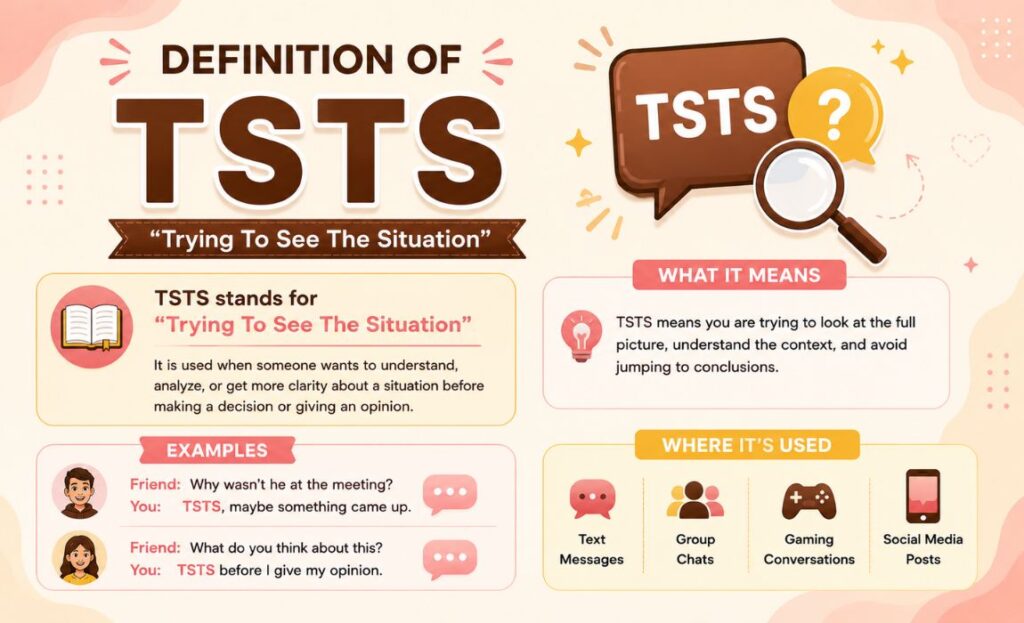
At the most basic level, the TSTS meaning is best understood as a written stand-in for the sound “tsk tsk” — the small disapproving click of the tongue people make out loud when reacting to something mildly silly, slightly frustrating, or a little too bold. In texting form, TSTS captures that exact same reaction without needing to type out a full sentence or explain the feeling behind it.
This is what makes TSTS meaning so interesting from a language perspective. It isn’t really a traditional acronym standing for a fixed phrase the way “LOL” stands for “laugh out loud.” Instead, it behaves more like an emotional shorthand — a texted sound effect that carries tone, attitude, and reaction all in four letters.
That said, because slang constantly evolves and different online communities reshape terms to fit their own conversations, TSTS meaning has picked up several secondary interpretations over time, including:
- “That’s So True, Seriously” — used to express strong, emphatic agreement
- “Too Smart To Say” — used when someone playfully avoids stating the obvious
- “Talk Soon, Talk Later” — used as a casual, friendly way to pause a conversation
- A simple, unintentional typo for the word “tests”
Because TSTS carries more than one accepted meaning, the surrounding conversation almost always determines which version applies. No single definition is “wrong,” but context is what separates a playful tease from an academic reference to an upcoming exam.
What Does TSTS Mean in Text?
In text messages, TSTS meaning usually functions less like a statement and more like a reaction. It’s short, expressive, and works almost like typing out a sound effect in the middle of a sentence.
Someone might use it to gently tease a friend, react to a bold or risky joke, or express light disapproval without sounding harsh or judgmental.What makes TSTS meaning tricky for newcomers is that it doesn’t come with an obvious emotional label attached.
Unlike an emoji, which visually signals happiness, sarcasm, or frustration, TSTS relies entirely on the words around it and the relationship between the texters to land correctly. This is part of why the term causes so much confusion when people first encounter it — the letters alone don’t tell the whole story.
Real-World Example
Friend 1: “I told my boss I’d finish the report by Friday… it’s due tomorrow and I haven’t started.” Friend 2: “tsts, you never learn 😂”
Here, the TSTS meaning works as a lighthearted, teasing reaction — not a serious criticism. Friend 2 isn’t genuinely upset; they’re playfully calling out a familiar pattern of behavior in a way that keeps the mood light.
Another quick example:
Text 1: “I already knew the test answer, I just didn’t feel like raising my hand.” Text 2: “tsts, such a mood”
In this second example, TSTS meaning leans closer to “too smart to say” — acknowledging that the person clearly understood something but chose not to announce it.
Primary Meaning (Text & Chat)
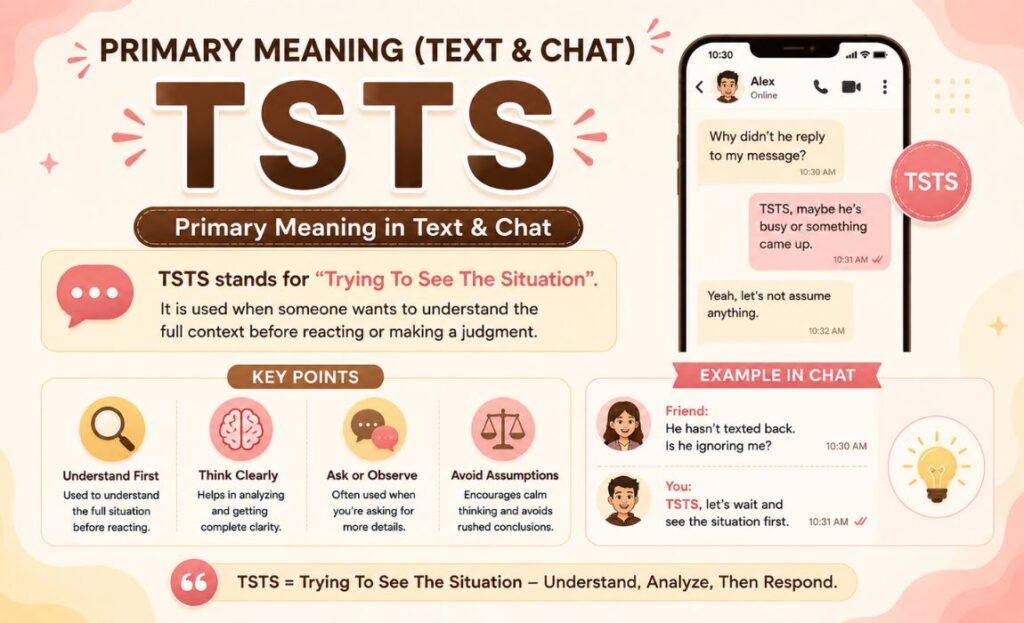
In everyday chat and texting, the primary TSTS meaning is a reaction marker representing disapproval, sarcasm, or playful teasing — essentially the digital version of the audible “tsk tsk” sound. It’s rarely meant to be hurtful; instead, it signals something closer to “I see what you did there” delivered in a light, conversational way rather than a harsh judgment.
This primary meaning has stuck around because it fills a very specific communication gap. Texting strips away tone of voice, facial expressions, and body language — all the small cues that usually soften or clarify a reaction in face-to-face conversation. TSTS meaning steps in to recreate that soft, teasing tone in writing, letting the reader know the comment is playful rather than serious.
How It Is Commonly Used
- Reacting to a friend’s questionable decision, like spending money impulsively
- Responding to a bold, slightly risky, or edgy joke
- Teasing someone about a mistake they clearly saw coming
- Reacting to relatable or funny content shared online
- Gently calling out a repeated pattern of behavior among close friends
Conversation Examples
- “You spent your whole paycheck on sneakers again? tsts.”
- “He said that in front of everyone 💀 tsts.”
- “tsts, I can’t believe you actually did that.”
- “You knew this would happen and did it anyway, tsts.”
- “tsts, some things never change with you.”
In each of these examples, the TSTS meaning stays consistent: a light, semi-judgmental reaction wrapped in humor rather than genuine criticism.
Secondary Meanings
While the “tsk tsk” sound is the most common and widely recognized TSTS meaning, several secondary interpretations exist depending on the group, platform, personal texting style, or even regional slang trends.
Understanding these secondary meanings is important because relying only on the primary definition can occasionally lead to confusion, especially in conversations about school, work, or scheduling.
Possible Alternative Interpretations
- “That’s So True, Seriously” — an emphatic, heartfelt way of agreeing with something someone just said, often used when a statement feels deeply relatable.
- “Too Smart To Say” — implying someone is holding back an obvious response, often used playfully or with a hint of confidence.
- “Talk Soon, Talk Later” — a friendly, casual way to pause a conversation without sounding abrupt or dismissive.
- “True Story, True Story” — reinforcing that a story or claim being shared is completely accurate, often repeated for emphasis.
- A simple typo for the word “tests,” especially common in academic or scheduling-related conversations where the missing “e” is an easy slip while typing quickly.
Contextual Usage Examples
| Sentence | Likely TSTS Meaning |
| “That homework was brutal, tsts I need a break” | Talk soon / pause conversation |
| “tsts, that’s exactly what happened to me too” | That’s so true, seriously |
| “I have tsts all week at school” | Typo for “tests” |
| “You already know the answer, tsts” | Too smart to say |
| “tsts, I told you this would happen” | Tsk tsk / mild teasing |
Key Point
The letters themselves don’t guarantee one fixed meaning — tone, punctuation, capitalization, and the sentence surrounding TSTS almost always reveal which interpretation applies. A lowercase, casual “tsts” tends to read as playful, while a capitalized “TSTS!” can occasionally carry a slightly stronger reaction.
Key Insights to Remember
- TSTS meaning is context-dependent, not fixed to a single definition.
- The “tsk tsk” reaction remains the most widely used and recognized version.
- Typos and academic references are less common but still completely valid readings.
- Punctuation and emojis nearby often clarify which meaning is intended.
Quick Understanding Table
| Meaning | Tone | Common Setting |
| Tsk tsk (disapproval/tease) | Playful, light sarcasm | Friend chats, social comments |
| That’s So True, Seriously | Sincere agreement | Casual texting |
| Too Smart To Say | Witty, confident | Banter, flirting |
| Talk Soon, Talk Later | Neutral, polite | Ending a conversation |
| Typo for “tests” | Literal | School-related chats |
Background History & Origin of TSTS
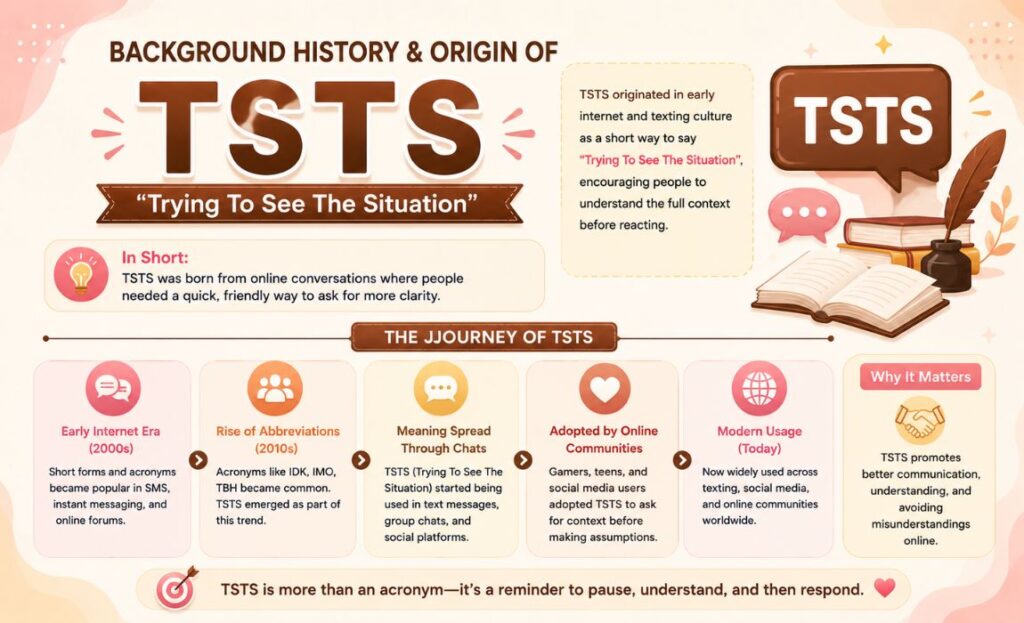
Like most texting slang, TSTS meaning didn’t emerge from one single, clearly documented source. Instead, it developed organically as digital communication pushed people toward shorter, faster ways of expressing emotional reactions.
The “tsk tsk” sound has existed in spoken language for generations as a universally understood way to express mild disapproval or amusement, and typing it out as TSTS is simply the natural texting-era adaptation of that sound.
Evolution of Digital Slang
Early texting culture, shaped heavily by SMS character limits, gave rise to now-classic abbreviations like LOL, BRB, and OMG — all built around saving keystrokes while still preserving emotional tone.
TSTS follows this same evolutionary pattern, converting a real-world verbal sound into a compact, typed reaction that fits naturally into fast-paced digital conversations.
As messaging moved from basic SMS to app-based platforms like WhatsApp, iMessage, and Discord, users had more room to type but kept many of the shorthand habits formed during the texting era. TSTS meaning persisted through this shift because it still served a purpose: expressing a nuanced reaction faster than a full sentence ever could.
Cultural Influences
Reaction-based slang has always been shaped by spoken communication, meme culture, and viral online trends. As platforms like Twitter/X, Instagram, and TikTok normalized short, punchy reactions in comment sections, terms like TSTS spread quickly among younger, digitally fluent users who prioritize speed and personality in their messaging.
Music, television, and everyday spoken interactions also played a role. The “tsk tsk” sound has long been part of everyday spoken culture, appearing in cartoons, sitcoms, and casual conversation as a universally recognized signal of playful disapproval — making the transition into texting slang feel intuitive rather than invented.
Linguistic Perspective
From a linguistic standpoint, TSTS is a fascinating example of onomatopoeia converted into abbreviation form — a spoken sound turned into letters that carry tone and emotion rather than a literal, dictionary-style definition. This is part of why TSTS meaning feels intuitive once you say it out loud but can feel confusing when you only encounter it in written form for the first time.
Linguists often note that texting slang built around sounds (rather than full words) tends to spread faster because it doesn’t require translation — readers who are familiar with the verbal “tsk tsk” sound can intuitively grasp the tone of TSTS even before learning its formal explanation.
Timeline Overview
| Era | Development |
| Pre-2010s | “Tsk tsk” used verbally to express disapproval or amusement |
| 2010s | Texting culture shortens common reactions into acronyms |
| Late 2010s–2020s | TSTS spreads through gaming chats and social media comments |
| 2020s–Present | TSTS meaning expands into multiple casual interpretations |
Secondary & Less Common Meanings of TSTS
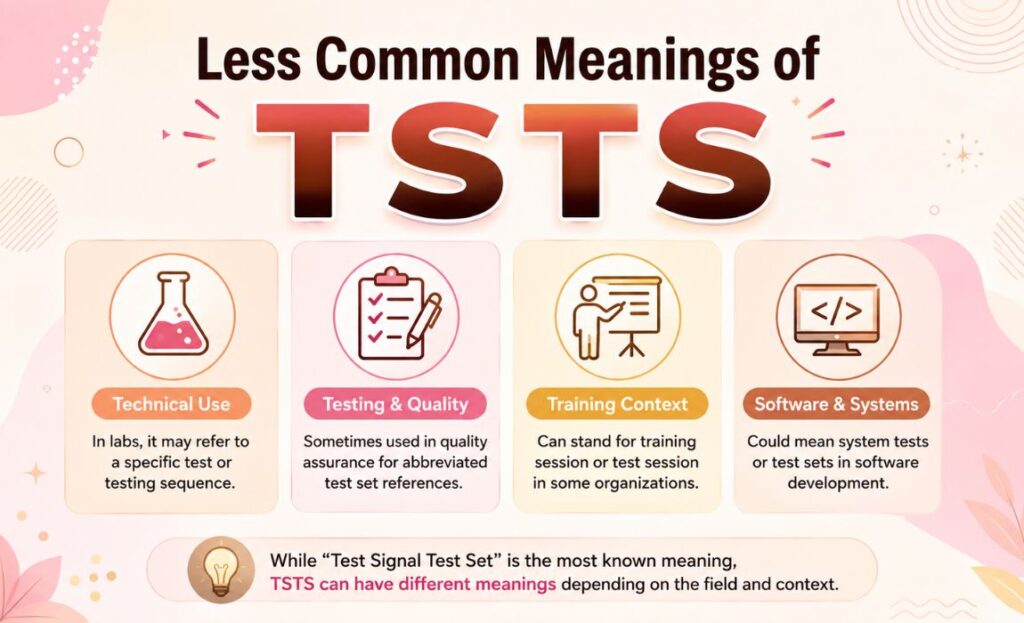
Outside of everyday texting, a few niche and less common uses of TSTS meaning exist — and knowing about them helps prevent confusion in specific settings like school, work, or specialized online communities.
Alternative Interpretations of TSTS
- Two Stage Testing System — used in some academic or assessment contexts to describe a multi-phase evaluation method, where students or trainees are tested across two distinct stages to more accurately measure understanding.
- Typo for “tests” — extremely common in casual messages about school or work, especially when someone is typing quickly on a phone keyboard and drops the letter “e.”
- Occasional inside-joke usage within specific friend groups or online communities, where the letters TSTS are repurposed to carry a private, group-specific meaning that outsiders wouldn’t recognize.
Example Usage
- “We have tsts (tests) scheduled for next week, I’m stressed.”
- “The program uses a TSTS approach to evaluate student progress across two separate phases.”
- “Our group chat uses tsts to mean something totally different, it’s an inside joke at this point.”
Why These Alternate Meanings Persist
Even though the “tsk tsk” reaction remains dominant, alternate versions of TSTS meaning haven’t disappeared, largely because slang terms rarely spread through a single, centralized source.
Different communities, schools, and friend groups independently reshape abbreviations to fit their own needs, which is exactly how a single set of letters ends up carrying several loosely related meanings at once. This is common across internet slang generally, not just with TSTS, and it’s part of why context always outranks the letters themselves when it comes to understanding intent.
How to Know Which Meaning Is Intended
Reading the full sentence is the fastest and most reliable way to confirm the intended TSTS meaning. A message about school schedules carries a very different tone than a message reacting to a funny or embarrassing story, and the topic alone often makes the correct interpretation obvious.
Key Factors That Help Identify Meaning
- The overall topic of the conversation (school, casual chat, banter, etc.)
- The relationship between the people texting (close friends vs. acquaintances)
- Emojis or punctuation used alongside TSTS
- The platform where the message appears (academic group vs. meme page comments)
- Whether the term is capitalized, lowercase, or repeated for emphasis
Context Comparison Table
| Context Clue | Likely Meaning |
| Casual reaction to a story | Tsk tsk / teasing |
| School or academic topic | Typo for “tests” |
| Agreement-heavy conversation | That’s so true, seriously |
| Ending a chat politely | Talk soon, talk later |
| Formal or technical document | Two Stage Testing System |
Why TSTS Became Popular
Major Reasons Behind Its Popularity
- Speed — three or four letters type significantly faster than a full sentence explaining the same reaction.
- Expressiveness — it captures tone and emotion, not just literal words, which full sentences sometimes struggle to convey quickly.
- Flexibility — it adapts naturally to teasing, agreement, flirting, or casual conversational sign-offs.
- Platform culture — short-form platforms like TikTok and Twitter/X actively reward quick, punchy reactions over lengthy comments.
- Group identity — using recognizable slang like TSTS helps signal familiarity with current online culture, especially among younger users.
Real-Life Example
A viral TikTok comment section filled with “tsts 😭” reactions shows exactly how quickly this kind of shorthand spreads once a handful of users start using it — other commenters pick it up simply by seeing it repeated in context, without ever needing a formal explanation of the TSTS meaning behind it.
Is TSTS Considered Formal or Informal?
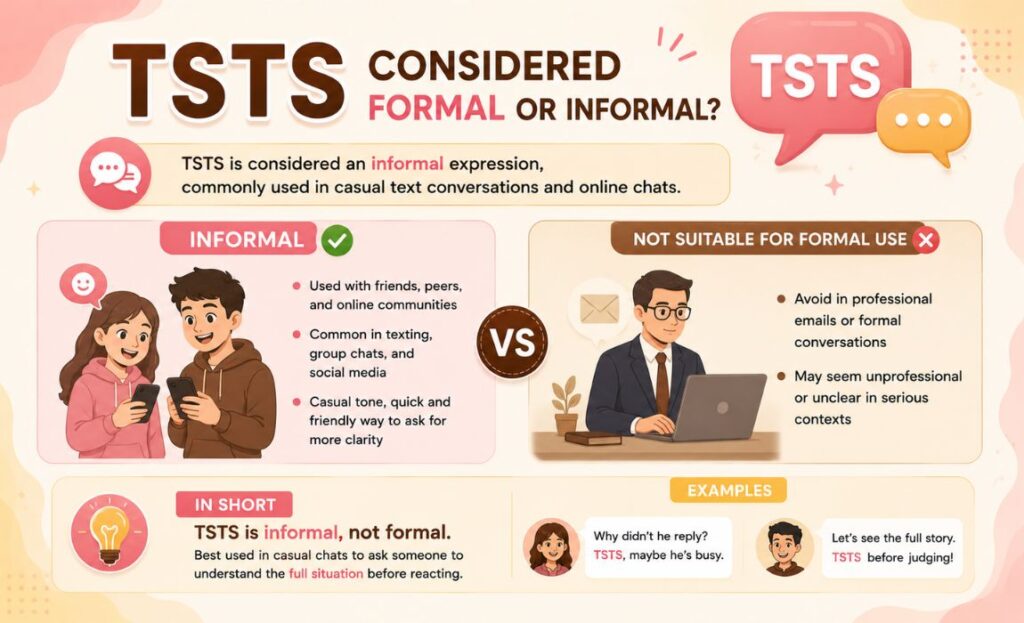
TSTS meaning belongs firmly in informal, casual communication. It’s built for texting, social media comments, and relaxed conversations between people who already understand the tone — not for professional correspondence or academic writing where clarity and precision matter most.
Informal Usage Characteristics
- Short, reaction-based, and tone-dependent
- Relies heavily on context clues rather than literal meaning
- Common among younger, digitally active users
- Rarely explained outright — usually learned through repeated exposure
Situations Where TSTS Is Appropriate
- Texting close friends
- Reacting to social media posts or comments
- Casual group chats
- Gaming or Discord conversations
- Light, humorous banter with people who understand texting slang
Situations Where TSTS Should Be Avoided
- Work emails or internal business communication
- Academic writing or formal essays
- Formal customer service communication
- Serious, sensitive, or emotionally heavy conversations
- Messages to people unfamiliar with modern texting slang
Formal vs Informal Comparison
| Setting | Appropriate? | Reason |
| Friend group chat | Yes | Casual, tone-friendly environment |
| Work email | No | Unclear and unprofessional |
| Social media comment | Yes | Matches platform tone and pace |
| Academic paper | No | Slang has no place in formal writing |
| Customer support chat | No | Risk of appearing dismissive |
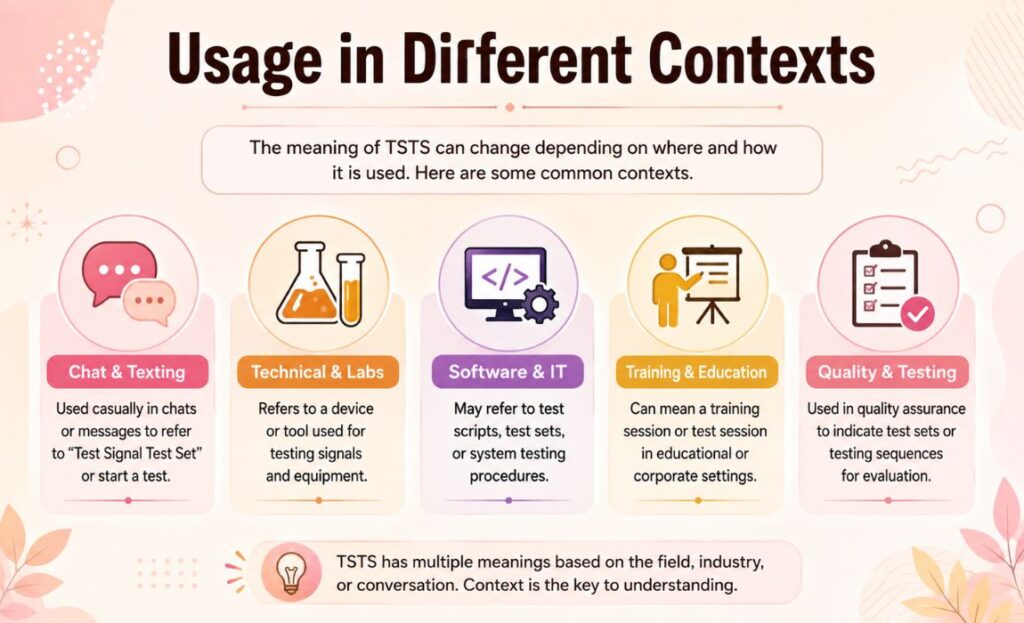
Usage in Different Contexts
Casual Conversations
In casual texting, TSTS meaning usually leans toward the “tsk tsk” reaction — a soft, playful way to comment on something without being harsh or overly critical. It works especially well between people who already share an established, joking rapport.
Social Media Communication
On social platforms, TSTS often appears in comment sections as a quick, relatable reaction to a post, video, or caption. It helps commenters express a shared feeling without writing out a lengthy response, which fits naturally into fast-scrolling social feeds.
Professional or Semi-Formal Settings
TSTS rarely appears in professional settings, and when it does show up, it’s usually an accidental typo for “tests” rather than intentional slang. Because the informal TSTS meaning can easily be misread in a work context, it’s best avoided entirely in professional communication.
Casual Chat
Why TSTS Is Popular in Casual Conversations
Casual conversations move fast, and TSTS meaning fits naturally into that pace — offering a quick, expressive reaction without slowing the conversation down with a lengthy explanation of how someone feels.
Casual Chat Examples
- “You told her that?? tsts”
- “tsts, you always do this lol”
- “That’s wild, tsts”
- “tsts, I knew you’d forget again”
- “Why would you even say that 💀 tsts”
Social Media
How TSTS Appears on Social Media
On platforms like Instagram, TikTok, and X, TSTS meaning typically shows up as a comment reacting to relatable, funny, or slightly chaotic content — often paired with laughing or skull emojis to reinforce the playful tone.
Social Media Examples
- “The way he tripped and kept walking 💀 tsts”
- “tsts, this is too real”
- “Not you posting this at 3am, tsts”
- “tsts, the audacity 😭”
TikTok
TikTok Usage Patterns
On TikTok specifically, TSTS meaning is often used in comment threads to react to relatable or dramatic moments in a video, sometimes paired with crying-laughing emojis for extra emphasis. Because TikTok comment culture thrives on short, witty reactions, TSTS fits the platform’s rhythm perfectly.
TikTok Example
Comment: “tsts, why is this literally my life 😭”
Snapchat
Snapchat Usage Characteristics
On Snapchat, conversations move quickly and informally, and TSTS meaning here tends to be more playful or lightly teasing, often used between close friends chatting throughout the day about small, everyday moments.
Snapchat Example
Snap caption: “Forgot my charger again… tsts at myself”
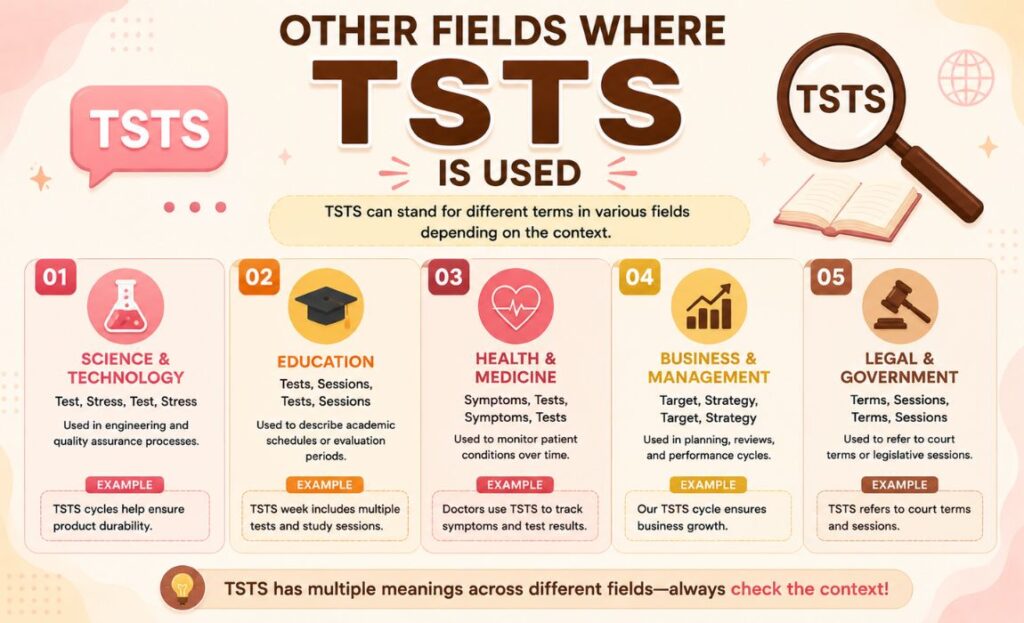
Other Fields Where TSTS Is Used
Gaming and Esports
In gaming chats, TSTS meaning can appear as a quick reaction to a teammate’s mistake or a bold in-game decision, often used humorously rather than as genuine criticism. Fast-paced voice and text chats during matches favor short reactions like TSTS over longer explanations.
Education and Training Programs
In some academic or training contexts, TSTS refers to a Two Stage Testing System, an assessment method involving multiple evaluation phases designed to measure understanding more accurately than a single test alone. This meaning is completely unrelated to the casual texting slang version and typically appears in formal documentation.
Business and Technical Environments
In select business or technical documentation, TSTS may appear as an internal shorthand or acronym specific to a particular company, department, or process, unrelated to its casual slang usage. Employees encountering TSTS in an internal document should rely on company-specific context rather than assuming the texting definition applies.
Common Misconceptions & Mistakes
Frequent Misinterpretations
- Assuming TSTS always means the exact same thing in every conversation.
- Reading it as aggressive or mean-spirited when it’s usually lighthearted and playful.
- Confusing it with unrelated acronyms that look visually similar.
- Missing the academic “tests” typo interpretation in relevant school-related conversations.
- Overusing TSTS to the point where its playful tone starts feeling repetitive or forced.
Example of Miscommunication
Text: “I can’t believe you did that, tsts” Misread as: A serious insult Actually meant as: Playful teasing between friends
Understanding the correct TSTS meaning in context prevents this kind of unnecessary friction, especially in text-based conversations where tone of voice is completely absent.
Slang Terms & Acronyms Containing TSTS (Table)
| Term | Meaning | How It Differs From TSTS |
| TS | Emphasis or disapproval, often stronger | More blunt, single reaction word |
| TBTS | Throwback to something | Refers to nostalgia, not reaction |
| SMH | Shaking my head | More critical in tone |
| TBH | To be honest | Adds honesty, not reaction |
| NGL | Not gonna lie | Similar casual tone, different function |
How to Respond to TSTS
Friendly or Humorous Response
- “Lol I know, I know.”
- “Guilty as charged 😂”
- “Don’t judge me!”
- “Okay fair, you got me there.”
Clarifying Response
- “Wait, what do you mean by that?”
- “Are you teasing me or being serious?”
- “Is that a typo or are you saying I’m too smart to answer?”
Professional or Neutral Response
In work or formal settings, it’s best to simply ask for clarification rather than responding with slang, since TSTS meaning can be easily misunderstood outside of casual, familiar conversation. A quick “just to clarify, what do you mean?” avoids any awkwardness.
Differences From Similar Words
TSTS vs TMI
TMI means “too much information,” used when someone overshares personal or uncomfortable details. TSTS meaning, by contrast, is reaction-based and playful — it’s not about oversharing at all, but about responding to something someone else said or did.
TSTS vs SMH
SMH (“shaking my head”) tends to carry more genuine frustration or disappointment, often used when someone is actually annoyed. TSTS meaning is usually lighter and more playful, closer to a gentle tease than a real complaint.
TSTS vs TBH
TBH (“to be honest”) introduces an honest opinion or admission, while TSTS reacts to something someone else already said or did. The two terms serve different conversational functions even though both are common in casual texting.
Quick Comparison Table
| Term | Function | Tone |
| TSTS | Reaction to something said/done | Playful, teasing |
| TMI | Reaction to oversharing | Uncomfortable, blunt |
| SMH | Expresses disappointment | Critical |
| TBH | Introduces honest opinion | Sincere |
Relevance in Online Conversations & Dating Apps
Role in Online Conversations
In group chats and online communities, TSTS meaning helps keep reactions quick and expressive without derailing the conversation with lengthy explanations. It allows people to acknowledge something funny, bold, or relatable without breaking the natural flow of a fast-moving chat.
Use in Dating Apps
On dating apps, TSTS is sometimes used playfully to tease a match about something bold or flirty they said, adding a light, ironic tone to the exchange. In this setting, TSTS meaning often signals interest and playful chemistry rather than genuine disapproval — it’s a way of flirting through mock judgment.
Popularity & Trends Over Time
Early Digital Slang Era
Early texting slang focused heavily on efficiency — terms like LOL, BRB, and similar acronyms dominated conversations as SMS character limits encouraged brevity above all else.
Social Media Expansion (2010s)
As platforms like Twitter and Instagram grew throughout the 2010s, reaction-based slang like TSTS started appearing more frequently in comments and captions, reflecting a broader shift toward quick, emotionally expressive online communication.
Modern Meme & Viral Culture (2020s–Present)
Today, TSTS meaning thrives within meme culture and viral comment sections, where quick, relatable reactions spread fast across TikTok and similar short-form platforms, often reaching millions of users within days.
Trend Growth Factors
- Increased consumption of short-form video content
- Faster-paced group chat culture across messaging apps
- Growth of comment-based engagement on social platforms
- Wider adoption of reaction-based slang among Gen Z and younger millennials
When You Should NOT Use TSTS
Situations to Avoid Using TSTS
- Formal emails or workplace communication
- Serious or emotionally sensitive conversations
- Conversations with people unfamiliar with texting slang
- Academic or professional writing
- Customer-facing business communication
Example of Inappropriate Usage
Not appropriate: “I’m sorry for your loss, tsts.”
Using TSTS in a serious or comforting message can come across as dismissive or careless, even if that’s not the intent behind it. When emotions are genuinely serious, it’s always safer to skip slang entirely.
TSTS in Group Dynamics and Friend Circles
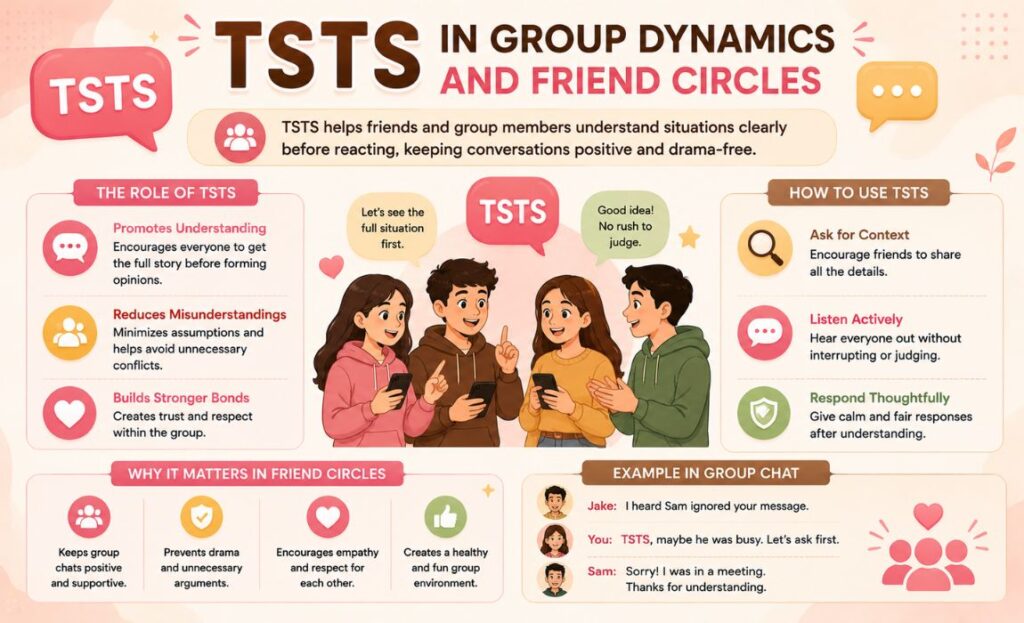
Slang terms rarely exist in isolation — they’re shaped by the specific friend groups, online communities, and social circles that adopt them. TSTS meaning is a great example of this, since the way it’s used can vary noticeably from one group chat to another, even though the core “tsk tsk” reaction stays fairly consistent overall.
How Friend Groups Shape Slang Meaning
In some friend groups, TSTS becomes a running joke tied to a specific person’s habits — for example, always being late, always forgetting something, or always making the same joke. Over time, the group starts using TSTS almost exclusively in reference to that pattern, giving it a slightly more personalized meaning within that specific circle. Someone outside the group might not immediately understand the inside joke layered on top of the standard TSTS meaning, even though the general playful tone still comes through.
TSTS as a Bonding Tool
Shared slang often strengthens social bonds. When a group of friends consistently uses TSTS the same way, it becomes a small but meaningful part of their shared communication style — similar to inside jokes, nicknames, or recurring memes passed around the group chat. This is part of why texting slang spreads so effectively through friend groups rather than through formal channels: it’s reinforced through repetition and shared context rather than dictionary definitions.
When New Members Join a Group Chat
If someone new joins a group chat where TSTS is already an established part of the conversation style, they’ll usually pick up the intended meaning simply through repeated exposure and context, without needing a formal explanation. This organic learning process is one of the main reasons slang like TSTS spreads so efficiently across social circles, even without anyone deliberately teaching it.
TSTS Meaning in Voice-to-Text and Auto-Correct Scenarios
An interesting wrinkle in understanding TSTS meaning involves how it interacts with auto-correct and voice-to-text technology. Because TSTS isn’t a recognized dictionary word, many phone keyboards will attempt to auto-correct it to “tests” or flag it as a misspelling, which occasionally causes confusion in conversations.
Common Auto-Correct Issues
- A phone might silently change “tsts” to “tests,” altering the intended meaning of a playful message.
- Voice-to-text software almost never recognizes TSTS as intentional slang, often transcribing it as unrelated words or simply dropping it.
- Users sometimes have to manually re-type TSTS after auto-correct changes it, which can slow down otherwise quick, casual conversations.
How to Avoid Auto-Correct Confusion
Some users add TSTS to their phone’s personal dictionary to prevent unwanted auto-correction, ensuring the intended playful TSTS meaning comes through clearly every time. Others simply double-check messages before sending, especially in conversations where the term is important to the joke or reaction being made.
Comparing TSTS Meaning Across Native and Non-Native English Speakers
For non-native English speakers, TSTS meaning can be especially tricky to pick up, since it relies on the culturally specific “tsk tsk” sound rather than a straightforward translated phrase. Someone unfamiliar with this verbal expression in English-speaking culture may need extra context before the connection clicks.
Tips for Non-Native Speakers Learning TSTS
- Listen for or research the “tsk tsk” sound in English-language media to understand its verbal origin.
- Pay close attention to the sentence surrounding TSTS rather than relying on the letters alone.
- Don’t hesitate to ask a native-speaking friend for a quick explanation — most people are happy to clarify casual slang.
- Practice using TSTS in low-stakes, casual conversations before using it in more nuanced situations like flirting or sarcasm.
This kind of gradual, context-based learning mirrors how most native speakers pick up TSTS meaning in the first place — through repeated exposure rather than formal instruction.
Regional & Cultural Differences
Regional Differences
Slang adoption varies by region, and TSTS meaning may be more familiar in some English-speaking online communities than others, depending on local texting trends, platform popularity, and how quickly slang spreads through a specific area’s youth culture.
Cultural Communication Styles
Cultures that favor indirect, tone-based communication may adopt reaction-style slang like TSTS more readily than cultures that favor direct, literal messaging, where clarity is prioritized over playful ambiguity.
TSTS Meaning in Written Content: Blogs, Captions, and Memes
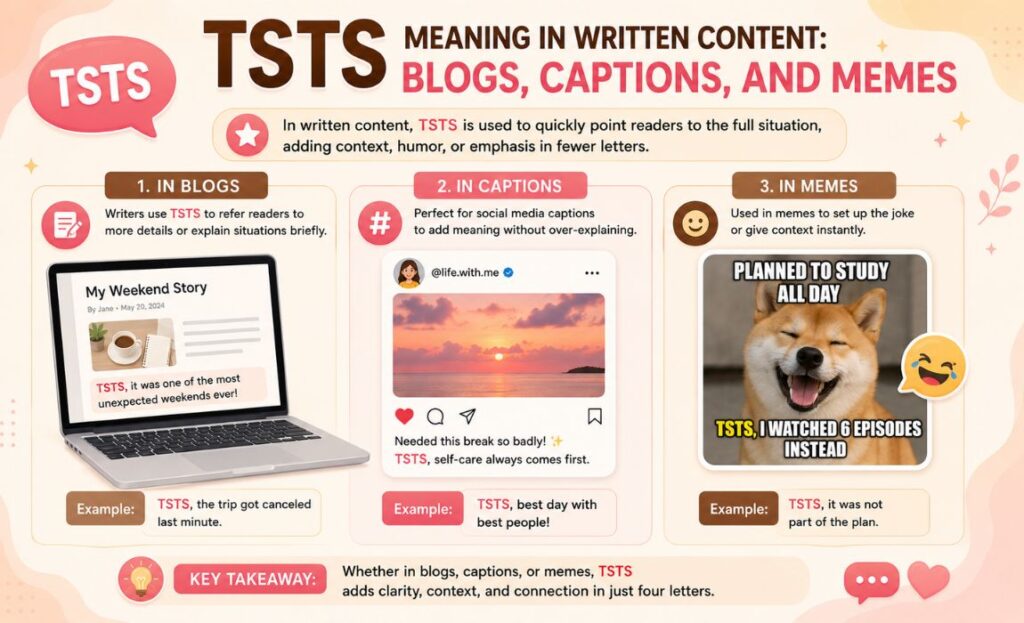
Beyond one-on-one texting, TSTS meaning has also found a home in written online content, including blog captions, meme text overlays, and short-form video subtitles. Content creators frequently use TSTS as a caption to summarize a relatable or slightly chaotic moment without needing extra explanation, trusting that their audience already understands the tone.
Why Creators Use TSTS in Captions
- It’s short enough to fit cleanly into a caption or overlay without cluttering the visual.
- It instantly signals a playful, self-aware tone to the audience.
- It encourages engagement, since viewers familiar with TSTS meaning often reply in the comments using the same term.
Example Caption Usage
- A video of someone spilling coffee captioned simply: “tsts, every morning”
- A meme showing a relatable mistake captioned: “tsts, we’ve all been there”
This kind of caption usage reinforces TSTS meaning as a shared cultural shorthand, strengthening its recognition across large online audiences rather than just small private group chats.
Common Questions People Ask Before Using TSTS Themselves
Before adopting new slang into their own texting habits, many people run through a quick mental checklist. Here are some of the most common questions related to TSTS meaning that come up before someone feels comfortable using it.
“Will people understand what I mean?”
This depends heavily on who you’re texting. Close friends who are active on social media or texting-heavy platforms will likely understand TSTS meaning instantly, while older relatives or less digitally active contacts might need a bit of context.
“Could this come across as rude?”
In most casual settings, no — TSTS meaning reads as playful rather than genuinely critical. However, tone always matters, and pairing it with an emoji can help ensure the intended lightheartedness comes through clearly.
“Is it okay to use with someone I just started talking to?”
It’s generally safer to wait until a conversation has an established casual, joking tone before introducing slang like TSTS, since context and rapport play a big role in how the term lands.
A Closer Look at Tone: How Punctuation Changes TSTS Meaning
Small formatting choices can meaningfully shift how TSTS meaning is interpreted in a given message. While the underlying playful reaction usually stays the same, punctuation and repetition can adjust the intensity of that reaction.
Lowercase, No Punctuation
A relaxed, lowercase “tsts” without any punctuation typically reads as the softest, most casual version of the reaction — light teasing with no real edge behind it.
Repeated for Emphasis
Typing “tsts tsts” or adding extra letters like “tstsss” usually signals exaggerated disapproval or amusement, often used for comedic effect rather than genuine annoyance.
Paired With an Exclamation Point
Adding an exclamation point, as in “TSTS!”, can occasionally read as a stronger, more theatrical reaction — still playful in most cases, but delivered with extra flair.
Table: Formatting and Tone
| Formatting Style | Likely Intensity | Typical Use |
| tsts (lowercase, plain) | Light, casual | Everyday teasing |
| TSTS (all caps) | Slightly stronger | Dramatic or exaggerated reaction |
| tsts tsts (repeated) | Exaggerated, comedic | Playful mock outrage |
| tsts… (trailing dots) | Sarcastic, drawn-out | Ironic or sarcastic teasing |
Recognizing these small formatting cues can make a real difference in correctly interpreting TSTS meaning, especially in text-only conversations where tone of voice is completely absent.
Why Understanding Slang Like TSTS Matters
Communication Benefits
Understanding TSTS meaning helps prevent miscommunication, keeps conversations flowing naturally, and helps you sound current and comfortable in casual digital spaces, whether you’re texting friends or scrolling through comment sections.
Pros and Cons
✅ Pros
- Quick and expressive way to react
- Adds personality and humor to casual texts
- Widely recognized among younger, digitally active users
❌ Cons
- Can be misread as rude or dismissive without proper context
- Multiple accepted meanings can cause genuine confusion
- Not appropriate for formal or professional communication
The Psychology Behind Reaction-Based Slang Like TSTS
Understanding why TSTS meaning resonates so widely requires looking beyond the letters themselves and into the psychology of digital communication. Texting strips away tone of voice, posture, facial expression, and pacing — all the natural cues humans rely on to interpret meaning in face-to-face conversation. Reaction-based slang like TSTS exists to patch that gap.
When someone types “tsts” instead of writing out “I can’t believe you did that, that’s so typical of you but I still find it funny,” they’re compressing an entire emotional reaction into a single, recognizable unit. The brain processes this shorthand almost instantly once it’s familiar, the same way a raised eyebrow or a smirk communicates meaning without a single spoken word.
Why Short Reactions Feel More Authentic
Ironically, shorter reactions like TSTS often feel more genuine than longer, more deliberate responses. A quick “tsts” reads as spontaneous and unfiltered, almost like a gut reaction typed in real time, whereas a longer written explanation can sometimes feel overly formal or rehearsed for a casual conversation. This spontaneity is part of what keeps TSTS meaning feeling fresh and current rather than stiff or dated.
The Role of Shared Understanding
Slang terms like TSTS also function as social signals. Using them correctly shows that you’re plugged into current texting culture, while misusing or misunderstanding them can occasionally mark someone as being “out of the loop.” This social dimension is part of why so many people actively search for TSTS meaning — nobody wants to feel lost in a conversation their friends clearly understand.
How TSTS Meaning Differs Across Age Groups
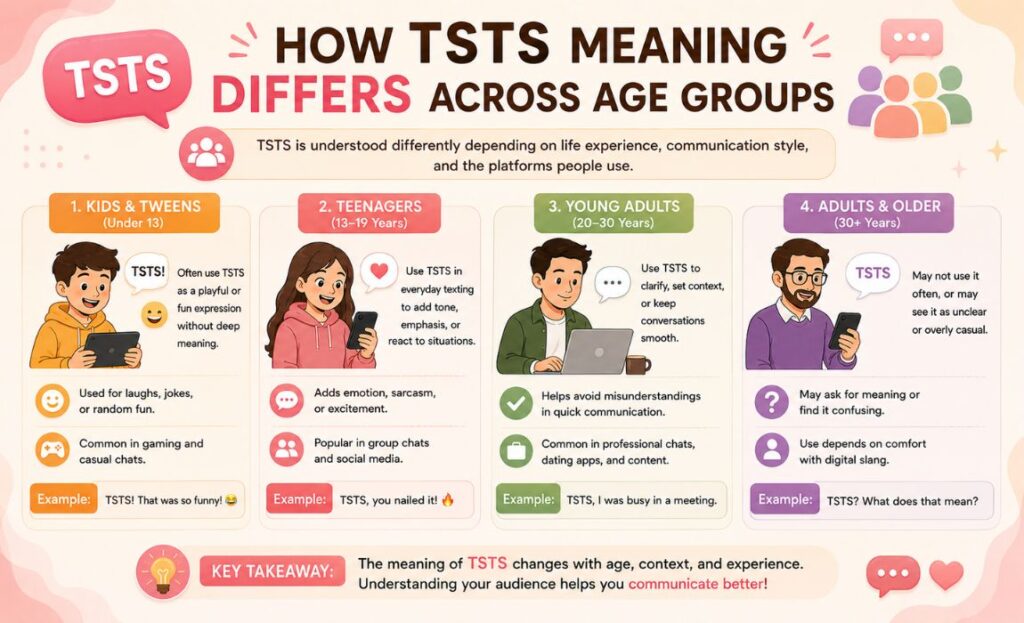
Slang usage often varies significantly by age group, and TSTS meaning is no exception. Younger texters, particularly Gen Z users who grew up entirely within app-based messaging and short-form video platforms, tend to use TSTS more instinctively and interpret it primarily as the playful “tsk tsk” reaction.
Older users encountering TSTS for the first time are more likely to read it literally, assume it’s a typo, or search for a formal definition before using it themselves. This generational gap is part of the reason TSTS meaning continues to trend as a search term — plenty of people encounter it in a message from a younger friend, sibling, or coworker and need a quick, reliable explanation.
Bridging the Generational Gap
If you’re unfamiliar with texting slang and receive a message containing TSTS, the safest approach is simply to read the surrounding sentence carefully. In the vast majority of cases, the context will make the intended tone obvious, even if you’ve never encountered the abbreviation before. Asking a quick, friendly clarifying question is also completely acceptable and rarely comes across as awkward.
Practical Tips for Using TSTS Naturally in Conversation
Understanding TSTS meaning is one thing — using it naturally in your own texting style is another. Here are some practical guidelines to help it land the way it’s intended.
Match the Energy of the Conversation
TSTS works best when it matches the existing tone of a conversation. Dropping it into an already playful, joking exchange feels natural, while inserting it into a serious or emotionally heavy conversation can feel jarring or out of place.
Don’t Overuse It
Like most slang, TSTS meaning loses some of its punch when it’s used in every single message. Save it for moments that genuinely call for a reaction — a bold statement, a funny confession, or a lighthearted tease — rather than sprinkling it into every text as a filler word.
Pair It With Emojis When Helpful
Because TSTS meaning depends heavily on tone, pairing it with an emoji can help remove any ambiguity, especially when texting someone who may not be fully familiar with the term yet. A skull emoji, laughing emoji, or simple smiley can instantly clarify that the message is meant playfully.
Consider Your Audience
Before using TSTS, it helps to think about who’s on the other end of the conversation. Close friends who already text casually will likely understand the tone instantly, while newer contacts, coworkers, or older relatives may need more context or a different word choice entirely.
Conclusion
At its core, TSTS meaning comes down to reaction and tone rather than a single fixed definition. Most often, it functions as a playful, text-based version of “tsk tsk,” though it can also mean strong agreement, a casual conversational sign-off, or even a simple typo for “tests” depending entirely on the surrounding conversation.
Because TSTS carries more than one accepted meaning, context will always be your best and most reliable guide.
Now that you understand the full TSTS meaning across texting, social media, gaming, dating apps, and even academic settings, you’ll be able to read the tone correctly and respond with confidence the next time it shows up in your messages — no more pausing mid-scroll to guess what someone meant.
Frequently Asked Questions
What does TSTS mean in text?
TSTS meaning in text is most commonly a written version of “tsk tsk,” used to react playfully to something said or done.
What does TSTS mean in text message?
In a text message, TSTS usually signals a light, teasing reaction, though it can also mean “that’s so true, seriously” depending on context.
What does TSTS mean in text funny?
Used humorously, TSTS meaning mimics the “tsk tsk” sound to tease a friend about a funny or slightly embarrassing situation.
What is TSTS eligible meaning?
Outside slang, “TSTS eligible” can refer to being eligible under a Two Stage Testing System used in certain academic or assessment programs.
What does TSTS mean texting?
In texting, TSTS meaning is a quick reaction — usually playful disapproval, agreement, or a casual conversational pause.
Is TSTS rude?
Not usually. TSTS meaning is generally playful rather than hostile, though tone and context can occasionally make it feel dismissive.
Is TSTS appropriate for work messages?
No, TSTS is casual slang and should be avoided in professional or formal communication.
Does TSTS always mean the same thing?
No, TSTS meaning depends on context — it can express teasing, strong agreement, a conversational pause, or simply be a typo for “tests.”
Where did TSTS come from?
TSTS meaning developed from the spoken “tsk tsk” sound, adapted into texting shorthand as digital communication favored shorter, faster reactions.
How should I reply to TSTS?
A light, humorous reply or a simple clarifying question both work well, depending on whether the tone feels playful or unclear.
What does TSTS mean from a guy?
When a guy texts TSTS, it’s usually a playful, teasing reaction meant to keep the conversation light, and occasionally a flirty way of calling out something bold you said.
Can TSTS be used sarcastically?
Yes, TSTS meaning often carries a sarcastic edge, especially when reacting to an obvious or exaggerated statement someone made on purpose.
