
Serendipity is a happy accident. It means finding something good when you were not looking for it. The word describes those lucky moments that seem to happen by chance. Many people feel it is a small gift from life.
The word has a fun history. In 1754, writer Horace Walpole made it up. He took the idea from an old tale called “The Three Princes of Serendip.” In the story, the princes kept finding great things by luck and smart thinking. Serendip was an old name for Sri Lanka.
Serendipity shows up in everyday life. You might meet a dear friend by chance in a new city. You might pick up a book and find the exact answer you needed. Even big science discoveries, like penicillin, came from lucky mistakes.
But luck alone is not enough. You must notice the chance and use it well. Staying curious and open helps a lot. So the next time something unplanned happens, pay attention. It might be serendipity.
Serendipity Meaning
What Is Serendipity?

Serendipity is finding something good by chance. You were not looking for it. It simply showed up.
Simple Definition
The basic serendipity meaning is “a fortunate accident.” It is a lucky discovery you did not expect.
Dictionary Definition
Most dictionaries explain serendipity in two ways:
- The ability to find valuable things without searching for them.
- Luck that takes the form of such a discovery.
The first sense is older. The second is how most people use the word today.
How to Pronounce It
Say it like this: ser-uhn-DIP-i-tee.
The stress falls on the third syllable, “DIP.”
Part of Speech
Serendipity is a noun. Its related forms are listed below.
| Word | Part of Speech | Example |
| Serendipity | Noun | Our meeting was pure serendipity. |
| Serendipitous | Adjective | It was a serendipitous find. |
| Serendipitously | Adverb | We met serendipitously at a cafe. |
Serendipity Meaning in Simple Words
Think of serendipity as a good surprise. You walk one way and find a treasure. You did not plan it. You did not expect it.
Here are the key parts of the serendipity meaning:
- It involves chance.
- It brings a good result.
- It was not planned.
- It often needs a curious mind.
If any of these parts is missing, it may not be true serendipity. A planned success is not serendipity. A bad accident is not serendipity either.
Origin of the Word Serendipity
The history of this word is fun. It comes from a fairy tale.
The Three Princes of Serendip
The word comes from an old Persian tale. The tale is called The Three Princes of Serendip. It reached Europe in the 1500s through an Italian version.
In the story, three princes travel far from home. They solve problems using clues they find along the way. They notice small details. They draw smart conclusions. Many of their discoveries happen by accident.
Horace Walpole Coins the Word
An English writer named Horace Walpole invented the word. He used it in a letter in 1754. He wrote the letter to a friend named Horace Mann.
Walpole loved the fairy tale. He wanted a word for the way the princes made discoveries. So he created “serendipity.”
Where Is Serendip?
Serendip is an old name for Sri Lanka. Arab traders used a name like it for the island. The name traces back to a Sanskrit phrase for the island of the Sinhalas.
So the word has real geography behind it. It points to a real island.
How the Meaning Changed Over Time
The word has shifted a little since 1754. Walpole’s version was about skill. The modern version is more about luck.
| Era | Serendipity Meaning |
| 1754 (Walpole) | Making smart discoveries by accident and wisdom |
| 1900s | A talent for finding good things by chance |
| Today | A happy accident or a fortunate coincidence |
Some scholars say the original serendipity meaning described a capability, not an event. In other words, it was a skill. People noticed clues and used them well.
Today, most people use it for the lucky event itself. Both uses are common. Both are correct.
Serendipity vs Luck
Many people mix up these two words. They are close, but not the same.
Key Differences
| Feature | Serendipity | Luck |
| Outcome | Always good | Can be good or bad |
| Needs awareness | Often yes | No |
| Involves discovery | Yes | Not always |
| Example | Finding a great job through a chance chat | Winning a lottery |
Luck can be bad. We say “bad luck.” We do not say “bad serendipity.” Serendipity is always positive.
Also, serendipity usually needs you to notice something. Luck can happen without you doing anything.
Serendipity vs Coincidence
A coincidence is two events happening together by chance. It can be neutral. It does not have to be good.
Serendipity adds value. It is a coincidence that helps you.
A Quick Example
- Coincidence: You and a stranger wear the same shirt.
- Serendipity: You and that stranger talk and become business partners.
See the difference? Serendipity leads to a benefit.
Serendipity vs Fate and Synchronicity
These ideas sound alike. Yet each has its own flavor.
- Fate means events are destined. Someone or something planned them.
- Synchronicity means meaningful coincidences. The psychologist Carl Jung used this term.
- Serendipity means a happy accident. No plan is required.
The serendipity meaning does not say that the universe arranged things. It only says that a good thing happened by chance.
Synonyms of Serendipity
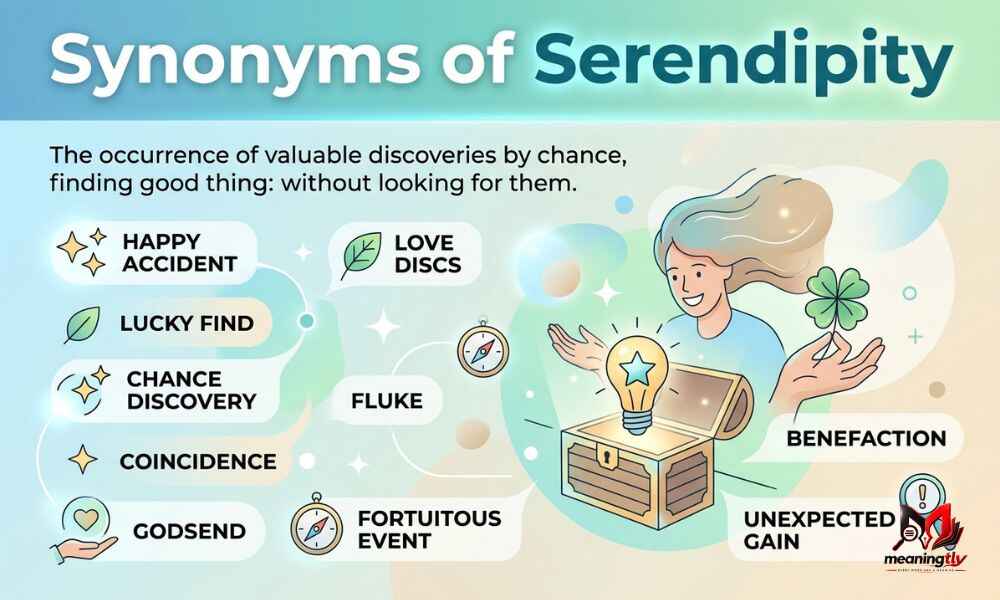
Here are words with a similar sense:
- Good fortune
- Happy accident
- Fluke (informal)
- Windfall
- Lucky break
- Stroke of luck
- Fortuity
- Chance discovery
- Godsend
No synonym matches the serendipity meaning perfectly. Each word has a slightly different tone. “Windfall,” for example, often means money. “Godsend” suggests help arriving at the right time.
Related Adjectives
- Fortunate
- Fortuitous
- Providential
- Auspicious
- Opportune
Antonyms of Serendipity
Here are the opposites:
- Misfortune
- Bad luck
- Mishap
- Calamity
- Planning (in the sense of deliberate design)
Misfortune is the closest opposite. It is an unlucky event.
Serendipity Meaning in Urdu and Hindi
Many learners search for the serendipity meaning in their own language. Here are simple translations.
| Language | Translation | Roman Script |
| Urdu | خوش اتفاقی | Khush ittefaqi |
| Hindi | सुखद संयोग | Sukhad sanyog |
These phrases mean a happy coincidence or a pleasant chance event. Other phrases may also work, depending on the sentence.
Serendipity in a Sentence
Examples help you remember a word. Here are many simple ones.
Everyday Sentences
- We found the best cafe in town by pure serendipity.
- Meeting her at the airport was serendipity.
- It was serendipity that the shop had one last copy.
- By serendipity, he took the same train as his old friend.
- Their friendship began with a bit of serendipity.
- She believes serendipity brought her to this city.
- A serendipitous phone call changed his career.
- The trip turned out better thanks to serendipity.
- I stumbled on this song through serendipity.
- Serendipity led them to a hidden beach.
Work and Study Sentences
- The team’s big idea came from a serendipitous mistake.
- A chance talk at a seminar sparked her research.
- Serendipity helped him land his first client.
- The discovery was serendipitous, not planned.
- Good research often includes a little serendipity.
Tips for Using the Word
- Use it for good surprises only.
- Pair it with words like “pure” or “sheer.”
- Use “serendipitous” as the adjective.
Serendipity in Daily Life
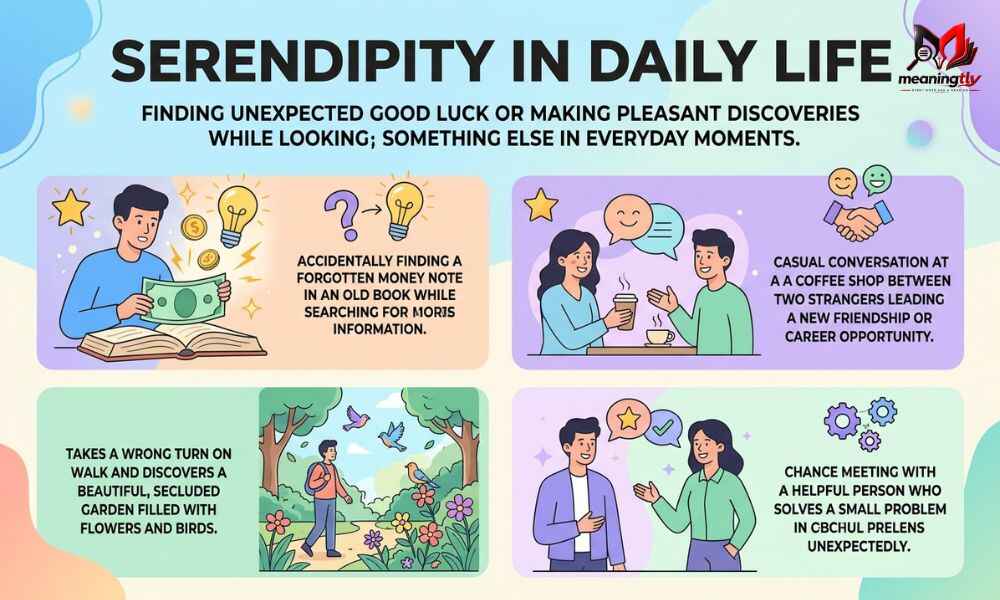
You do not need to be a scientist to enjoy serendipity. It happens in ordinary moments.
In Love and Relationships
Many couples say they met by chance. A wrong turn. A shared table. A borrowed pen. These small events can start big stories.
Films love this idea. The 2001 romantic movie Serendipity is built around it. Two strangers reach for the same pair of gloves.
In Careers
Many careers begin by accident. A friend of a friend mentions an opening. A casual chat turns into an interview.
Studies of job seekers often note that weak ties matter. These are acquaintances, not close friends. They often bring news that your close circle does not know.
In Travel
Travel is full of serendipity. You skip a tourist spot and find a local market. You get lost and discover a quiet street.
Some travelers plan less on purpose. They leave room for surprise.
In Friendship
New friends often appear by chance. A shared class. A queue. A waiting room. A talk that you did not plan.
In Learning
Libraries and bookshops invite serendipity. You look for one book. The book next to it catches your eye. It teaches you something new.
Famous Examples of Serendipity in Science
Science offers the best proof of the serendipity meaning. Many great inventions began as accidents.
| Discovery | Year | The Happy Accident |
| X-rays | 1895 | Wilhelm Röntgen noticed a glow near his equipment |
| Saccharin | 1879 | A chemist tasted something sweet on his hands |
| Penicillin | 1928 | Alexander Fleming noticed mold killing bacteria |
| Velcro | 1941 | George de Mestral studied burrs stuck to his dog |
| Microwave oven | 1945 | Percy Spencer saw a candy bar melt near radar gear |
| Post-it Notes | 1970s | A weak glue found a new use as a sticky bookmark |
| Teflon | 1938 | Roy Plunkett found a slippery white substance |
Penicillin
Alexander Fleming returned from a holiday. He found mold in a dish of bacteria. Around the mold, the bacteria had died.
Many people had seen mold before. Fleming noticed what it meant. That led to the first antibiotic.
Microwave Oven
Percy Spencer worked with radar equipment. A candy bar in his pocket melted. He got curious. He tested popcorn next. Soon, the microwave oven was born.
Velcro
George de Mestral walked his dog in the Swiss countryside. Burrs clung to the dog’s fur. He looked at them under a microscope. He saw tiny hooks. Velcro came from that.
Post-it Notes
A researcher at 3M made a glue that was too weak. It was a failed result. Later, a colleague used it to hold bookmarks in a hymn book. The idea for sticky notes took off.
Types of Serendipity
Scholars have studied serendipity closely. They describe a few kinds.
Pure Serendipity
You find something good while searching for nothing in particular. The discovery is a complete surprise.
Pseudo-Serendipity
You search for something specific. You find it in an unexpected way. Or you find a better way to reach the same goal.
Walpolian vs Mertonian
- Walpolian: The classic idea. A person finds something valuable while looking for something else.
- Mertonian: Named after the sociologist Robert K. Merton. It focuses on how chance findings spark new ideas in research.
You do not need to remember these terms. Still, they show that experts take the serendipity meaning seriously.
Is Serendipity Just Luck?
No. Not entirely.
Luck brings the moment. Skill makes use of it. The French scientist Louis Pasteur said that chance favors the prepared mind. That line sums up serendipity well.
The Prepared Mind
A prepared mind has three habits:
- It stays curious.
- It pays attention.
- It acts on small clues.
Many people saw mold before Fleming. Only he saw what it meant.
The Role of Action
Chance only helps if you do something with it. A great idea unused is just a thought. So serendipity needs both luck and effort.
The Psychology of Serendipity
Why do some people experience more serendipity than others? Psychology offers a few clues.
Openness to Experience
People high in openness try new things. They talk to strangers. They explore. This gives chance more opportunities to work.
Attention and Noticing
A relaxed, curious person notices more. A stressed, rushed person often misses small signs.
Positive Mindset
Optimistic people tend to see chance events as helpful. They remember good surprises. They treat setbacks as clues.
A Gentle Warning
Not every coincidence is meaningful. We should enjoy happy surprises. But we should also think clearly. Good decisions still need facts.
BDE Meaning in Text: How to Use It in Conversations(2026)
How to Create More Serendipity
You cannot force serendipity. But you can make it more likely.
1. Stay Curious
Ask questions. Wonder about small things. Curiosity opens doors.
2. Talk to New People
Say hello to someone new each week. A short chat can lead anywhere.
3. Change Your Routine
Take a different route home. Try a new cafe. Small changes bring new views.
4. Leave Room in Your Schedule
A packed day has no space for surprise. Keep some free time.
5. Say Yes More Often
Accept invitations. Try new events. You never know what a single “yes” can start.
6. Read Widely
Read outside your field. Ideas from other areas often spark new thoughts.
7. Share What You Are Working On
Tell people about your goals. Someone may know just the right person or tool.
8. Keep a Notebook
Write down odd ideas and strange facts. Later, you may link them in a new way.
9. Visit Places That Mix People
Libraries, markets, and workshops bring different people together. Chance meetings grow there.
10. Stay Patient
Serendipity cannot be rushed. In real life, it usually comes when you stop forcing things.
Serendipity in Business and Innovation
Companies love planning. Yet many great products came from chance.
Open Offices and Shared Spaces
Some firms design spaces to help people bump into each other. A casual chat by the coffee machine can lead to a new idea.
Learning from Failure
The Post-it Note started as a failed glue. Many firms now treat failed tests as possible clues.
Cross-Team Talks
Engineers, designers, and sales staff see different things. When they talk, new ideas appear.
Tips for Leaders
- Allow time for open exploration.
- Reward curiosity, not only results.
- Share lessons from failed projects.
- Mix people from different teams.
Serendipity in the Digital Age
The internet can help or hurt serendipity.
The Problem with Algorithms
Many apps show you what you already like. This is useful. But it can trap you in a bubble. You rarely see surprising things.
The Upside
You can also discover amazing things online. A random link leads you to a new hobby. A stranger’s post changes your view.
How to Keep Online Serendipity Alive
- Follow people from different fields.
- Browse without a goal sometimes.
- Use “random” or “surprise me” features.
- Visit a real bookstore or library often.
Serendipity in Pop Culture
The word appears across art and media.
- Film: The 2001 romantic comedy Serendipity stars John Cusack and Kate Beckinsale.
- Music: Many songs use the word as a title. The singer Jimin of BTS released one in 2018.
- Food: A famous New York dessert cafe, Serendipity 3, uses the name.
- Names: Many brands, shops, and children’s names use it.
People love the sound of the word. It feels light and magical. The serendipity meaning fits that mood.
Benefits of Serendipity
Why does serendipity matter? Here are some good effects.
- It sparks creativity.
- It builds new relationships.
- It brings joy and surprise.
- It leads to new ideas and products.
- It reminds us to stay open.
- It makes life feel richer.
Even small moments of serendipity can lift your mood.
Can Serendipity Be Bad?
By definition, no. The serendipity meaning always involves a good result.
If something bad happens by chance, we call it misfortune or bad luck.
Yet a bad event can sometimes lead to a good one. A lost job may lead to a better career. A missed flight may lead to a lucky meeting. In that case, the final outcome is serendipitous. The first event is not.
Common Mistakes with the Word
Let’s clear up a few errors.
Mistake 1: Using It for Bad Events
Wrong: “It was serendipity that my car broke down.” Better: “It was bad luck that my car broke down.”
Mistake 2: Using It for Planned Results
If you planned it, it is not serendipity.
Mistake 3: Mixing Up Spelling
The correct spelling is s-e-r-e-n-d-i-p-i-t-y. People often miss the “d” or the second “i.”
Mistake 4: Confusing It with Coincidence
A coincidence is neutral. Serendipity is helpful.
Serendipity vs Serendipitous
These two words are close cousins.
| Word | Role | Example |
| Serendipity | Noun | Serendipity brought them together. |
| Serendipitous | Adjective | It was a serendipitous meeting. |
Use “serendipity” for the thing itself. Use “serendipitous” to describe an event or find.
ALR Meaning: Complete Guide to Its Use, Slang & Examples (2026)
Why the Word Is So Loved
Many people call serendipity one of the most beautiful words in English. There are a few reasons.
- The sound is soft and musical.
- It has a fairy-tale origin.
- No other English word says exactly the same thing.
- It carries hope.
Learning the full serendipity meaning makes the word even more special. It is not just luck. It is luck plus curiosity.
Quick Summary Table
| Question | Short Answer |
| What is serendipity? | A happy accident |
| Who coined it? | Horace Walpole |
| When? | 1754 |
| Where did it come from? | A Persian fairy tale |
| What is Serendip? | An old name for Sri Lanka |
| Part of speech? | Noun |
| Adjective form? | Serendipitous |
| Closest synonym? | Fortuity or good fortune |
| Opposite? | Misfortune |
Conclusion
Serendipity means finding something good by chance. You were not looking for it, but it comes to you anyway. It is a happy surprise that feels like luck.
The word has a fun history. A writer named Horace Walpole used it in 1754. He took it from an old tale called “The Three Princes of Serendip.” The princes kept finding good things they were not searching for.
We see serendipity in daily life. You may meet a great friend at a random event. You may find a book that changes your thinking. Many famous discoveries also came this way, like penicillin.
In the end, serendipity reminds us to stay open. Life does not always follow our plans. Sometimes the best things arrive by accident. So stay curious and enjoy the surprises.
Frequently Asked Questions (FAQs)
What is the true meaning of serendipity?
Serendipity means finding something good or valuable by chance, without looking for it.
What does serendipity mean in love?
It means meeting or falling for someone by a happy accident, when you weren’t searching for love.
What is the synonym of serendipity?
Luck, fortune, chance, happy accident, or fluke.
What is a good example of serendipity?
Alexander Fleming discovering penicillin by accident, when mold ended up contaminating his lab dish.
How do I use serendipity in a sentence?
“It was pure serendipity that I met my best friend while waiting for a delayed train.”
What is the opposite of serendipity?
Misfortune, bad luck, or “mishap” (an unlucky accident).
