Esoteric meaning is the hidden side of an idea, a symbol, or a text. It is not found on the surface. You have to look deeper to see it. Many people believe every sacred story has two layers. One layer is simple, and the other is secret.
The word “esoteric” comes from a Greek word meaning “inner.” In old times, only a small group of students learned these teachings. Their teachers shared them slowly and with care. The goal was to guide the mind, not just fill it with facts.
You can find esoteric meaning in many places. Religions, myths, dreams, and symbols all carry it. A snake, a circle, or a tree may seem plain at first. But each one can point to ideas like change, unity, or growth.
Today, many people still study these hidden meanings. They use them to understand life and themselves. Some see them as spiritual guides, and others see them as old stories with deep lessons. Either way, they invite us to think, ask, and look beyond the obvious.
Esoteric Meaning
What Is the Esoteric Meaning?
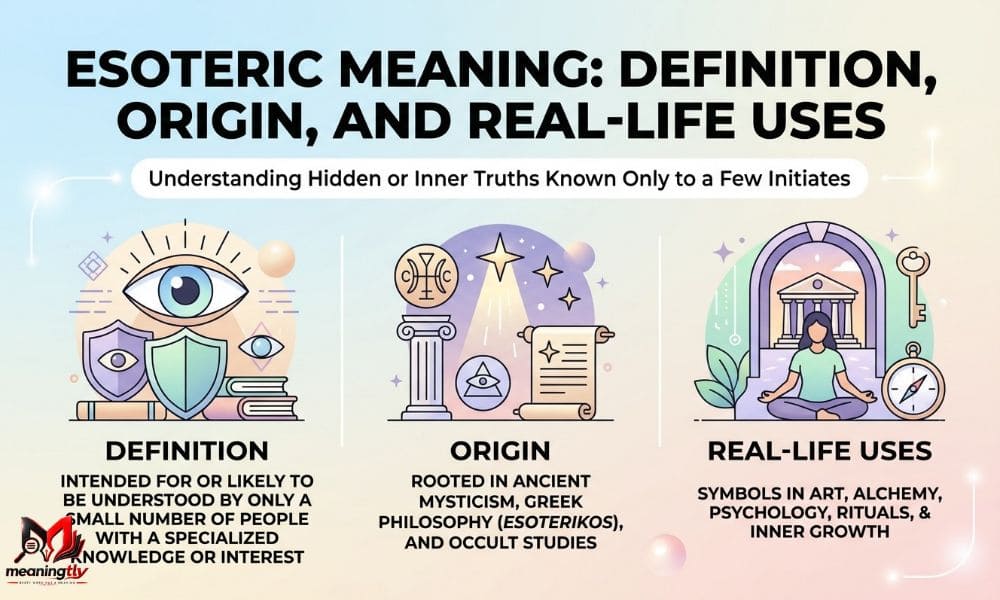
The esoteric meaning is “known by a few.” It describes ideas, teachings, or knowledge that are hard to access. Often, you need training or initiation to understand them.
The word can also mean “hidden.” It can mean “secret.” In casual talk, it can even mean “too complex.”
Simple Definition
Esoteric means meant for a small, select group. Ordinary people do not usually know it.
Think of a secret club. Only members know the rules. Those rules are esoteric.
Pronunciation and Word Type
- Pronunciation: es-uh-TAIR-ik
- Part of speech: adjective
- Related noun: esotericism
- Related adverb: esoterically
Quick Facts Table
| Feature | Detail |
| Word | Esoteric |
| Type | Adjective |
| Core idea | Inner, hidden, specialized |
| Root language | Ancient Greek |
| Opposite | Exoteric |
| First English use | Around the 1600s |
| Common fields | Religion, philosophy, academia |
Where Does the Word Come From?
The history of the word explains its meaning. Let’s trace it.
The Greek Roots
The word comes from the Greek esōterikos. It means “belonging to an inner circle.”
That word grew from esō. This means “within.” So the base idea is “inside.”
Plato and the Inner Things
Ancient Greek thinkers split ideas into two groups. Some were “inner things.” Others were “outer things.”
Inner things were for trained minds. Outer things were for the public.
Teaching in Closed Circles
Greek schools kept some lessons private. Students often had to earn trust first.
Pythagoras is a famous example. His followers had two levels. Beginners listened. Advanced members studied the deeper lessons.
This is the early esoteric meaning in action. Knowledge had layers. Not everyone got the top layer.
Arrival in English
English writers began using the word around the 1600s. At first, it described private teachings of old schools.
Later, the meaning widened. Today, it covers any subject that needs special knowledge.
Esoteric vs Exoteric
These two words are opposites. Understanding both makes the esoteric meaning clearer.
What Exoteric Means
Exoteric means open and public. Anyone can learn it. It is easy to share.
Side-by-Side Comparison
| Point | Esoteric | Exoteric |
| Audience | Small group | General public |
| Access | Restricted or earned | Open to all |
| Style | Symbolic, layered | Direct, literal |
| Difficulty | High | Low to moderate |
| Example | Mystical teachings | Public lectures |
Do They Conflict?
Not always. Many traditions use both.
The outer teaching gives rules and stories. The inner teaching gives deeper insight. One often rests on the other.
Esoteric Meaning in Daily Speech
People now use the word loosely. You will hear it in offices, classrooms, and news.
The Modern Sense
Today, esoteric often means “too specialized.” A topic may be esoteric if few people study it.
For example, a rare math field is esoteric. So is a niche hobby with its own jargon.
Example Sentences
- The lecture was too esoteric for beginners.
- She collects esoteric books on ancient symbols.
- His jokes were esoteric. Only his coworkers laughed.
- The software manual was full of esoteric terms.
- The monk taught esoteric practices to a few students.
Positive or Negative?
It depends on tone. It can sound respectful. It can also sound critical.
Saying “an esoteric study” can praise depth. Saying “an esoteric rant” suggests confusion.
Esoteric Meaning in Religion
Religion is where the esoteric meaning shines most. Many faiths have an outer path and an inner path.
Islam and Sufism
In Islam, some scholars read the Quran on two levels. The outer level covers the plain words and laws. The inner level explores deeper, spiritual meaning.
Sufi teachers often focus on the inner path. They stress purity of heart. They teach that insight comes through practice, not just study.
Some traditions say the inner meanings have many layers. Each layer opens a deeper view.
Christianity and Gnosticism
Early Gnostic groups valued gnosis. This Greek word means “knowledge.”
They sought direct, personal insight into the divine. Their teachings were often kept private.
Later Christian mystics also explored inner paths. They wrote about prayer, silence, and union with God.
Buddhism
Some schools of Buddhism teach in stages. Tantric Buddhism is one example.
Teachers pass certain practices directly to students. This is called transmission. It is not open to everyone at once.
Judaism and Kabbalah
Kabbalah is the best-known Jewish mystical tradition. It studies hidden layers in scripture.
Traditionally, students prepared for years before studying it. Teachers wanted them ready in mind and character.
Hinduism
Hindu thought has deep inner teachings. The Upanishads focus on the self and ultimate reality.
The word “Upanishad” is often linked to sitting near a teacher. That idea fits the esoteric meaning well. Learning happens up close.
Religion at a Glance
| Tradition | Inner Path | Main Focus |
| Islam | Sufism | Purity of heart |
| Christianity | Gnosticism, mysticism | Direct divine knowledge |
| Judaism | Kabbalah | Hidden layers of scripture |
| Buddhism | Tantric schools | Direct transmission |
| Hinduism | Upanishadic thought | Self and reality |
Esoteric Meaning in Philosophy
Philosophy has always had public and private sides. This is a key part of the esoteric meaning.
Ancient Schools
Greek schools taught beginners with simple lessons. Advanced students got harder material.
Aristotle’s work is often described in two groups. Some writings were for the public. Others were for his close students.
Reading Between the Lines
Some thinkers hid ideas inside their writing. They had good reasons. Open speech could be risky in some eras.
Readers had to look for clues. They read slowly and carefully. This habit is still taught today.
Modern Philosophy
Today, an esoteric topic in philosophy is one that is highly technical. Examples include deep logic puzzles or very narrow debates.
Most people never meet them. Experts debate them for years.
What Is Western Esotericism?
Western esotericism is a field of study. It groups several old traditions in Europe and nearby regions.
Main Traditions
- Hermeticism: Texts linked to the figure Hermes Trismegistus.
- Alchemy: The study of matter and change.
- Astrology: The study of stars and human life.
- Rosicrucianism: A secret brotherhood from early modern Europe.
- Theosophy: A modern spiritual movement from the 1800s.
- Tarot and symbolism: Image-based systems for reflection.
Alchemy Explained
Many people think alchemists only wanted gold. That is only part of the story.
Alchemy also had a spiritual side. Practitioners saw changing metal as a symbol of changing the self.
This is a clear case of the esoteric meaning. The surface task hid a deeper purpose.
Scholars Take It Seriously
Universities now study these traditions. Researchers look at their history, texts, and influence.
They do not need to believe in them. They study them as part of human culture.
Esoteric Meaning in Psychology
Psychology borrowed many symbolic ideas. This makes the topic useful for modern readers.
Carl Jung
Carl Jung studied myths, dreams, and symbols. He believed people share deep patterns.
He called them archetypes. Examples include the hero, the shadow, and the wise elder.
Jung read alchemy as a map of the mind. In his view, turning lead into gold mirrored personal growth.
Why It Matters Today
Many people use symbols for reflection. They journal about dreams. They study myths.
You do not need to accept every claim. You can still find value in the questions.
Esoteric Meaning in Literature
Writers have long hidden deeper ideas inside stories. This makes literature a rich home for the esoteric meaning.
Allegory and Hidden Layers
An allegory tells one story on the surface. Underneath, it tells another.
A reader can enjoy the plot alone. A careful reader can find the second layer.
Poetry and Symbol
Poets use images that carry more than one meaning. A rose may be just a flower. It may also stand for love, time, or the soul.
How to Read for Hidden Meaning
- Read the story once for pleasure.
- Read it again for repeated images.
- Note names, numbers, and colors.
- Study the author’s background.
- Compare your reading with expert notes.
Symbols and Their Hidden Layers
Symbols are central to the esoteric meaning. A symbol shows one thing and suggests another.
Common Examples
| Symbol | Outer Look | Inner Idea (in many traditions) |
| Circle | A round shape | Wholeness, eternity |
| Snake | An animal | Renewal, wisdom |
| Light | Brightness | Knowledge, awareness |
| Tree | A plant | Growth, connection |
| Mirror | A glass surface | Self-reflection |
Meanings Change
Symbols are not fixed. A snake can mean danger in one culture. It can mean healing in another.
So always check the source. Context matters.
How to Read a Symbol
- Note the culture it comes from.
- Check the time period.
- Look at how the text uses it.
- Compare more than one source.
- Avoid jumping to one answer.
Esoteric Meaning in Hindi and Urdu
Many readers search for translations. This is common in South Asia.
Hindi
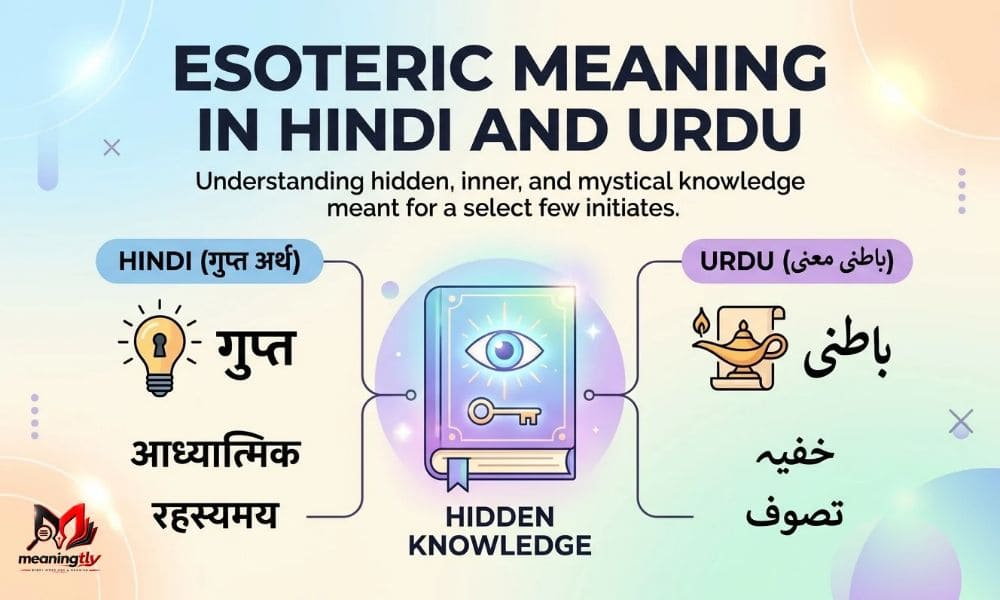
In Hindi, esoteric is often rendered as गूढ़. It means deep, hidden, or hard to grasp.
You will see phrases like गूढ़ ज्ञान (esoteric knowledge) and गूढ़ अर्थ (esoteric meaning).
Urdu
In Urdu, words like باطنی (inner) and پوشیدہ (hidden) come close. The word “batini” refers to the inner side of something.
No single word fits every context. Choose based on the sentence.
Synonyms and Antonyms
Knowing related words helps you write better. It also makes the esoteric meaning easier to remember.
Synonyms
- Hidden
- Secret
- Mystical
- Occult
- Arcane
- Cryptic
- Obscure
- Abstruse
Antonyms
- Exoteric
- Public
- Common
- Open
- Simple
- Mainstream
Word Choice Table
| Word | Best Used For |
| Esoteric | Specialized or inner knowledge |
| Arcane | Old, mysterious knowledge |
| Obscure | Little-known facts |
| Cryptic | Puzzling messages |
| Occult | Hidden or supernatural study |
Esoteric vs Occult
People mix these up. They are not the same.
“Occult” means hidden. It often links to supernatural practice. “Esoteric” is wider. It can describe any specialized or inner knowledge, even a math paper.
Esoteric Meaning in Modern Culture
The word has left old libraries. It now lives online.
Books and Media
Writers use the term for mystery stories. Filmmakers use it for secret societies. Game designers use it for hidden lore.
It adds an air of depth. Audiences like that.
Social Media
Online groups share niche ideas daily. Some are playful. Some are serious.
A niche meme can be called esoteric. So can an inside joke.
Why People Are Drawn to It
People want meaning. They also like belonging.
Hidden knowledge gives both. It feels personal. It feels earned.
Common Myths
The esoteric meaning is often misunderstood. Let’s clear up a few points.
Myth 1: It Always Means Evil
False. The word is neutral. It simply means specialized or inner.
Myth 2: It Is Only About Magic
False. Many esoteric subjects are academic or spiritual. Some are purely technical.
Myth 3: It Means Fake
False. The word says nothing about truth. A topic can be esoteric and valid. It can also be esoteric and doubtful.
Myth 4: Only Experts Can Learn It
False. Most esoteric subjects can be learned. It takes time and patience.
Myth 5: It Must Be Secret
Not always. Some esoteric books are in public libraries. They are simply hard to read.
How to Explore Esoteric Topics Wisely
Curiosity is healthy. A careful approach is better.
Start with Trusted Sources
- University press books
- Academic encyclopedias
- Respected dictionaries
- Museum or library guides
Ask Good Questions
- Who wrote this?
- What is their background?
- Does the claim have evidence?
- Is someone selling something?
- Do other experts agree?
Watch for Red Flags
- Promises of instant power
- Pressure to pay large sums
- Demands for total secrecy
- Claims that doubt is forbidden
A good teacher welcomes questions. Be cautious if yours are ignored.
Keep a Balanced View
Study with an open mind. Keep your judgment sharp.
You can respect a tradition without accepting every claim.
How to Use the Word Correctly
Using the word well makes your writing sharper.
Do
- Use it for specialized or inner knowledge.
- Pair it with clear nouns, like “esoteric teachings.”
- Check that your reader knows the term.
Don’t
- Use it as a fancy word for “weird.”
- Use it when “obscure” or “complex” fits better.
- Overuse it in one piece.
Sample Rewrites
| Weak | Better |
| This is a weird topic. | This is an esoteric topic. |
| The idea is hard. | The idea is esoteric, even for experts. |
| He loves secret stuff. | He studies esoteric traditions. |
ICL Text Meaning: What It Really Means in Texting
Why the Esoteric Meaning Still Matters
Knowledge comes in layers. Some is easy. Some takes years.
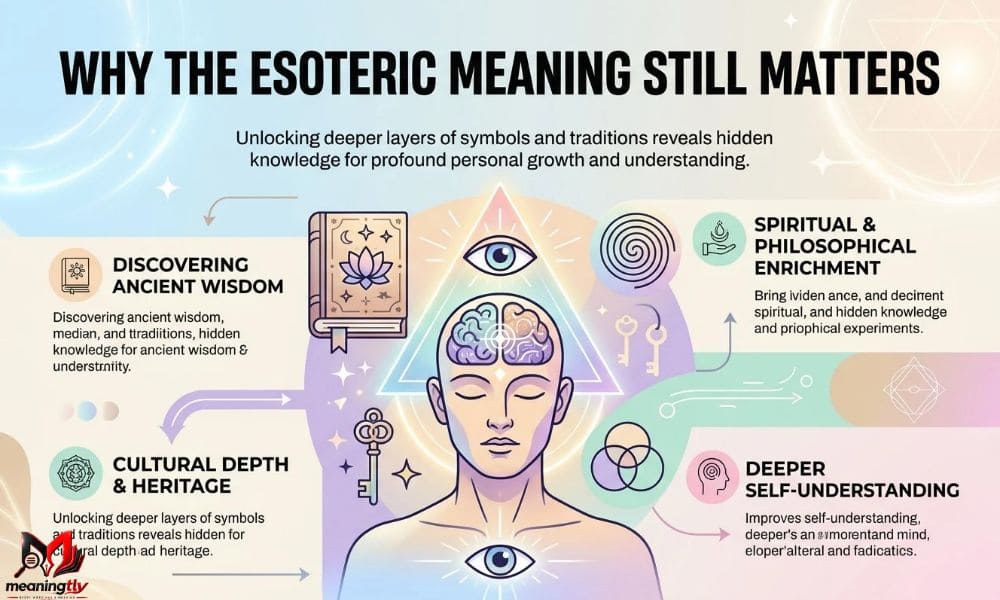
The esoteric meaning reminds us of this. It shows that depth takes effort. It also shows that not every answer is on the surface.
Understanding the term helps you read better. It helps you talk clearly. It also helps you judge claims with care.
Conclusion
Esoteric meaning is the hidden meaning behind words, symbols, or teachings. It is not meant for everyone to see at first glance. Only those who study deeply or seek with patience can understand it. This is why many old traditions kept such knowledge for a small circle of students.
Every religion and culture has an outer meaning and an inner meaning. The outer meaning is what most people see and follow in daily life. The inner meaning points to deeper truths about the soul, life, and the universe. Symbols like light, water, and the circle often carry these hidden lessons.
Understanding esoteric meaning takes time and an open mind. It asks us to look beyond the surface and question what we think we know. Reading, reflection, and quiet thought help a person grow in this way. Each person may also find a slightly different meaning that fits their own journey.
In the end, esoteric meaning teaches us that life is more than what we see. It invites us to look inward and find wisdom within ourselves. We do not need to accept everything blindly, but we can stay curious. When we keep learning, the hidden meanings slowly become clear.
Frequently Asked Questions
What does esoteric mean in simple words?
It means known or understood by only a small group. It can also mean hidden or deeply specialized.
What is the esoteric meaning of a word or text?
It is the inner or hidden layer of meaning. It goes beyond the plain, literal reading.
Where does the word esoteric come from?
It comes from the Greek esōterikos, meaning “belonging to an inner circle.”
What is the opposite of esoteric?
The opposite is “exoteric.” It means public, open, and easy for all to understand.
Is esoteric the same as occult?
No. Occult usually means hidden or supernatural. Esoteric is broader and can describe any specialized knowledge.

1 thought on “Esoteric Meaning: Powerful Insights & Hidden Truths(2026) ”