
Nonchalant meaning is a word we use for a calm and relaxed person. A nonchalant person does not look worried or upset. They act like nothing is a big deal. This word comes from French, and it means “not caring too much.”
You can see this style in daily life. A student may walk into an exam with a smile. A friend may shrug when plans change. Their face stays cool, and their voice stays soft. They seem easy and unbothered.
Being nonchalant is not always bad. Sometimes it helps us stay calm in tough moments. It can stop us from panicking over small things. But too much of it can look like we do not care.
So the meaning depends on the situation. Calm is good when it keeps us steady. It is not good when it hurts other people’s feelings. Next, let’s look at the word closely with simple examples.
Nonchalant Meaning
Quick Answer
Nonchalant meaning: Nonchalant is an adjective. It describes a person who looks calm, relaxed, and unconcerned. They show little worry, interest, or excitement. This is true even when the situation seems serious.
In short, a nonchalant person acts like “no big deal.”
Quick facts:
- Word type: Adjective
- Adverb form: Nonchalantly
- Noun form: Nonchalance
- Simple meaning: Calm and unbothered
- Hindi/Urdu meaning: Beparwah (بے پرواہ), udaaseen
What Does Nonchalant Mean?
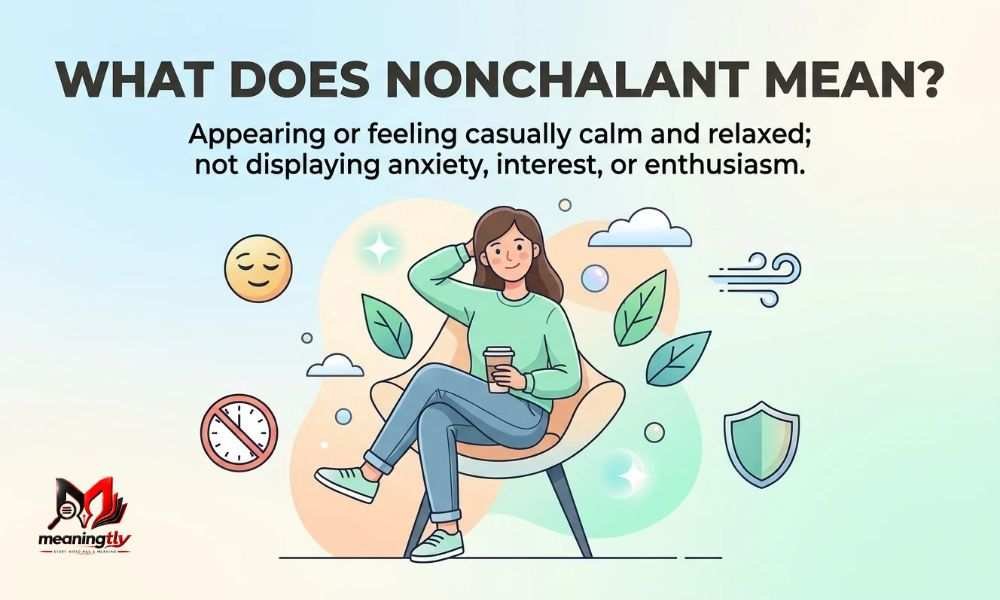
The nonchalant meaning centers on a relaxed attitude. A nonchalant person does not look nervous. They do not look overly eager. They stay cool.
Dictionaries describe it as “casually calm and relaxed.” Some also add “not showing anxiety, interest, or enthusiasm.”
Think of it like this. Someone gets a huge job offer. They shrug and say, “Nice. I’ll think about it.” That is a nonchalant reaction.
Simple Definition
Nonchalant means calm, casual, and unbothered. The person seems not to care much. Or they simply hide their feelings well.
Dictionary Definition
Most dictionaries give two ideas:
- Feeling or appearing relaxed and calm.
- Showing a lack of interest or concern.
Both ideas matter. The first one sounds positive. The second one can sound negative. Context decides which one you mean.
Pronunciation Guide
Many learners ask how to say it. Here is the easy way.
- Phonetic: non-shuh-LAHNT
- Stress: On the last syllable
- Silent letters: None. The “ch” sounds like “sh.”
The “ch” comes from French. That is why it sounds like “sh.”
Nonchalant Meaning in Hindi and Urdu
Many readers search for the nonchalant meaning in their own language. Here are common translations.
| Language | Word | Pronunciation |
| Hindi | बेपरवाह | Beparwah |
| Hindi | उदासीन | Udaaseen |
| Hindi | निश्चिंत | Nishchint |
| Urdu | بے پرواہ | Beparwah |
| Urdu | لاپرواہ | Laparwah |
No single word fits perfectly. “Beparwah” is the closest match in daily speech. It describes someone who does not worry.
Keep one thing in mind. In Urdu, “laparwah” often sounds negative. It can mean careless. The English word is milder.
Word Origin and Etymology
The origin of nonchalant is interesting. It tells you why the word feels “cool.”
From French to English
English borrowed the word from French. The French verb was nonchaloir. It meant “to disregard.”
That verb has two parts:
- non-: meaning “not”
- chaloir: meaning “to concern” or “to be warm”
So the root idea is “not warm” or “not concerned.”
The Latin Link
The French chaloir came from the Latin calere. It means “to be warm.” A person who is not warm about something does not feel heat or passion for it.
That is why nonchalant people seem “cool.” The link is almost literal.
When Did It Enter English?
Dictionaries trace the first known use to around the 1700s. Since then, the word has kept its core sense. It has not changed much.
Is “Chalant” a Word?
No. Traditional dictionaries do not list “chalant” as a word. It was never a standalone English term.
But the internet changed that. Social media users now joke about it. They use “chalant” to mean someone who is warm and openly caring. It is a playful opposite. We cover this later.
Nonchalant Parts of Speech
The word has several forms. Learn them all. They help in writing and exams.
| Form | Word | Example |
| Adjective | Nonchalant | She gave a nonchalant shrug. |
| Adverb | Nonchalantly | He nonchalantly walked past the crowd. |
| Noun | Nonchalance | His nonchalance surprised everyone. |
Using the Adjective
The adjective describes a person, a look, or an action. You can say a nonchalant attitude or a nonchalant reply.
Using the Adverb
“Nonchalantly” describes how someone does something. It means in a calm and casual way.
Using the Noun
“Nonchalance” is the quality itself. It means a cool, easy manner. Writers love this noun.
Nonchalant Examples in Sentences
Examples make the nonchalant meaning clear. Read these slowly.
Everyday Examples
- She was nonchalant about her test results.
- He gave a nonchalant wave and left.
- The cat looked nonchalant after knocking the glass off the table.
- My brother stayed nonchalant during the power cut.
- “I don’t mind,” she said in a nonchalant voice.
- The driver nonchalantly parked in the tight spot.
- They acted nonchalant, but they were secretly excited.
Work Examples
- The manager stayed nonchalant when the deadline moved.
- He nonchalantly shared the big news in a meeting.
- Her nonchalant style calmed the whole team.
School Examples
- The student gave a nonchalant answer to a hard question.
- He was nonchalant before the final exam.
- She nonchalantly handed in her perfect paper.
Dating Examples
- He replied in a nonchalant way to hide his interest.
- She texted nonchalantly, as if she did not care.
- His nonchalant attitude confused her.
Nonchalant Synonyms
Synonyms are words with a similar meaning. They help you avoid repeating yourself.
Common Synonyms
| Synonym | Meaning | Tone |
| Calm | Free from stress | Positive |
| Relaxed | At ease | Positive |
| Casual | Easygoing | Neutral |
| Cool | Stylishly unbothered | Positive |
| Composed | In full control | Positive |
| Unconcerned | Not worried | Neutral |
| Insouciant | Carefree and light-hearted | Positive |
| Blasé | Bored or unimpressed | Negative |
| Indifferent | Showing no interest | Negative |
| Aloof | Distant and cold | Negative |
| Detached | Emotionally apart | Negative |
| Offhand | Casual, sometimes rude | Neutral |
Positive Synonyms
Use these when you want praise:
- Calm
- Composed
- Easygoing
- Unflappable
- Poised
Negative Synonyms
Use these when you want criticism:
- Apathetic
- Indifferent
- Careless
- Dismissive
- Uninterested
Which Synonym Fits Best?
Pick based on context. “Composed” fits a calm leader. “Blasé” fits a bored teenager. “Insouciant” fits a carefree artist.
Nonchalant Antonyms
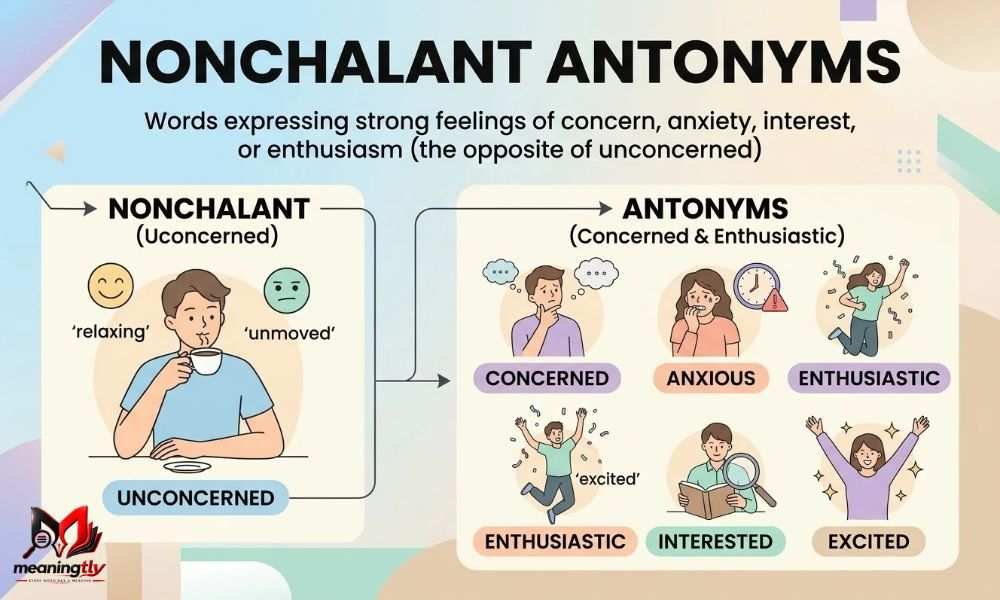
Antonyms are opposites. They show what nonchalant is not.
| Antonym | Meaning |
| Anxious | Worried and tense |
| Nervous | Jumpy and uneasy |
| Concerned | Caring and alert |
| Excited | Full of energy |
| Enthusiastic | Eager and keen |
| Passionate | Strongly emotional |
| Eager | Wanting something badly |
| Worried | Troubled by fear |
| Agitated | Restless and upset |
Example of the Opposite
“He felt anxious before the interview.” This is the opposite of a nonchalant mood.
Nonchalant vs Similar Words
Learners mix these words up. Let’s clear it up.
Nonchalant vs Indifferent
Indifferent means you truly do not care. Nonchalant means you seem not to care. The feeling may be hidden.
Nonchalant vs Calm
Calm is always positive. Nonchalant can be positive or negative. It depends on the situation.
Nonchalant vs Apathetic
Apathetic is stronger. It means no feeling or motivation at all. A nonchalant person may still care deeply.
Nonchalant vs Casual
Casual is about style or tone. Nonchalant is about attitude toward events or feelings.
Quick Comparison Table
| Word | Real feeling | Usually seen as |
| Nonchalant | Maybe hidden | Cool or careless |
| Indifferent | Truly none | Negative |
| Calm | Peaceful | Positive |
| Apathetic | No drive | Very negative |
| Casual | Relaxed style | Neutral |
Is Nonchalant Positive or Negative?
It can be both. This is the tricky part of the nonchalant meaning.
Positive Side
Being nonchalant can show:
- Confidence
- Calm under pressure
- Emotional control
- A relaxed mindset
Pilots, doctors, and leaders often need this trait.
Negative Side
It can also show:
- Lack of care
- Arrogance
- Disrespect
- Poor effort
Imagine a friend who shrugs at your bad news. That hurts.
Tone Decides Everything
Say “He was nonchalant under pressure.” That is praise. Say “He was nonchalant about my feelings.” That is a complaint.
Signs of a Nonchalant Person
How do you spot one? Look for these habits.
Body Language
- Slow, easy movements
- A casual shrug
- Relaxed posture
- Little visible stress
Speech Habits
- Short replies
- A flat or even tone
- Phrases like “Whatever works” or “No worries”
- Few emotional words
Behavior Patterns
- Stays steady in a crisis
- Does not chase drama
- Rarely shows excitement
- Does not rush decisions
Quick Checklist
- Do they stay calm when others panic?
- Do they downplay big news?
- Do they avoid showing strong feelings?
- Do they act like nothing matters?
If you said yes to most, you may be dealing with a nonchalant person.
Nonchalant Meaning in Dating
This is a very popular search. People ask what a nonchalant guy or girl really means.
What Is a Nonchalant Guy?
A nonchalant guy acts relaxed about everything. He may reply late. He may avoid big gestures. Some do this to look cool. Others are just laid-back.
What Is a Nonchalant Girl?
The same idea applies. She may seem unbothered. She does not chase or over-text. She keeps her cool.
Is It an Act?
Sometimes yes. Many people hide interest to avoid looking desperate. It is a form of playing it cool.
Others are genuinely relaxed. You cannot always tell from one text.
Pros in Relationships
- Less drama
- Calm arguments
- Healthy space
Cons in Relationships
- Mixed signals
- Emotional distance
- Feeling unimportant
What To Do
Talk openly. Ask, “How do you feel?” Clear words beat guesswork.
CLFS Meaning: Complete Definition, Uses & Texting Examples (2026)
Nonchalant Meaning on Instagram and Social Media
Online slang has changed how we use the word. The nonchalant meaning now appears on Instagram, TikTok, and X.
Social Media Slang
On these platforms, “nonchalant” often means someone who acts uninterested. It shows up in texting and dating talk.
Example: “He’s so nonchalant about my stories.” It means he does not react much.
The Rise of “Chalant”
Gen Z invented a fun term. If nonchalant means unbothered, then “chalant” means openly caring. A chalant person replies fast. They show interest. They say what they feel.
This trend rejects the old advice to always play it cool.
Common Social Phrases
- “Nonchalant energy”
- “Acting nonchalant”
- “Nonchalant vibes”
- “Nonchalant reply”
Is It a Compliment Online?
Sometimes. “Nonchalant aesthetic” can mean effortless style. But “nonchalant texter” is often a complaint.
Nonchalant in Fashion and Style
The word also appears in fashion. Here, it means effortless.
Effortless Look
A nonchalant outfit looks easy. It seems like no effort was made. Yet it still looks good.
Examples of Nonchalant Style
- A loose white shirt with jeans
- Slightly messy hair
- A worn leather jacket
- Simple sneakers
Why It Works
People admire it. It shows confidence without trying too hard.
Nonchalant in Literature and Movies

Writers love this word. It adds mood fast.
In Books
Authors use “nonchalant” to show a calm character. It often hides danger or secrets. A nonchalant villain feels scarier.
In Film
Think of spies and heroes. They walk away from explosions without looking back. That is nonchalant acting.
In Student Reading
School texts often use the adverb. Students search for “nonchalantly” when reading novels. It means in a casual, calm way.
How to Use Nonchalant Correctly
Using the word well takes practice. Follow these tips.
Tip 1: Match the Tone
Decide if you mean praise or criticism. Add clues like “calmly” or “coldly.”
Tip 2: Pair It With “About”
The common pattern is “nonchalant about something.” Example: “She was nonchalant about the delay.”
Tip 3: Use the Right Form
- Describing a person → nonchalant
- Describing an action → nonchalantly
- Naming the trait → nonchalance
Tip 4: Avoid Overuse
One use per paragraph is plenty. Too many make writing feel stiff.
Common Mistakes
| Mistake | Fix |
| “He is nonchalance.” | “He shows nonchalance.” |
| “She walked nonchalant.” | “She walked nonchalantly.” |
| “Nonchalant means angry.” | “Nonchalant means calm.” |
Common Phrases With Nonchalant
These collocations sound natural.
- A nonchalant attitude
- A nonchalant shrug
- A nonchalant manner
- A nonchalant tone
- A nonchalant glance
- Act nonchalant
- Seem nonchalant
- Remain nonchalant
- Nonchalant about the outcome
Example in Use
“She gave a nonchalant glance and walked on.”
Nonchalant Attitude Explained
What is a nonchalant attitude? It is a casual, relaxed, and unconcerned mindset.
Where It Comes From
Several things shape this attitude:
- Natural personality
- Strong self-confidence
- Past experience with stress
- Fear of showing weakness
- Cultural habits
Healthy Nonchalance
This is calm confidence. You do not overreact. You focus on what you can control.
Unhealthy Nonchalance
This means ignoring real problems. It can hurt work, school, and relationships.
Finding Balance
Care about what matters. Let small things go. That is the sweet spot.
Psychology Behind Being Nonchalant
Why do people act this way? Several reasons exist.
Emotional Regulation
Some people manage feelings well. They stay level even under stress.
Self-Protection
Others hide their feelings. Acting cool keeps them safe from rejection.
Social Image
Many want to look confident. Seeming relaxed helps them fit in.
Avoidant Habits
For some, it is avoidance. They dodge deep emotions. This may lead to distance in close bonds.
When To Seek Help
If indifference feels heavy or constant, talk to a counselor. It can signal deeper stress.
Benefits of Staying Nonchalant
In the right dose, it helps.
- Better focus: Less panic means clearer thinking.
- Lower stress: You waste less energy on small worries.
- Strong leadership: Calm leaders keep teams steady.
- Better decisions: You think before you react.
- Healthy boundaries: You do not take everything personally.
Risks of Too Much Nonchalance
Too much of a good thing backfires.
- Missed warnings: You may ignore real danger.
- Hurt feelings: Others may feel unimportant.
- Poor results: Low effort shows in work.
- Weak bonds: People want warmth.
- Lost chances: Looking uninterested can cost you.
How to Be More Nonchalant
Want a calmer, cooler attitude? Try these steps.
Step 1: Pause Before Reacting
Take one slow breath. Then respond.
Step 2: Sort Problems by Size
Ask yourself: “Will this matter in a year?” If not, relax.
Step 3: Practice Calm Body Language
Drop your shoulders. Slow your speech. Unclench your jaw.
Step 4: Limit Overthinking
Set a short time to worry. Then move on.
Step 5: Build Confidence
Prepare well. Preparation reduces fear.
Step 6: Stay Kind
Be calm, not cold. Show care where it counts.
How to Handle a Nonchalant Person
Sometimes you must deal with one. Here is how.
Do Not Take It Personally
Their style may have nothing to do with you.
Ask Direct Questions
Use clear words. “Are you okay with this plan?” works well.
Set Clear Expectations
Tell them what matters to you. Be calm and honest.
Give Them Space
Pressure often makes them pull away further.
Know Your Limits
If their attitude hurts you often, speak up. You deserve care.
Nonchalant Word History in Pop Culture
The word has grown beyond dictionaries. You will hear it in songs, memes, and chats.
Music and Media
People use it to describe artists with a cool stage presence. It signals effortless talent.
Memes
A famous meme shows someone calm in a burning room. That image sums up the nonchalant meaning perfectly.
Everyday Speech
Students, workers, and friends all use it. It is now part of normal English.
ASMR Meaning: Fascinating Facts You Should Know(2026)
Related Words to Learn
Build your vocabulary with these.
| Word | Meaning |
| Unflappable | Never easily upset |
| Phlegmatic | Calm and slow to react |
| Stoic | Enduring without complaint |
| Laid-back | Very relaxed |
| Imperturbable | Cannot be disturbed |
| Debonair | Charming and confident |
| Sangfroid | Calm in danger |
| Blithe | Cheerful and carefree |
Which One Is Closest?
“Insouciant” and “unflappable” come closest. Both describe an easy, calm manner.
Quick Practice Quiz
Test yourself. Answers are below.
- Which word means the opposite of nonchalant?
- A) Calm
- B) Anxious
- C) Casual
- Choose the adverb form.
- A) Nonchalance
- B) Nonchalantly
- C) Nonchalanted
- Fill in the blank: She shrugged _____ and walked away.
- A) nonchalantly
- B) nervously
- C) angrily
Answers: 1-B, 2-B, 3-A.
Quick Summary Table
| Feature | Detail |
| Word | Nonchalant |
| Type | Adjective |
| Meaning | Calm, relaxed, unconcerned |
| Origin | Old French nonchaloir |
| Adverb | Nonchalantly |
| Noun | Nonchalance |
| Synonyms | Calm, casual, cool, composed |
| Antonyms | Anxious, nervous, excited |
| Hindi/Urdu | Beparwah |
Conclusion
Being nonchalant means staying calm and relaxed. A nonchalant person does not show worry or stress. They act as if nothing bothers them. This can look cool and confident to others.
Sometimes, this attitude is helpful. It keeps us calm in hard moments. We do not panic over small things. We can think clearly and make better choices.
But there is another side to it. Too much nonchalance can look like not caring. People may think you are lazy or rude. Important things need real attention and effort. So we must know when to relax and when to care.
In the end, balance is the key. Stay calm, but do not ignore what matters. Care about people and your duties. Be relaxed, but never careless. That is the best way to use a nonchalant nature.
Frequently Asked Questions
What Is a Nonchalant Person?
A nonchalant person is someone who stays calm, relaxed, and doesn’t show much emotion or excitement.
Why Does Gen Z Say Nonchalant?
Gen Z uses the word nonchalant to describe someone who acts cool, unbothered, or emotionally unaffected.
Does Nonchalant Mean Lazy?
No, nonchalant doesn’t mean lazy; it means appearing calm, unconcerned, or not overly interested.
What Is a Nonchalant Boyfriend?
A nonchalant boyfriend is someone who seems emotionally distant, stays relaxed, and rarely shows excitement or affection.
Do Girls Like Nonchalant Guys?
Some girls like nonchalant guys because they seem confident and calm, while others prefer more expressive and caring partners.
What Is a Nonchalant Girlfriend?
A nonchalant girlfriend is someone who appears relaxed, shows fewer emotions, and doesn’t easily get bothered by things.

1 thought on “Nonchalant Meaning: Powerful Definition & Usage Guide (2026)”