
The word celibate is often misunderstood. Many people think it only means no sex. But the meaning is a little wider than that. Let us understand it in a simple way.
A celibate person chooses not to marry. Some also choose to stay away from sexual relations. This choice may last for a short time or for life. It is always a personal decision.
People choose celibacy for many reasons. Some do it because of religion or faith. Others do it to focus on work, study, or healing. Some just feel it suits their life.
Celibacy is not the same as abstinence. Abstinence is often a short-term act. Celibacy is usually a long-term life choice. Both deserve respect.
Celibate Meaning
Celibate Meaning in Simple Words

A celibate person does not take part in sexual activity. The choice can be short or lifelong. It can be personal or religious.
The word works in two ways. As an adjective, it describes a state. For example, “He lives a celibate life.”
As a noun, it names a person. For example, “Monks are often celibates.” Both uses are common in English.
The celibate meaning has changed over time. Long ago, it meant “unmarried.” Today, most people use it for someone who avoids sex by choice.
Quick Definition
Celibate: a person who chooses to abstain from sex, often for religious or personal reasons.
That one line is enough for a quick answer. The rest of this guide adds the details.
Key Points to Remember
- Celibacy is a choice, not a lack of chances.
- It can last weeks, years, or a whole life.
- It can be spiritual, personal, or practical.
- It does not mean a person hates love or romance.
Dictionary Definition of Celibate
Most dictionaries give two main senses. The first sense is about marriage. The second sense is about sex.
The older sense means “not married.” The newer sense means “not having sex.” Many writers now use the second sense most often.
| Part of Speech | Meaning | Example |
| Adjective | Abstaining from sex | A celibate priest |
| Noun | A person who abstains | The celibates lived together |
| Noun (celibacy) | The state of abstaining | Celibacy is a personal vow |
You can see the word has a few forms. The noun “celibacy” names the practice. The word “celibate” names the person or the state.
Common Synonyms
Some words come close in meaning. They are not always exact twins, though.
- Abstinent
- Chaste
- Continent
- Pure
- Unmarried (older sense)
Common Antonyms
- Sexually active
- Promiscuous
- Married (in the older sense)
Origin of the Word
The word comes from Latin. The Latin word caelebs meant “unmarried.” From it came caelibatus, the state of being unmarried.
English took the word in the 1600s. The suffix “-cy” was added to make “celibacy.” This is the same ending as in “efficiency.”
So the first celibate meaning had nothing to do with sex. It was only about marital status. Over many years, the sense moved toward abstaining from sex.
How the Meaning Shifted
Church life played a big part. Priests and monks stayed unmarried and did not have sex. People began to link the two ideas.
Today, the old link to marriage has faded. Many people even speak of a “celibate married couple.” That phrase would have sounded odd centuries ago.
Celibate Meaning in Hindi and Urdu
Many readers search for the Hindi or Urdu term. In Hindi, a close word is brahmachari (ब्रह्मचारी). In Urdu, people often use mujarrad for an unmarried person.
The match is not perfect. Each word carries its own culture and history. Still, the core idea of self-control is shared.
In Hindi thought, brahmacharya has a wide sense. It means discipline of mind, body, and speech. It also includes control over desire.
Why Translation Is Tricky
- English focuses on the act of abstaining from sex.
- Hindi terms often add moral and spiritual layers.
- Urdu terms may stress the unmarried state.
So when you translate, check the context. A single word may not fit every sentence.
Celibacy vs Abstinence vs Chastity
These words look alike. They are often mixed up. Each one has a slightly different focus.
| Term | Core Idea | Usually Lasts | Common Reason |
| Celibacy | Not having sex, often by vow or lifestyle | Long term or life | Religion, personal path |
| Abstinence | Not having sex for a set time | Short or medium term | Health, values, timing |
| Chastity | Moral purity in sexual conduct | Ongoing | Faith, ethics |
| Virginity | Never having had sex | A past fact | Not a choice by itself |
This table shows the main gap. Celibacy is usually a bigger life choice. Abstinence is often more temporary.
Celibacy vs Abstinence
Abstinence often has a goal in mind. A person may wait until marriage. Another person may pause after a breakup.
Celibacy tends to feel like a lifestyle. It can be a long-term identity. That is why the celibate meaning feels deeper to many people.
Celibacy vs Chastity
Chastity is a moral idea. A married person can be chaste. They stay faithful and respect their vows.
A celibate person does not have sex at all. So a married person can be chaste but not celibate. That difference helps explain the celibate meaning clearly.
Does Celibate Mean Virgin?

No, it does not. A virgin has never had sex. A celibate person may or may not have had sex before.
Someone can be sexually experienced and later choose celibacy. A widow, a divorced man, or a former partner can all make that choice.
Simple Example
Anna had a long relationship in her twenties. In her thirties, she chose to stay celibate for a few years. She is celibate, but she is not a virgin.
This shows why the two words are different. One is a past fact. The other is a present choice.
Celibate vs Asexual
These two words are also mixed up. They describe different things. One is about behavior. The other is about attraction.
Celibacy is a choice to avoid sex. Asexuality is a sexual orientation. An asexual person feels little or no sexual attraction.
| Feature | Celibate | Asexual |
| Type | Behavior or choice | Orientation |
| Desire | May feel desire | Feels little or none |
| Duration | Can change | Usually stable |
| Reason | Faith, goals, healing | Natural makeup |
So a person may feel desire and still choose celibacy. An asexual person may have sex or may not. Their orientation is not a vow.
Why the Difference Matters
Using the wrong word can hurt people. An asexual person is not “celibate by default.” Their identity is not a decision.
Respect starts with the right words. Understanding the celibate meaning helps you speak with care.
Types of Celibacy
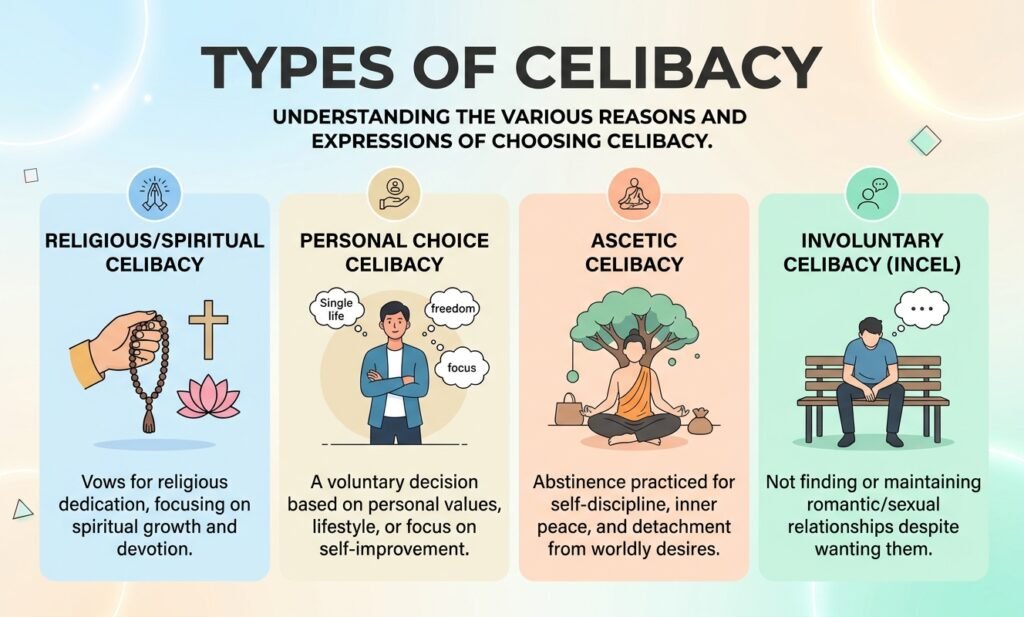
People practice celibacy in many ways. Experts and writers often group it into a few types. The names differ by source, but the ideas are similar.
Religious Celibacy
This is the most known type. Priests, monks, and nuns often take a vow. They give up sex to serve their faith.
Personal Celibacy
Here, a person chooses it for their own reasons. They may want focus, peace, or healing. No religion is needed.
Temporary Celibacy
Some people stay celibate for a set time. It may last a month, a season, or a year. After that, they may go back to normal life.
Situational Celibacy
Life can also push a person into it. Long distance, illness, or a lost partner can cause a break. This is less of a vow and more of a situation.
Quick Comparison
| Type | Who Chooses | Length |
| Religious | Clergy, monks, nuns | Often lifelong |
| Personal | Anyone | Flexible |
| Temporary | Anyone | Set period |
| Situational | Life events decide | Varies |
Celibacy in Religion
Faith is the biggest reason behind celibacy in history. Many traditions honor it. Each one has its own rules and reasons.
Christianity
In the Catholic Church, most priests in the Latin tradition stay celibate. They promise to give their life to service. Monks and nuns also take vows.
Other Christian groups differ. Eastern Orthodox churches allow married men to become priests. Many Protestant churches also allow married clergy.
Buddhism
Buddhist monks and nuns follow strict training rules. Celibacy is a core part of that path. It supports calm focus and less attachment.
Lay Buddhists have other guidelines. They are not expected to be celibate. Their rules ask for respect and responsible conduct.
Hinduism
Hindu thought has the idea of brahmacharya. It is one stage of life, often tied to study and discipline. It also applies to those who renounce worldly life.
Some sadhus and monks stay celibate for life. Others follow it for a set time, such as during fasting or study.
Jainism
Jain monks and nuns follow five great vows. One of them is brahmacharya, which means complete restraint. It is seen as a way to reduce attachment.
Islam
Islam generally does not promote monastic celibacy. Marriage is encouraged and respected. Still, Muslims are asked to avoid sex outside marriage.
So you may hear “abstinence” or “chastity” more than “celibacy” in this setting. The celibate meaning is less common in everyday Islamic talk.
Quick Religion Table
| Tradition | Who Practices | Main Idea |
| Catholic (Latin) | Priests, monks, nuns | Service to God |
| Buddhism | Monks, nuns | Less attachment |
| Hinduism | Sadhus, students | Self-control |
| Jainism | Monks, nuns | Full restraint |
| Islam | Not typical for clergy | Marriage is valued |
Why People Choose Celibacy
The reasons are many. No two stories are the same. Here are the most common ones.
Spiritual Growth
Some people feel closer to God or to inner peace. They see celibacy as a path to focus. It frees time and energy for prayer or study.
Personal Healing
A hard breakup can leave deep pain. Some people step back from sex to heal. They want to rebuild trust in themselves first.
Career and Goals
A busy life can leave little room for dating. A student, athlete, or founder may choose celibacy for focus. They put big goals first.
Clear Thinking
Some want to slow down and think about what they truly want. They stop casual encounters. They wait for a deeper bond.
Health and Safety
A few people avoid sex because of health concerns. Others fear risk or pregnancy. Their choice is about care for their body.
List of Common Reasons
- Faith and vows
- Healing after loss
- Career focus
- Self-discovery
- Health concerns
- Preparing for marriage
Celibate Meaning in a Relationship
Celibacy can exist inside a relationship too. Two partners may agree to pause sex. They may do it for a week, a month, or longer.
The goal is often deeper connection. Couples talk more. They share time in new ways. Trust can grow.
Why Couples Try It
- To rebuild emotional closeness
- To heal after a conflict
- To slow down and build trust
- To focus on communication
It works best when both partners agree. One person should never force the other. Open talk is key.
Tips for Couples
- Talk about the reason first.
- Set a clear time frame.
- Find other ways to show love.
- Check in often.
- End the plan if either partner feels hurt.
This shows another side of the celibate meaning. It is not always about being alone. It can also be a shared choice.
Benefits of Being Celibate
People report many positive effects. These are personal experiences, not guaranteed results. Each person feels it differently.
Possible Benefits
- More time for hobbies and goals
- Clearer focus at work or study
- Less stress about casual dating
- Better self-knowledge
- Stronger friendships
- A sense of calm and control
Emotional Growth
Many people say they learn patience. They notice their needs more clearly. They also practice self-respect.
Stronger Bonds
Without sex, other ties may grow. Friends, family, and community can feel closer. Emotional intimacy gets more space.
Challenges of Celibacy
Celibacy is not easy for everyone. It can bring hard moments. Being honest about this helps.
Common Struggles
- Loneliness at times
- Strong urges or desire
- Pressure from friends or family
- Social stigma or jokes
- Doubts about the choice
How to Cope
- Keep busy with healthy goals.
- Stay close to supportive people.
- Exercise and rest well.
- Write down your reasons.
- Talk to a counselor if you feel stuck.
When It May Be a Red Flag
Celibacy should not come from fear or shame. If you avoid closeness because of deep anxiety, talk to a professional. A therapist can help you sort out the reasons.
The healthiest celibacy is a free and clear choice. It should add peace to your life, not pain.
Common Myths About Celibacy
Many ideas about celibacy are wrong. Let us clear a few up.
Myth 1: Celibate People Are Cold
This is false. Celibate people can be warm, loving, and social. They just choose not to have sex.
Myth 2: Celibacy Means Never Marrying
In the old sense, yes. Today, the word usually points to sex, not marriage. A person can even be married and celibate.
Myth 3: It Is Only Religious
Not true. Many people choose it for personal reasons. Faith is only one path.
Myth 4: It Is Unhealthy
There is no proof that celibacy harms health by itself. Problems arise when it comes from pressure or distress. Choice makes the difference.
Myth 5: It Lasts Forever
Not always. Many people stay celibate for a season. Then they return to relationships.
How to Practice Celibacy
If you are curious, start with a plan. Be honest with yourself. Take it one step at a time.
Step-by-Step Guide
- Know your reason. Write it down.
- Set a time frame. Start with a month if unsure.
- Tell a trusted person. Support helps.
- Avoid triggers. Limit things that cause strong urges.
- Build new habits. Try sports, art, or reading.
- Review your progress. Adjust if needed.
Healthy Habits That Help
- Sleep well
- Eat balanced meals
- Move your body daily
- Practice mindfulness or prayer
- Spend time with friends
Be Kind to Yourself
You may slip or doubt. That is human. Do not judge yourself harshly.
Celibate in a Sentence
Examples help the celibate meaning stick. Here are some easy ones.
- The monk lived a celibate life for forty years.
- She decided to stay celibate while she focused on her career.
- They agreed to a celibate month to rebuild trust.
- Many priests take a vow to remain celibate.
- He was celibate after his divorce.
Notice how each sentence shows a choice. That is the heart of the word.
CLFS Meaning: Complete Definition, Uses & Texting Examples (2026)
Famous Ideas Around Celibacy
Throughout history, many thinkers praised self-control. Some saw it as a path to wisdom. Others saw it as a duty.
In modern times, the topic is more open. People discuss it in books, podcasts, and therapy rooms. The stigma is slowly fading.
Modern View
Today, many people view celibacy as one valid life path. It is not better or worse than other paths. It is simply a choice.
The modern celibate meaning is broader than before. It covers faith, health, healing, and personal goals.
Quick Summary Table
| Topic | Short Answer |
| Celibate meaning | Choosing not to have sex |
| Old meaning | Unmarried |
| Not the same as | Virgin or asexual |
| Common reasons | Faith, healing, focus |
| Can last | Weeks to a lifetime |
FAQs About Celibate Meaning
What is the meaning of celibate?
Celibate means choosing not to have sex, often for religious or personal reasons. Older usage also meant “unmarried.”
What does celibate mean in Hindi?
A close Hindi word is brahmachari (ब्रह्मचारी). It points to self-control and discipline.
Is celibate the same as virgin?
No. A virgin has never had sex, but a celibate person may have had sex before.
Can a married person be celibate?
Yes. A couple can agree to avoid sex while staying married.
What is the difference between celibate and abstinent?
Celibacy is usually a long-term lifestyle or vow. Abstinence is often a shorter, goal-based choice.
Conclusion
Celibate means a person chooses not to marry or not to have sexual relations. Many people think it is only a religious idea. But it is also a personal choice that some people make for their own reasons. It is different from being single by chance.
People become celibate for many reasons. Some follow their faith, like monks, nuns, and priests. Others choose it for self-control, focus, or peace of mind. Some take this path after a hard past or a life change.
Being celibate does not mean a person is weak or lonely. Many celibate people live full and happy lives. They give their time to work, study, service, or family. They find meaning in other parts of life.
In the end, celibacy is a choice, and every person has the right to make it. We should respect it, just like we respect other life choices. Understanding it helps us avoid wrong ideas. It is a simple word with a deep meaning.

1 thought on “Celibate Meaning: Best Definition, Uses & Examples (2026)”