
Scroll through any comment section today and you’ll likely spot the word “cap.” It shows up in texts, tweets, and TikTok captions everywhere. If you’re wondering what it actually means, you’re not alone. This guide breaks down the full cap slang meaning, where it came from, and how people use it in 2026.
By the end, you’ll understand every version of the cap slang meaning, from “no cap” to “stop capping,” and why it’s become such a staple of online language.
Meaning & Definition of Cap Slang 🧢
In modern slang, “cap” means a lie, an exaggeration, or a boastful claim. When someone says “that’s cap,” they’re calling out a statement as false. The cap slang meaning centers on dishonesty, whether it’s a small stretch of the truth or a full-blown lie.
“No cap” flips the meaning entirely. It signals sincerity, similar to saying “I swear” or “for real.” Together, these two phrases form one of the most recognizable slang pairs online today.
Secondary meanings
- Bragging or boasting — an older use tied to “talking big.”
- A verbal insult or put-down, from older African American slang traditions.
- A unit of time (roughly 20 minutes) in some casual chats.
- A literal headwear item, unrelated to the slang use.
What does cap stand for
Cap doesn’t stand for an acronym. It’s a standalone slang word, not shorthand for a phrase. The cap slang meaning comes from cultural usage, not letter-by-letter meaning. People sometimes assume it’s an abbreviation, but it isn’t.
Stop the cap meaning
“Stop the cap” is a direct way of telling someone to stop lying or exaggerating. It’s a firmer version of just saying “cap.” People use it when a claim feels obviously untrue or over the top.
Background & Origin of Cap Slang 📜
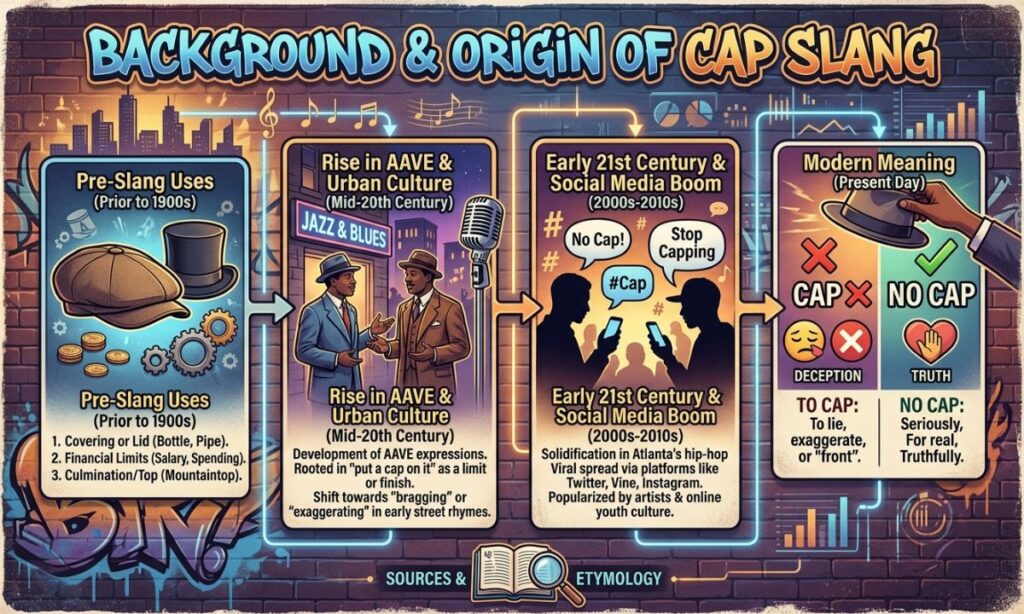
The cap slang meaning traces back to African American Vernacular English (AAVE). Early uses of “capping” referred to boasting, bragging, or “talking big” about oneself. Over decades, the word shifted toward describing outright lies.
Hip-hop culture played a major role in spreading the term. <cite index=”22-1″>Artists such as Future and Young Thug helped popularize the phrase in the 2010s.</cite> From there, it moved into everyday youth slang and eventually mainstream pop culture.
Word historians have also traced older, unrelated uses of “cap” tied to insults and verbal sparring. <cite index=”24-1″>Reference works have documented “cap” as meaning to verbally put someone down or censure them in earlier African American slang traditions.</cite> This shows the word has evolved multiple times before landing on today’s common usage.
By the late 2010s and early 2020s, “cap” and “no cap” exploded across social media. Memes, comment sections, and short-form video content helped cement the modern cap slang meaning into everyday internet language.
Usage in Different Contexts 💬
The cap slang meaning shifts slightly depending on where and how it’s used. Below are the most common real-world contexts.
Chat conversations
In texting, “cap” is used quickly to challenge a statement. A friend might text “I ran a mile in 4 minutes” and get the reply “cap.” It’s short, casual, and instantly understood.
Social media posts
On social platforms, people add “no cap” to captions for extra emphasis. It signals that a post, opinion, or claim is completely genuine, not exaggerated for likes.
Arguments or debates
During disagreements, “cap” becomes a callout tool. Saying “that’s cap” pushes back on someone’s argument without needing a long explanation. It’s blunt but effective.
Friendly teasing
Among friends, “cap” is often light-hearted. It’s used jokingly when someone brags a little too much, turning the moment into playful banter rather than a real accusation.
Meanings Across Platforms 📱
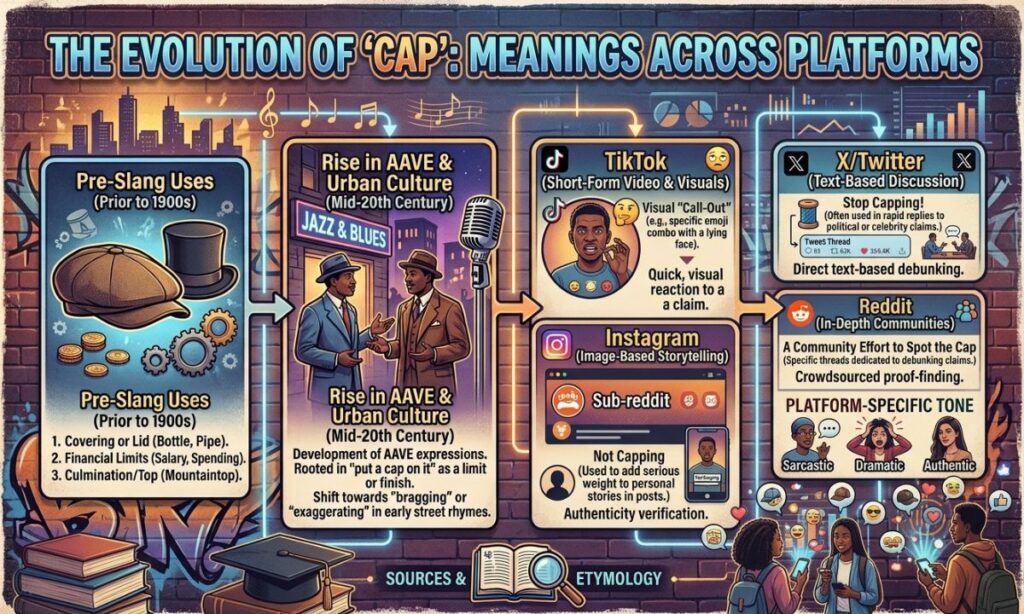
The cap slang meaning stays consistent across apps, but the tone and frequency change depending on the platform.
| Platform | Common Usage | Typical Tone |
| Used in casual group chats to call out exaggerated stories | Playful, informal | |
| Common in comments and captions with “no cap” | Confident, expressive | |
| TikTok | Frequently used in video captions and duets | Trend-driven, humorous |
| Snapchat | Used in quick chats and story replies | Fast, casual |
WhatsApp users often use “cap” within group chats when friends share unbelievable stories. It keeps conversations fun and lighthearted.
On Instagram, “no cap” frequently appears in captions to add authenticity to a photo or statement, especially opinion-based posts.
TikTok
TikTok has heavily driven the modern cap slang meaning, with creators using “no cap” to emphasize honesty in reviews, reactions, and storytimes.
Snapchat
Snapchat’s fast, casual messaging style makes “cap” a natural fit for quick call-outs during everyday conversations between friends.
Other Fields & Technical Meanings 🎯
Outside of slang, “cap” appears in several unrelated contexts. In finance, a “salary cap” or “price cap” refers to a maximum limit. In sports, teams operate under a “cap” that limits total spending on players.
In fashion and everyday language, “cap” simply refers to headwear. None of these meanings connect to the slang version, but context always makes the intended meaning clear.
Common Misconceptions & Mistakes ⚠️
Many people confuse the different meanings of cap, leading to mixed messages. Here are common mistakes to avoid.
- Assuming “cap” always means clothing instead of slang.
- Using “no cap” sarcastically, which can confuse the listener.
- Thinking “cap” is a brand-new word instead of an evolved AAVE term.
- Believing “cap” only relates to obvious lies, when it’s also used for playful exaggeration.
- Overusing the phrase, which can weaken its impact in serious conversations.
Similar Terms & Alternatives 🔍
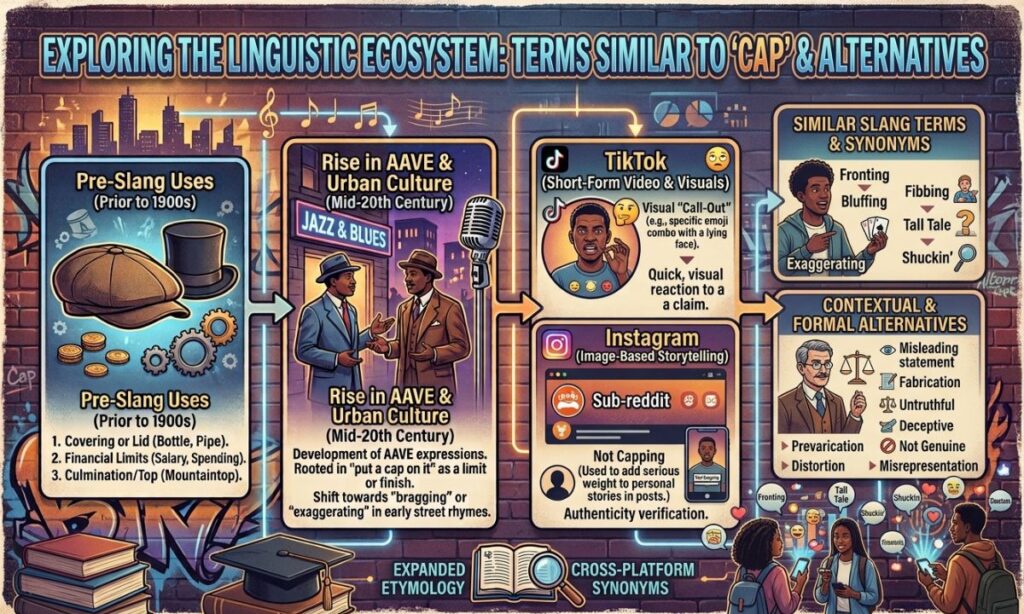
Understanding the cap slang meaning is easier when compared with related terms and questions people frequently search for.
Cap meaning slang origin
The origin blends older AAVE expressions about boasting with newer 2010s hip-hop slang describing lies. Both threads combined to shape today’s meaning.
Cap slang meaning urban dictionary
Crowd-sourced definitions online generally agree that cap refers to a lie or exaggeration, though some older entries list unrelated slang meanings tied to different contexts. <cite index=”21-1″>One entry defines cap simply as a lie or untruthful statement.</cite>
I had a cap meaning
This phrase usually refers to reaching a personal or situational limit, similar to saying “I hit my cap.” It’s unrelated to the lying slang and instead ties back to the “limit” meaning of cap.
Why does cap mean lie
Cap likely evolved from “capping,” an older term for boasting or exaggerating claims. Over time, bragging blurred into outright lying, and the shortened word “cap” stuck.
Synonyms cap
- Lie
- Fib
- Exaggeration
- BS
- Tall tale
How to Respond to “Cap” in Chat 💡
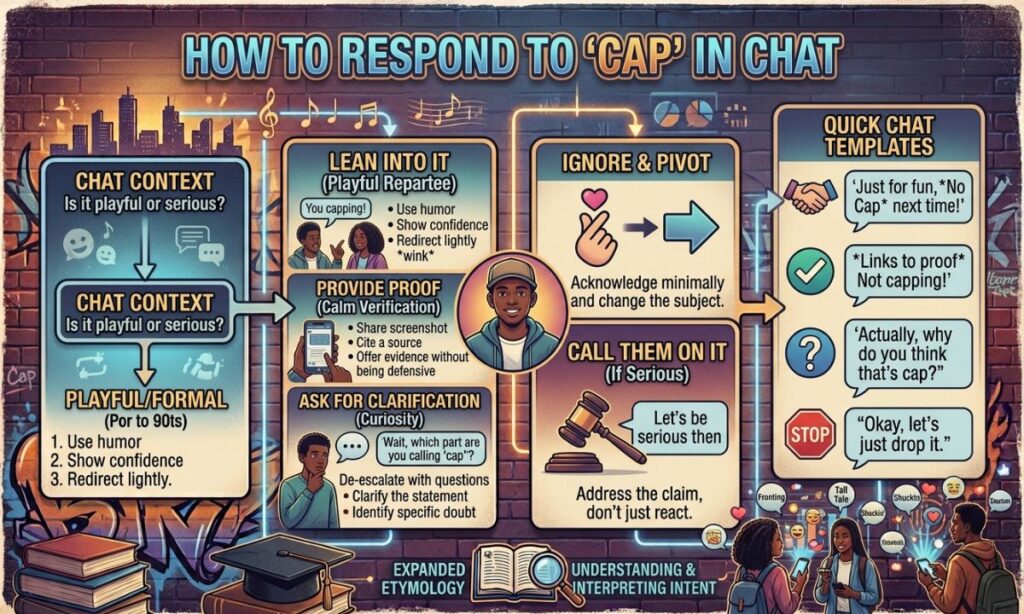
When someone calls “cap” on you, there are a few natural ways to respond depending on the situation.
- Defend your statement if it’s true: “No cap, I swear it happened.”
- Laugh it off if it was a joke: “Okay, maybe a little cap.”
- Double down playfully: “Deadass, no cap at all.”
- Ask for proof: “Watch, I’ll show you.”
Examples
- Friend: “I met a celebrity yesterday.” Reply: “Cap.”
- Friend: “No cap, I actually did.”
- Text: “This burger is the best in the city, no cap.”
- Comment: “Bro that story is major cap.”
Differences From Similar Words 📊
The cap slang meaning is often confused with related slang terms. Here’s a quick comparison.
| Term | Meaning | Example Use |
| Cap | A lie or exaggeration | “That’s cap.” |
| No cap | Genuine truth | “No cap, it happened.” |
| Facts | Agreement with a true statement | “Facts, that’s real.” |
| Deadass | Serious emphasis | “Deadass, I’m not joking.” |
| Sus | Suspicious behavior | “That story sounds sus.” |
Relevance in Online Conversations & Dating Apps 💌
On dating apps, “no cap” is often used to signal honesty in a bio or message, especially when discussing intentions or interests. It helps build quick trust in short, casual exchanges.
The cap slang meaning also shows up when people question exaggerated dating profiles. A match claiming an unbelievable job or lifestyle might get called out with a simple “cap” in the chat.
Popularity & Trends Over Time 📈
The cap slang meaning has grown steadily since its rise in hip-hop culture. The table below shows a simplified timeline of its journey into mainstream use.
| Period | Trend |
| Pre-2010s | Used mainly within AAVE and hip-hop circles |
| 2010s | Popularized through mainstream hip-hop lyrics |
| 2018–2022 | Rapid growth across TikTok, Instagram, and Twitter |
| 2023–2026 | Fully mainstream, used across all age groups online |
Search interest and everyday usage suggest the cap slang meaning isn’t fading anytime soon. It has become a lasting part of digital communication rather than a short-lived trend.
Conclusion 🌟
The cap slang meaning has come a long way from its roots in AAVE and hip-hop culture. Today, it’s a simple, effective way to call out lies or emphasize honesty online. Whether you’re texting friends or scrolling social media, understanding this slang helps you keep up with modern conversation. Now that you know the full cap slang meaning, you’ll never misread “no cap” again.
Frequently Asked Questions
What does cap mean in slang?
Cap means a lie or exaggeration, often used to call out an untrue statement.
What does no cap mean?
No cap means someone is being completely honest and not exaggerating.
Where did cap slang come from?
It originated in African American Vernacular English and spread through hip-hop culture.
Is cap only used by teens?
No, while it started with younger users, people across many age groups use it now.
What’s the difference between cap and facts?
Cap points out a lie, while facts confirm agreement with something true.
Does cap mean the same thing everywhere online?
Yes, its core meaning stays consistent across platforms like TikTok, Instagram, and Snapchat.
Can cap be used in a friendly way?
Yes, it’s often used playfully among friends without any real offense intended.
Is cap slang still popular in 2026?
Yes, it remains widely used and shows no signs of disappearing from everyday language.
