KPI meaning is a short form of Key Performance Indicator. It is a number that shows progress. Companies use it to check how they are doing. It tells you if you are on track. Every goal needs a clear measure.
A KPI turns a big goal into a simple figure. For example, a shop may track monthly sales. A school may track student pass rates. A website may track daily visitors. The number shows what is working.
Good KPIs are clear and easy to measure. They match the main goal of the team. They have a time limit too. Too many KPIs can cause confusion. Pick only the ones that truly matter.
KPIs help people make better decisions. They show strengths and weak points. Teams can fix problems early. Workers know what is expected of them. Success becomes easy to see.
KPI Meaning
KPI Meaning in Simple Words
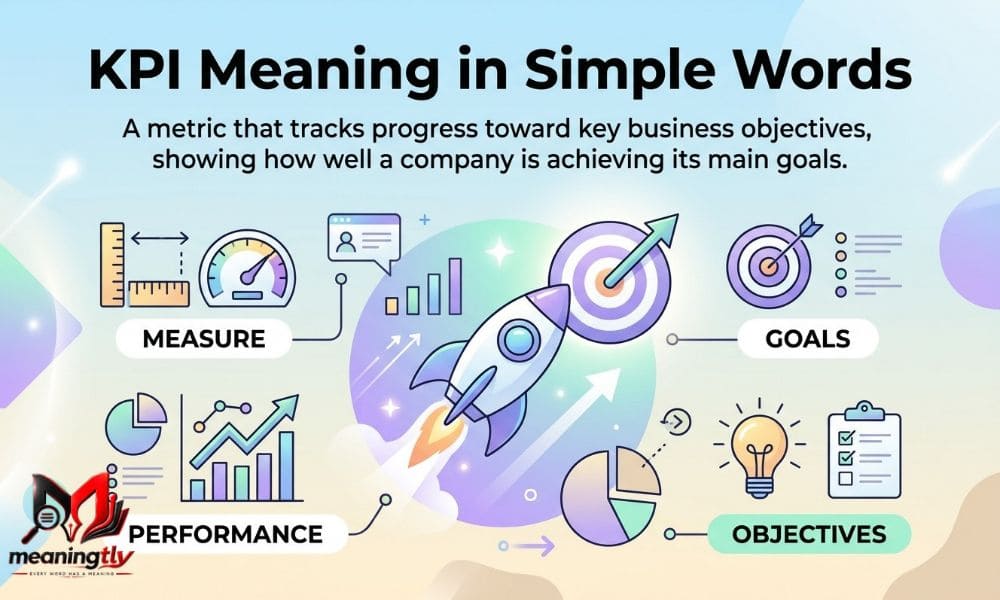
A KPI meaning is a measurable value. It shows progress toward an important goal.
Think of a car dashboard. The speedometer shows your speed. The fuel gauge shows how far you can go. KPIs do the same job for a team or a business.
The KPI meaning has three parts:
- Key: It matters a lot.
- Performance: It tracks real results.
- Indicator: It gives a clear signal.
Not every number is a KPI. Only numbers tied to a main goal earn that label.
Quick definition: A KPI is a measurable value that shows how well a person, team or company is reaching a key goal.
KPI Full Form
The KPI full form is Key Performance Indicator.
You may also see these related terms:
- KPIs: The plural form.
- Performance indicator: A looser term for any performance number.
- Key result indicator (KRI): A number that shows the final outcome.
Most people use KPI and key performance indicator as the same thing. That is fine for daily work.
Why KPIs Matter
KPIs turn big goals into small, clear signals. They answer one question: are we on track?
Here is why they matter:
- Clear focus: Everyone knows what counts.
- Better decisions: Data beats gut feeling.
- Early warnings: You spot problems before they grow.
- Team alignment: Daily work links to the bigger plan.
- Fair reviews: Results are easy to compare.
- Steady growth: You can test, learn and improve.
Without KPIs, teams work in the dark. They may feel busy but miss the goal.
What KPIs Do for You
A good KPI does more than show a number. It guides action.
Here is how KPIs help in real life:
- They set a target everyone can see.
- They show progress over time.
- They highlight what is working.
- They expose what is broken.
- They help you share results with leaders.
Use KPIs as a compass. They point you in the right direction.
KPI vs Metric
Many people mix these two terms. The KPI meaning is narrower than the meaning of a metric.
A metric is any number you can track. A KPI meaning is a metric tied to a key goal.
Simple rule: Every KPI is a metric. Not every metric is a KPI.
| Point | Metric | KPI |
| Meaning | Any measurable number | A number tied to a key goal |
| Scope | Wide | Narrow |
| Link to goals | Optional | Required |
| Number to track | Many | Few |
| Example | Page views | Monthly sales from the website |
| Use | Day-to-day tracking | Strategic decisions |
Here is an example. Your site gets 50,000 visits. That is a metric. Your goal is more sales. So you track the visitor-to-buyer rate. That is a KPI.
KPI vs Target
A KPI is the thing you measure. A target is the value you want to hit.
For example, “customer satisfaction score” is the KPI. “90 percent by December” is the target.
Always pair a KPI with a target. Without one, a number has no meaning.
Traits of a Good KPI
Not all KPIs are useful. Strong ones share a few traits.
A good KPI is:
- Clear: Anyone can understand it.
- Measurable: It uses real data.
- Relevant: It links to a main goal.
- Actionable: Your team can move it.
- Timely: You can check it often.
- Owned: One person is in charge.
- Comparable: You can compare it to past results.
If a KPI fails these tests, drop it or rewrite it.
SMART KPIs
Many teams use the SMART method. It makes a KPI sharper.
SMART stands for specific, measurable, achievable, relevant and time-bound.
| Letter | Meaning | Question to ask |
| S | Specific | What exactly are we measuring? |
| M | Measurable | Which number proves progress? |
| A | Achievable | Can we really hit it? |
| R | Relevant | Does it support our main goal? |
| T | Time-bound | By when? |
Weak KPI: Get more leads.
SMART KPI: Raise qualified leads from 200 to 300 per month by June.
The second version leaves no doubt. Everyone knows the aim and the deadline.
Types of KPIs
KPIs come in many forms. You can group them in a few ways.
Each type answers a different need. Pick the mix that fits your goal.
Strategic KPIs
Strategic KPIs track big, long-term goals. Leaders use them.
Examples include revenue growth, market share and return on investment. They look at the whole company.
Operational KPIs
Operational KPIs track daily or weekly work. Managers use them.
Examples include order fulfillment time, defect rate and support tickets closed. They show how smoothly work flows.
Functional KPIs
Functional KPIs belong to one department. Think sales, finance, HR or IT.
Each team picks KPI meaning that match its own role. Yet all of them should support the company goal.
Leading KPIs
Leading KPIs predict future results. They show what is likely to happen.
For example, the number of sales calls made this week can predict next month’s sales. You can act on them early.
Lagging KPIs
Lagging KPIs show past results. They confirm what already happened.
Monthly revenue and annual profit are lagging KPIs. They are accurate but arrive late.
Quantitative KPIs
Quantitative KPIs use hard numbers. Think revenue, units sold or hours saved.
They are easy to compare and chart.
Qualitative KPIs
Qualitative KPIs capture opinions and quality. Think customer feedback or employee morale.
You often convert them into scores. A satisfaction survey is a good example.
KPI Types at a Glance
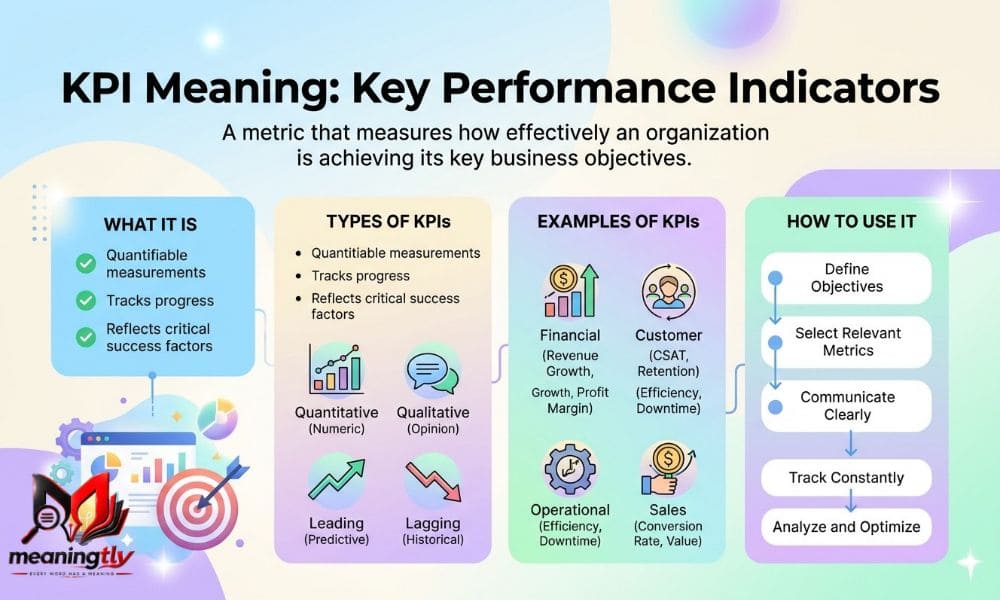
This table sums up the main types.
| Type | What it shows | Example |
| Strategic | Long-term goals | Market share |
| Operational | Daily performance | Order cycle time |
| Functional | Department results | Cost per hire |
| Leading | Future outcomes | Demos booked |
| Lagging | Past outcomes | Quarterly revenue |
| Quantitative | Hard numbers | Units sold |
| Qualitative | Opinions and quality | Customer feedback |
Leading vs Lagging KPIs
This pair confuses many people. Here is an easy way to remember it.
A leading KPI meaning is like a weather forecast. A lagging KPI is like yesterday’s weather report.
Use both together. Leading KPIs help you steer. Lagging KPIs prove the result.
| Feature | Leading KPI | Lagging KPI |
| Time focus | Future | Past |
| Speed | Fast feedback | Slow feedback |
| Control | Easy to influence | Hard to change |
| Example | Trial sign-ups | Yearly revenue |
KPI Examples by Team
The KPI meaning becomes clearer with real examples. Here are common picks by team.
Sales KPIs
Sales teams track deals and revenue.
- Monthly sales revenue: Total money earned in a month.
- Conversion rate: Share of leads who buy.
- Average deal size: Mean value of each closed deal.
- Sales cycle length: Days from first contact to close.
- Win rate: Share of deals you win.
- Quota attainment: Percent of target reached.
Marketing KPIs
Marketing teams track reach and results.
- Website traffic: Visits to your site.
- Cost per lead (CPL): Spend divided by leads.
- Customer acquisition cost (CAC): Cost to win one customer.
- Click-through rate (CTR): Clicks divided by views.
- Return on ad spend (ROAS): Revenue per dollar of ads.
- Email open rate: Share of emails opened.
Finance KPIs
Finance teams track money health.
- Gross profit margin: Profit left after direct costs.
- Net profit margin: Profit left after all costs.
- Operating cash flow: Cash from daily operations.
- Burn rate: Cash spent each month.
- Budget variance: Gap between plan and actual spend.
- Return on investment (ROI): Gain compared to cost.
HR KPIs
HR teams track people and culture.
- Employee turnover rate: Share of staff who leave.
- Time to hire: Days to fill a role.
- Cost per hire: Money spent to hire one person.
- Employee satisfaction score: How happy staff feel.
- Absenteeism rate: Share of days missed.
- Training completion rate: Share who finish courses.
Customer Support KPIs
Support teams track service quality.
- First response time: Time to the first reply.
- Resolution time: Time to fix an issue.
- Customer satisfaction (CSAT): Rating after a support chat.
- Net promoter score (NPS): Chance a customer will recommend you.
- First contact resolution: Issues solved in one touch.
- Ticket backlog: Open tickets waiting.
Operations KPIs
Operations teams track speed and quality.
- On-time delivery rate: Orders shipped on schedule.
- Defect rate: Share of faulty products.
- Inventory turnover: How fast stock sells.
- Capacity utilization: Share of capacity in use.
- Order accuracy: Orders filled without errors.
- Cost per unit: Spend to make one item.
Project KPIs
Project teams track delivery.
- Schedule variance: Gap between plan and actual dates.
- Cost variance: Gap between budget and actual cost.
- Milestones met: Share of goals hit on time.
- Scope changes: Number of added requests.
- Team velocity: Work done per sprint.
- Stakeholder satisfaction: Client or sponsor happiness.
IT and Software KPIs
Tech teams track reliability and speed.
- System uptime: Share of time a system runs.
- Mean time to repair (MTTR): Average time to fix a failure.
- Bug count: Open defects.
- Deployment frequency: How often you release.
- Page load time: Seconds a page takes to load.
- Incident count: Number of outages.
E-commerce KPIs
Online stores track shopping habits.
- Conversion rate: Visitors who buy.
- Cart abandonment rate: Shoppers who leave before paying.
- Average order value (AOV): Mean spend per order.
- Customer lifetime value (CLV): Total value of a customer.
- Repeat purchase rate: Buyers who return.
- Return rate: Orders sent back.
Healthcare KPIs
Healthcare teams track care quality.
- Patient wait time: Minutes before care starts.
- Readmission rate: Patients who return soon after discharge.
- Bed occupancy rate: Share of beds in use.
- Patient satisfaction score: Feedback on care.
- Appointment no-show rate: Missed visits.
- Staff-to-patient ratio: Care workers per patient.
SaaS KPIs
Software firms sell subscriptions. They watch recurring money.
- Monthly recurring revenue (MRR): Predictable income each month.
- Annual recurring revenue (ARR): MRR over a year.
- Churn rate: Customers who cancel.
- Trial-to-paid rate: Free users who start paying.
- Customer lifetime value to CAC ratio: Value earned per dollar spent to win a customer.
- Net revenue retention: Revenue kept and grown from existing customers.
Education KPIs
Schools and training firms track learning and reach.
- Graduation rate: Students who finish a program.
- Course completion rate: Learners who reach the end.
- Student retention rate: Students who stay enrolled.
- Average test score: Mean result on exams.
- Student-to-teacher ratio: Learners per teacher.
- Enrollment growth: Rise in new students.
Hospitality KPIs
Hotels and restaurants track guest experience.
- Occupancy rate: Rooms filled.
- Average daily rate (ADR): Mean room price.
- Revenue per available room (RevPAR): Revenue for each room on offer.
- Guest satisfaction score: Review ratings.
- Table turnover rate: How fast tables refill.
- Food cost percentage: Food cost compared to sales.
Social Media KPIs
Social teams track reach and response.
- Follower growth: New followers over time.
- Engagement rate: Likes, comments and shares per post.
- Reach: Unique people who see a post.
- Click-through rate: Clicks on your links.
- Share of voice: Your brand mentions versus rivals.
- Social conversions: Sales or sign-ups from social posts.
SEO KPIs
Search teams track visibility and traffic.
- Organic traffic: Visits from search engines.
- Keyword rankings: Your position for target terms.
- Click-through rate in search: Clicks per impression.
- Backlinks: Links from other sites.
- Bounce rate: Visitors who leave fast.
- Organic conversions: Goals met by search visitors.
Common KPI Formulas
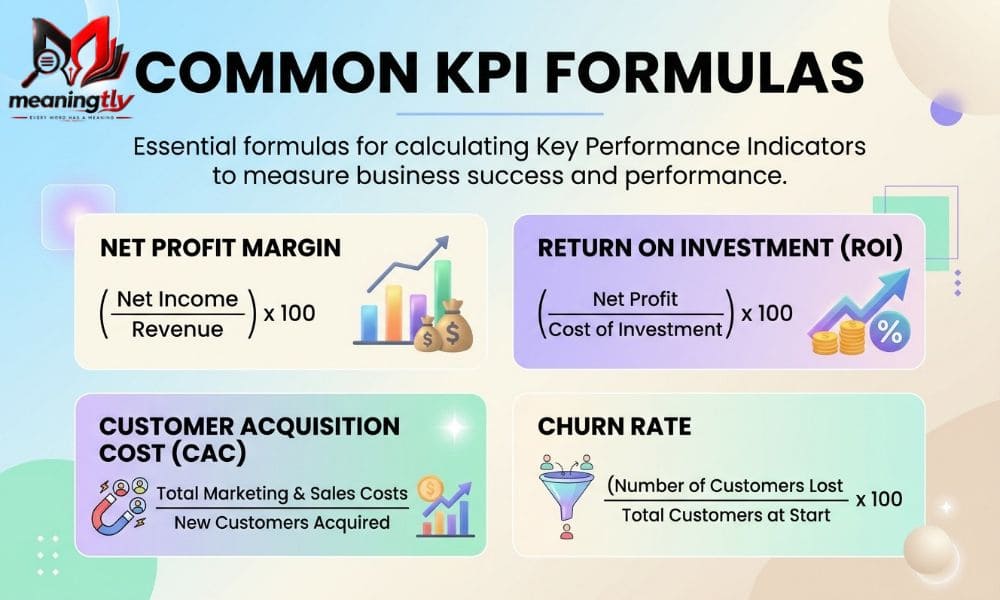
Some KPIs need a formula. Here are popular ones.
| KPI | Formula |
| Conversion rate | (Conversions ÷ Visitors) × 100 |
| Customer acquisition cost | Sales and marketing cost ÷ New customers |
| Churn rate | (Customers lost ÷ Customers at start) × 100 |
| Gross profit margin | ((Revenue − Cost of goods sold) ÷ Revenue) × 100 |
| ROI | (Net profit ÷ Cost of investment) × 100 |
| Net promoter score | % Promoters − % Detractors |
| Employee turnover rate | (Employees who left ÷ Average employees) × 100 |
| On-time delivery rate | (On-time orders ÷ Total orders) × 100 |
| System uptime | ((Total time − Downtime) ÷ Total time) × 100 |
| Average order value | Total revenue ÷ Number of orders |
Always use the same formula each period. That keeps your data fair.
KPI Meaning at Work
At work, you may hear KPI meaning in reviews. Managers use them to judge results.
In a job, the KPI meaning is simple. It is a measure of how well you do your role.
A KPI meaning for a person should be:
- Within their control.
- Linked to team goals.
- Agreed on in advance.
- Reviewed on a set date.
Here are sample KPIs by job role:
| Role | Sample KPI |
| Sales rep | Monthly quota attainment |
| Content writer | Articles published per month |
| Customer agent | First contact resolution rate |
| Recruiter | Time to fill a role |
| Developer | Bugs fixed per sprint |
| Accountant | Invoice processing time |
| Store manager | Sales per square foot |
Use KPIs to coach, not to punish. People do better when targets feel fair.
KPI Pros and Cons
KPIs bring big gains. They also carry some risks.
Pros of KPIs
- They make goals clear.
- They support smart choices.
- They improve teamwork.
- They show trends fast.
- They make reviews fairer.
Cons of KPIs
- They can push short-term thinking.
- They can miss soft factors like culture.
- They may encourage gaming.
- They need clean data.
- They take time to set up.
Balance is key. Pair numbers with context and good judgment.
How to Pick KPIs by Goal
Your goal decides your KPIs. This table gives a quick guide.
| Goal | Good KPIs to track |
| Grow revenue | Sales revenue, conversion rate, average deal size |
| Cut costs | Cost per unit, budget variance, waste rate |
| Keep customers | Churn rate, NPS, repeat purchase rate |
| Win new customers | CAC, leads, trial sign-ups |
| Improve quality | Defect rate, return rate, error count |
| Boost speed | Cycle time, resolution time, delivery time |
| Build a strong team | Turnover rate, satisfaction score, training completion |
Pick the goal first. Then pick the KPIs.
How to Set KPIs
Setting KPI meaning takes thought. Follow these steps.
- Define your goal. Start with a clear business aim.
- Find the drivers. Ask what moves that goal.
- Pick a few KPIs. Choose three to seven per goal.
- Make them SMART. Add a target and a deadline.
- Assign owners. Give each KPI one person in charge.
- Choose data sources. Decide where the numbers come from.
- Set a review rhythm. Check weekly, monthly or quarterly.
- Share the results. Make them visible to the team.
- Review and adjust. Drop or change KPIs that stop helping.
Keep the list short. Too many KPIs create noise.
A Quick Example
Say you run an online shop. Your goal is to grow sales by 20 percent this year.
Here is a simple KPI meaning set:
- Conversion rate: From 2 percent to 3 percent.
- Average order value: From $40 to $48.
- Repeat purchase rate: From 15 percent to 22 percent.
- Cart abandonment rate: From 75 percent to 65 percent.
Each KPI links to the goal. Each has a target. Each is easy to track.
What Is a KPI Dashboard?
A KPI meaning dashboard is a single screen with your key numbers. It uses charts, gauges and tables.
It saves time. You see the whole picture in seconds.
A good dashboard:
- Shows only key KPIs.
- Uses simple charts.
- Updates on a set schedule.
- Uses colors for status, like green, yellow and red.
- Shows targets next to actuals.
- Lets users filter by time or team.
Popular tools include Google Looker Studio, Microsoft Power BI, Tableau and Excel. Even a simple spreadsheet works for small teams.
KPI Meaning Reporting Tips
Reports turn data into action. Keep them short and useful.
- Lead with the headline. State the main result first.
- Compare to targets. Show the gap.
- Add trends. Show change over time.
- Explain causes. Say why numbers moved.
- End with actions. List the next steps.
Aim for one page. Busy readers will thank you.
ISK Meaning Guide: Full Definition, Usage, Contexts & Examples (2026)
KPI Meaning in Marketing
In marketing, the KPI meaning ties to growth and cost. A KPI shows whether your campaigns pay off.
Marketers often track a funnel. Each stage has its own KPI.
| Funnel stage | Goal | Sample KPI |
| Awareness | Get seen | Impressions, reach |
| Interest | Earn clicks | Click-through rate |
| Consideration | Capture leads | Cost per lead |
| Decision | Win the sale | Conversion rate |
| Loyalty | Keep customers | Repeat purchase rate |
Track one or two KPIs per stage. That gives you a full view without the clutter.
KPI Meaning in Project Management
In projects, the KPI meaning centers on time, cost and quality. A KPI tells you if the project is healthy.
Project managers often watch three things:
- Time: Are we on schedule?
- Cost: Are we on budget?
- Quality: Does the work meet the standard?
A red status on any of these is an early warning. Act fast and adjust the plan.
A Real-Life KPI Story
Picture a small café. The owner wants more profit.
She tracks three KPI meaning for one quarter:
- Average order value: $6.50 at the start.
- Food waste percentage: 12 percent at the start.
- Customer return rate: 30 percent at the start.
She adds a combo deal and a loyalty card. She also trims the menu to cut waste.
After three months, order value hits $7.80. Waste drops to 7 percent. Return rate climbs to 41 percent.
The numbers prove the changes worked. That is the power of a KPI.
KPI Myths
Some beliefs about KPIs are wrong. Let’s clear them up.
- Myth: More KPIs mean better control. Truth: Fewer, sharper KPIs work better.
- Myth: KPIs are only for big firms. Truth: Small teams gain just as much.
- Myth: A KPI is just a number. Truth: A KPI is a number with a goal, a target and an owner.
- Myth: You set KPIs once. Truth: You review and update them often.
- Myth: Every metric deserves a KPI label. Truth: Only goal-linked metrics qualify.
Common KPI Mistakes
Even strong teams slip up. Avoid these traps.
- Too many KPI meaning. Focus gets lost.
- No clear goal. Numbers float without meaning.
- Vanity metrics. Likes and views look nice but may not drive results.
- Bad data. Wrong inputs lead to wrong calls.
- No owner. Nobody acts on the numbers.
- Never reviewing. Old KPIs go stale.
- Ignoring context. Seasons and market shifts affect results.
- Gaming the system. People chase the number, not the goal.
Fix these early. Your KPIs will stay useful.
KPI vs OKR vs KRA
These three terms sound alike. They serve different roles.
| Term | Full form | Purpose | Example |
| KPI | Key performance indicator | Track ongoing performance | Monthly churn rate |
| OKR | Objectives and key results | Set bold goals and measure progress | Objective: Delight customers. Key result: Raise NPS to 60 |
| KRA | Key result area | Define the main areas of a role | Customer service |
KPIs measure health. OKRs push change. KRAs define the role.
Many teams use all three together.
Tips for Better KPIs
Use these habits to get more from your KPIs.
- Start small. Add more later.
- Tie every KPI to a goal.
- Mix leading and lagging KPIs.
- Keep names simple.
- Write each formula down.
- Use the same data source each time.
- Celebrate wins. Learn from misses.
- Review KPIs at least once a year.
Good KPIs evolve. Your goals will change, so your KPIs should too.
KPIs for Small Business
Small firms have small teams. Keep your KPI list tiny.
Start with these five:
- Monthly revenue: Is money coming in?
- Profit margin: Are you keeping enough of it?
- Customer acquisition cost: Is growth affordable?
- Customer retention rate: Do people come back?
- Cash on hand: Can you pay your bills?
Track them in a simple sheet. Review them every week.
Best Tools for KPIs
You do not need fancy software. Start simple and upgrade later.
| Tool | Best for | Cost level |
| Google Sheets | Small teams and quick tracking | Free |
| Microsoft Excel | Custom calculations | Paid |
| Looker Studio | Marketing dashboards | Free |
| Power BI | Company-wide reports | Low to mid |
| Tableau | Advanced visuals | Mid to high |
| Klipfolio | Live KPI dashboards | Mid |
Choose a tool your team will actually use.
KPI Review Checklist
Run this check every quarter. It keeps your KPIs healthy.
- Does each KPI link to a current goal?
- Is the target still fair?
- Is the data still accurate?
- Does one person own each KPI?
- Do we act on the numbers?
- Are any KPIs now useless?
- Do we need a new KPI?
Drop what no longer helps. Add what you need.
ICL Text Meaning: What It Really Means in Texting
Quick Recap
Here is a fast summary of everything above.
- A KPI is a measurable value tied to a key goal.
- KPI stands for key performance indicator.
- Every KPI is a metric, but not every metric is a KPI.
- Good KPIs are SMART, clear and owned by one person.
- Leading KPIs predict. Lagging KPIs confirm.
- Each team picks KPIs that match its own role.
- A dashboard puts your key numbers on one screen.
- Review your KPIs often and drop the ones that stop helping.
Save this list. It is a handy cheat sheet whenever someone asks about KPIs.
Final Thoughts on KPI Meaning
KPI means Key Performance Indicator. It is a number that shows progress. Teams use it to track their goals. It tells you if things are going well. That is why it matters.
A KPI must be clear and simple. It should be easy to measure. It should link to a real goal. Too many KPIs can confuse people. Pick only the ones that matter.
KPIs are used everywhere. Sales teams track monthly revenue. Schools track student results. Websites track visitors and clicks. Even personal goals can have KPIs.
In the end, KPIs show the full picture. They help you spot problems early. They also celebrate your wins. Review them often and adjust when needed. Good KPIs lead to better results.
FAQs About KPI Meaning
What is the meaning of KPI?
KPI means key performance indicator. It is a measurable value that shows progress toward a goal.
What is the full form of KPI?
The full form of KPI is key performance indicator.
What is a KPI in simple words?
It is a number that tells you if you are on track to reach an important goal.
What is an example of a KPI?
Conversion rate is a common one. It shows the share of visitors who become buyers.
What is the difference between KPI and metric?
A metric is any number you track. A KPI is a metric tied to a key goal.
How many KPIs should I track?
Aim for three to seven per goal. Fewer KPIs keep your focus sharp.

1 thought on “KPI Meaning: Powerful Definition, Examples & Benefits (2026) ”