
Limerence is a strong romantic obsession. Psychologist Dorothy Tennov coined the word in 1979. It feels like love. But it goes deeper and feels stranger. You think about one person all day long.
It starts with a small spark. Maybe it is a smile or a kind word. Then your mind replays every moment. One text can make your day. One missed reply can crush you.
Limerence is not real love. Love grows slowly. It cares about the real person. Limerence is built on fantasy. You want their attention more than you care about them.
Many people feel confused by it. Some feel embarrassed too. But it is more common than you think. It can fade with time and distance. A friend or therapist can help. Knowing what it is makes it easier.
Limerence Meaning
What Is Limerence?
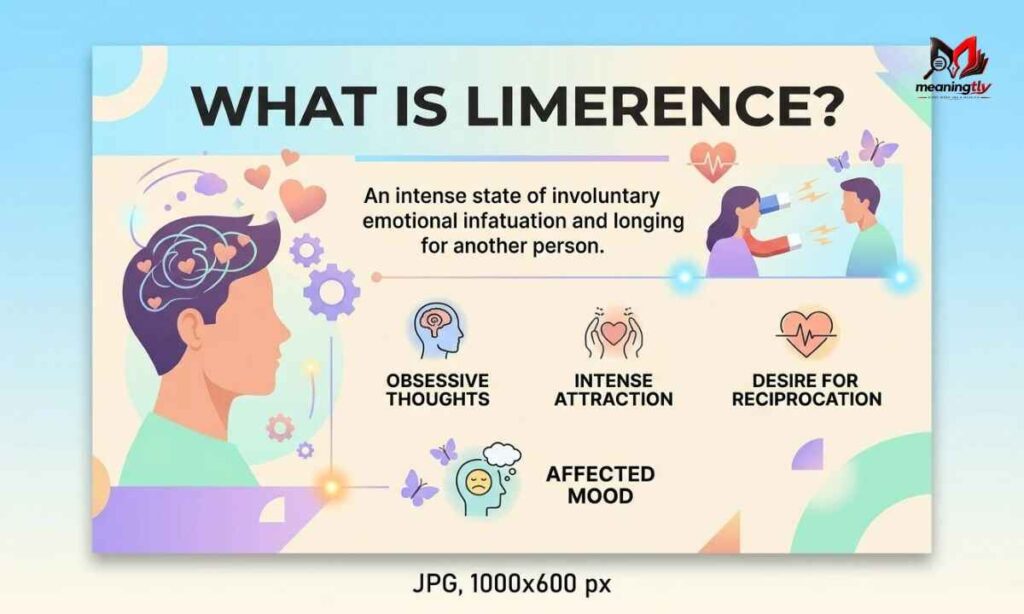
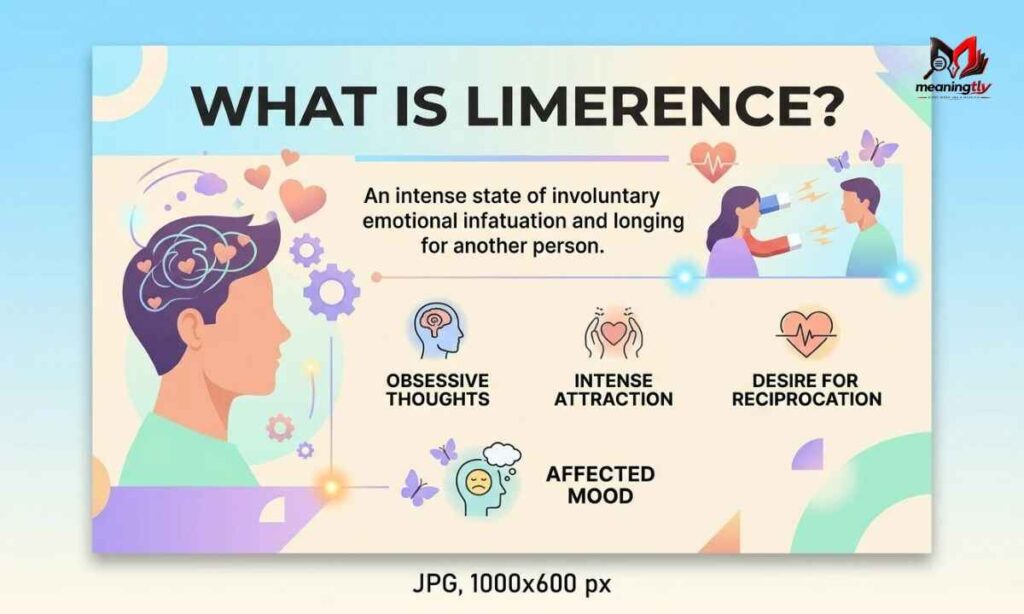
Limerence is a state of strong romantic longing. It feels hard to control. It often arrives without warning.
Psychologists describe it as an obsessive attraction. It comes with a deep need to be loved back.
Here is the limerence meaning in one line: it is a powerful craving for emotional return from one person who fills your thoughts.
A Simple Definition
Think of limerence as love-like obsession.
It feels like falling in love. But it centers on fantasy more than on the real person.
The person you fixate on is called the limerent object, or LO. You are the limerent.
Where the Word Came From
Psychologist Dorothy Tennov coined the term. She shared it in her 1979 book, Love and Limerence.
She made up the word on purpose. It has no older root. She wanted to avoid mixing it up with the word “love.”
Is It a Mental Disorder?
No. Limerence is not an official diagnosis. It does not appear as its own condition in diagnostic manuals.
Still, it can cause real pain. Some people notice traits that look like anxiety, OCD, or addiction.
Limerence Meaning in Psychology
In psychology, limerence is a descriptive idea. It names a pattern of thoughts and feelings. It is not a label for an illness.
The limerence meaning in psychology rests on three core features:
- Intrusive thoughts about one person
- A strong need for that person to return your feelings
- Emotional highs and lows tied to their behavior
Key Terms to Know
These words appear often in articles about limerence.
| Term | Simple Meaning |
| Limerent | The person experiencing limerence |
| Limerent object (LO) | The person they are fixated on |
| Reciprocation | The LO returning the feelings |
| Intrusive thoughts | Unwanted thoughts that keep repeating |
| Idealization | Seeing the LO as nearly perfect |
| Crystallization | The mind building a flawless image of the LO |
| Rumination | Replaying events again and again |
Why Uncertainty Matters
Tennov noticed that doubt keeps limerence alive.
A little hope mixed with a little fear is the fuel. Total certainty, in either direction, tends to cool it down.
That is why mixed signals feel so addictive. Each small sign of interest becomes a reward. Your brain keeps chasing the next one.
Limerence vs. Love
Limerence can feel like love. But it is not the same.
Love grows slowly. It is built on knowing a real person. Limerence is built on longing and imagination.
Quick Comparison Table
| Feature | Limerence | Love |
| Focus | Fantasy version of the person | Real person, flaws included |
| Emotions | Big highs and crashes | Steady and calm |
| Thoughts | Intrusive and constant | Present but balanced |
| Core need | Validation | Connection |
| Reciprocity | Often one-sided | Mutual |
| Self-worth | Tied to the LO’s response | Independent |
| Duration | Months to years | Can last a lifetime |
| Effect on life | Disrupts routines | Supports routines |
Why People Mix Them Up
Early love and limerence share many traits. Both bring butterflies. Both feel exciting.
The difference shows up over time. Love deepens. Limerence stays stuck in longing.
Knowing the true limerence meaning helps you see which one you are in.
A Useful Test
Ask yourself one question. “Do I miss the person, or the feeling they give me?”
If it is mostly the feeling, limerence may be at work.
Limerence vs. Crush
A crush is light. Limerence is heavy.
Main Differences
- A crush fades fast. Limerence can last months or years.
- A crush feels fun. Limerence often hurts.
- A crush rarely changes your habits. Limerence can.
- A crush lets you think of other things. Limerence does not.
Crush vs. Limerence Table
| Factor | Crush | Limerence |
| Intensity | Mild | Intense |
| Control | You feel in control | You feel stuck |
| Time span | Days or weeks | Months or years |
| Thoughts | Occasional | Constant |
| Daily impact | Small | Large |
Limerence vs. Infatuation
Infatuation is close to limerence. But it is milder and shorter.
Infatuation is often mutual. Limerence is usually one-sided. Many experts see limerence as an extreme, long-lasting form of infatuation.
Limerence vs. OCD
Both involve intrusive thoughts. Both can involve repeated behaviors.
But OCD is a diagnosis. Limerence is not. Some sources note that serotonin appears to drop in both states.
A therapist can help you tell them apart.
Common Signs of Limerence
The signs fall into four groups. You may notice some or all of them.
Mental Signs
- You think about the LO many times a day.
- You replay old chats in your head.
- You build detailed daydreams about a future together.
- You see only their good traits.
- You struggle to focus at work or school.
Emotional Signs
- You feel euphoric when they notice you.
- You feel crushed by small signs of distance.
- You fear rejection all the time.
- You feel jealous of people near them.
- Your mood depends on their behavior.
Physical Signs
- Racing heart
- Sweaty palms
- Butterflies or nausea
- Trouble sleeping
- Loss of appetite
- Shaky hands near them
Behavioral Signs
- You check their social media again and again.
- You dress to impress them.
- You look for reasons to be near them.
- You test them to see if they care.
- You drop hobbies and friends.
- You rehearse conversations before they happen.
Quick Self-Check
Ask yourself:
- Do I think about one person most of the day?
- Does their mood control my mood?
- Do I analyze every text or look?
- Do I fear rejection more than I enjoy the connection?
- Have I dropped my own goals?
- Do I wish these feelings would stop?
If you said yes to most, limerence may fit. This is not a diagnosis. A mental health professional can give you a real assessment.
What Limerence Feels Like
Many people compare it to a song stuck on repeat. You cannot turn it off.
One small event can trigger it. A name. A song. A smell. Over time, your mind links more things to the LO. The thoughts come more often.
It is also an emotional rollercoaster. A kind word lifts you up for days. A cold reply drops you for just as long.
You may also become hypervigilant. You read tone, timing, and emoji like clues in a mystery.
This is the limerence meaning in everyday life. It is not just “liking someone a lot.” It is a state that takes over your attention.
A Real-Life Example
Imagine a woman named Sara. She meets a new coworker named Adam. He smiles at her in a meeting.
She thinks about that smile all night. By the weekend, she has planned their wedding in her head.
Adam is polite to everyone. But Sara reads hidden meaning into each hello. When he skips lunch with her, she cannot eat.
Sara does not want to feel this way. She cannot stop. That gap between wanting to stop and being unable to is a classic sign of limerence.
The Stages of Limerence
Experts use different models. Some list three stages. Others list four or even seven.
The three-stage model is the most common. It includes infatuation, crystallization, and deterioration.
Stage Overview Table
| Stage | What Happens | Typical Feeling |
| Infatuation | You feel a strong spark | Excitement |
| Crystallization | You idealize the LO | Obsession |
| Deterioration | Reality sets in | Pain or relief |
| Post-limerence | Feelings fade | Calm or sadness |
Stage 1: Infatuation
This is the spark. You notice the person. Something about them pulls you in.
You feel butterflies. You want to be near them. You start to think about them often.
At this point, it looks like a normal crush. But the pull is stronger.
Stage 2: Crystallization
Here, the obsession grows. Your mind builds a perfect image of the LO.
You overlook flaws. You explain away red flags. You fill every gap with hopeful guesses.
Your self-worth now rides on their response. Every sign of interest feels huge.
Stage 3: Deterioration
Reality starts to break through. This can happen in several ways.
The LO may reject you. The relationship may begin and the fantasy may not match. Or the constant strain may simply wear you out.
Some people feel deep sadness here. Others feel relief.
After the Stages: Post-Limerence
Limerence can fade on its own. When it does, thoughts about the LO become neutral.
If the relationship is real and mutual, it may shift into stable love. That outcome is not common, but it happens.
What Causes Limerence?
There is no single cause. It usually comes from a mix of factors.
Attachment Style
People with an anxious attachment style may be more prone to it. They crave closeness. They fear being left.
Limerence can feed that fear. It also feeds the hunger for reassurance.
Low Self-Esteem
Low self-esteem is both a cause and a result. When you doubt your worth, one person’s approval can feel like proof you matter.
Then the cycle starts. You need more approval. Your self-worth drops further.
ADHD and Hyperfocus
Some experts link ADHD to limerence. People with ADHD may hyperfocus on one person or topic. A strong interest can lock in.
This does not mean everyone with ADHD will experience limerence. It means the risk may be higher.
Brain Chemistry
Romantic longing activates the brain’s reward system. It involves dopamine, the “wanting” chemical.
Some sources also link lower serotonin to both limerence and OCD. More research is needed. The science is still developing.
Loneliness and Life Changes
Big changes can open the door. A breakup. A move. A job loss. A quiet stretch of life.
When life feels empty, the mind may pour its energy into one person.
Social Media and Easy Access
Social media gives you a window into the LO’s life. You can see their posts, stories, and likes.
Each glance gives a small hit of hope. It keeps the loop going.
An old crush once faded when you lost touch. Today, you can watch their life every day. That makes it harder for limerence to cool down.
Past Experiences
Some people link limerence to unmet needs or past hurt. Old wounds around rejection or abandonment can resurface.
A therapist can help you explore this at a safe pace.
Who Gets Limerence?
Anyone can.
Limerence meaning shows up in all ages, genders, and backgrounds. It appears in single people and in people in relationships.
It also does not mean you are weak. Healthy, balanced people can fall into it. It often hits when they least expect it.
Limerence in Long-Term Relationships
Many people think limerence meaning only happens to singles. That is a myth.
A person in a stable relationship can develop limerence for someone else. It may be a coworker, a friend, or someone online.
Why It Happens
Sometimes the relationship feels flat. Sometimes life feels stressful. The LO offers excitement and escape.
The feeling is rarely about the partner’s flaws. It is often about a need that feels unmet.
What to Do
- Admit the feeling to yourself.
- Limit contact with the LO.
- Ask what need the fantasy fills.
- Invest in your real relationship.
- Seek couples or individual therapy if needed.
Having these feelings does not make you a bad person. What you do next matters most.
How Long Does Limerence Last?
It depends on the person.
Some people feel it for a few weeks. Others feel it for years. Tennov suggested that many cases last around 18 months to three years.
Things That Make It Last Longer
- Ongoing contact with the LO
- Mixed signals
- Constant social media checking
- Lack of closure
- Feeding the fantasy
Things That Help It Fade
- Reducing contact
- Clear rejection or clarity
- Strong routines
- Support from friends
- Professional help
Ambiguity is the biggest fuel. Clarity is often the biggest relief.
How Limerence Affects Daily Life
Limerence can reach every part of your day.
Work and School
You may lose focus. You may miss deadlines. You may daydream in meetings.
Sleep and Health
Racing thoughts can ruin sleep. Stress can drain your energy. Appetite may change.
Friendships
You may pull away from friends. Every conversation may drift back to the LO. Friends can grow tired or worried.
Existing Relationships
If you have a partner, limerence meaning can strain things. You may compare your partner to the LO. You may feel guilty or distant.
Mental Health
Constant highs and lows can bring anxiety. Some people feel low mood or hopelessness.
If you ever feel unsafe or hopeless, reach out for help right away. Contact local emergency services or a crisis line in your area.
How Limerence Ends
There are three common endings.
- It becomes a real relationship. The feelings are returned and grow into stable love.
- It fades. Time, distance, or rejection weaken the pull. You feel sad, then calm.
- It shifts to someone new. The pattern repeats with a new LO.
Some sources note that it can end in sadness, agony, or simple indifference.
None of these endings is a failure. Each one is part of how the mind processes strong longing.
How to Overcome Limerence
You cannot force feelings to vanish. But you can reduce their grip.
Try these steps one at a time.
Step 1: Name It
Say it out loud. “This is limerence.”
Understanding the limerence meaning takes away some of the mystery. A named feeling is easier to manage.
Step 2: Limit Contact
Less contact means fewer triggers. Mute their accounts. Stop checking their profile.
If you work together, keep chats short and polite.
Step 3: Stop Feeding the Fantasy
Notice when you start daydreaming. Gently pull your mind back.
You do not have to fight each thought. Just refuse to expand it.
Step 4: Do a Reality Check
Write down the facts. What has the LO actually said and done?
Then list their flaws. Everyone has them. This brings the fantasy back to earth.
Step 5: Rebuild Your Routine
Go back to your hobbies. Exercise. Sleep on time. Meet friends.
A full life leaves less room for obsession.
Step 6: Write It Out
Journaling helps. Dump your thoughts onto paper. Notice patterns.
You may see that certain times, places, or moods trigger the urge.
Step 7: Practice Mindfulness
Mindfulness teaches you to watch thoughts without chasing them. A few minutes a day can help.
Try slow breathing when an urge rises.
Step 8: Lean on Support
Talk to someone you trust. Shame grows in silence.
A friend can remind you of what matters when your mind runs wild.
Step 9: Consider Therapy
Therapy can help you find the roots of the pattern. Cognitive behavioral therapy (CBT) is a common choice. It helps you change unhelpful thought loops.
What Not to Do
- Do not test the LO with games.
- Do not check their location or messages.
- Do not make big life changes for them.
- Do not blame yourself.
Journaling Prompts for Limerence
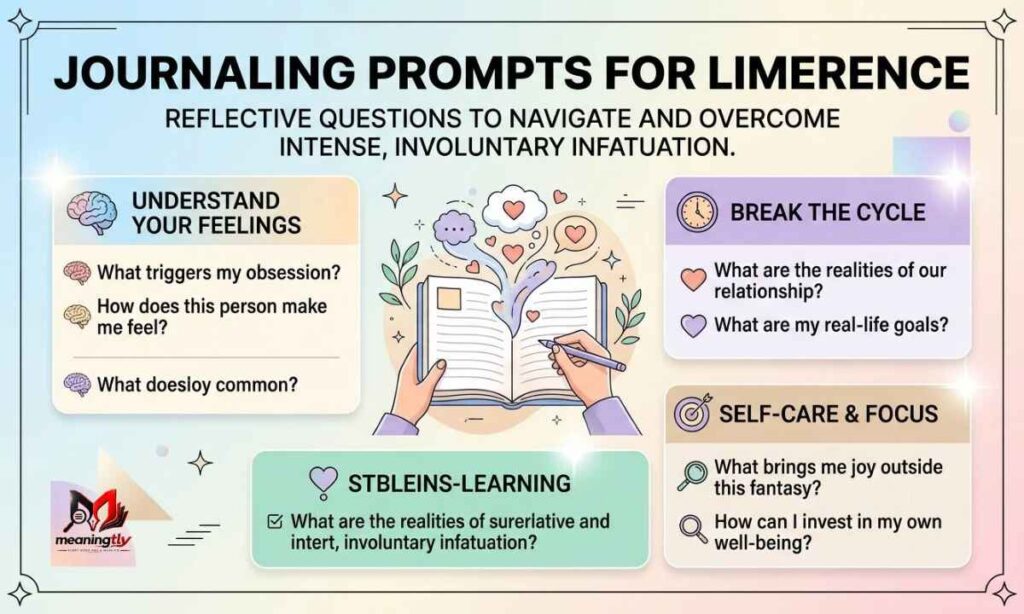
Writing can bring clarity. Try these prompts.
- What exactly do I miss about this person?
- What feeling does the LO give me that I lack elsewhere?
- What do I know about them as a real person?
- What flaws have I ignored?
- How has this affected my sleep, work, and friends?
- What would I do today if I did not think about them?
- What small step can I take to care for myself?
Answer honestly. No one else will read it.
Healthy Ways to Handle Intense Feelings
Intense feelings need an outlet. Here are safe ones.
- Move your body with walks, sports, or stretching.
- Learn a new skill.
- Spend time with people who care about you.
- Create something, like art, music, or writing.
- Set small daily goals.
These habits do not erase the feeling. They give you ground to stand on while it passes.
Limerence Myths vs. Facts
| Myth | Fact |
| Limerence is true love | It is a distinct state driven by longing and fantasy |
| Only teens feel it | Adults of any age can feel it |
| It means something is wrong with you | It is a common human experience |
| It always ends in a relationship | Often it fades or shifts |
| You cannot recover | Many people move past it with time and support |
| It is an official disorder | It is not an official diagnosis |
How to Help Someone With Limerence
If a friend is in limerence, be kind. They are not “being dramatic.”
Here is how to help:
- Listen without judging.
- Avoid mocking their feelings.
- Encourage healthy routines.
- Gently point out patterns.
- Suggest professional support if it affects their life.
When to See a Therapist
Get help if limerence:
- Stops you from working or studying
- Harms your relationships
- Triggers panic or deep sadness
- Leads you to follow or pressure the LO
- Feels impossible to stop
A licensed therapist can offer support and tools. You do not need to wait for a crisis.
Can Limerence Ever Be Healthy?
Some experts say limerence is not always harmful. Tennov herself did not see it as inherently unhealthy.
It can feel thrilling. It can even push people to grow. And if the feelings are mutual, it may mature into a lasting bond.
But when it is one-sided and consuming, it can hurt. The key is awareness. Once you know the limerence meaning, you can choose how to respond.
Conclusion
Limerence meaning is an intense state of romantic obsession. It makes a person feel deeply attached to someone, often called the “limerent object.” The term was created by psychologist Dorothy Tennov in 1979. She used it to describe a feeling that is stronger than normal attraction or a simple crush.
A person in limerence thinks about the other person almost all day. Small things, like a text or a smile, can bring great joy. A missed call or a cold word can bring deep sadness. Their mood depends on how the other person acts. This makes life feel like an emotional roller coaster.
Limerence meaning is not the same as true love. Love grows slowly and is built on trust and care. Limerence is often based on fantasy and hope. The person may not really know the one they adore. They often see only the good side and ignore the flaws.
In the end, limerence can be both sweet and painful. It can fade after weeks, months, or even years. Understanding it helps people see their feelings more clearly. If it starts to hurt daily life, talking to a friend or a therapist can help. Knowing what limerence means is the first step to healing.
FAQs About Limerence Meaning
What does being in limerence mean?
An involuntary, obsessive state of intense romantic infatuation with one person, along with a strong craving for their reciprocation.
Is limerence just a crush?
No, a crush is milder and fades quickly, while limerence is consuming and can last months or years.
How do you know if you are in limerence?
Constant intrusive thoughts about them, mood swings based on their attention, fear of rejection, and idealizing them.
What are the three stages of limerence?
Infatuation, crystallization (idealizing them), and deterioration (reality sets in and the feelings fade).
How do I know limerence is over?
They no longer dominate your thoughts, your mood doesn’t hinge on them, and you see them realistically.
What is the 3-3-3 rule of intimacy?
It’s an informal dating guideline (not a scientific rule) to assess compatibility and comfort at 3 dates, 3 weeks, and 3 months.

1 thought on “Limerence Meaning: Definition, Signs, and Examples(2026)”