
You are chatting with a friend on your phone. You send a long message about your weekend plan. A tiny reply pops up: “wtv.” You stare at the screen for a few seconds. You wonder if your friend is fine, bored, or a little upset with you.
WTV is a short form of the word “whatever.” People type it to save time in fast chats. It looks very small, but it carries a strong mood. Some people use it as a joke. Others use it when they are tired of a topic. That is why the WTV text meaning confuses so many people.
Sometimes WTV means “I don’t mind, you decide.” That is a calm and friendly use. Other times it means “I’m done with this talk.” Then it feels cold or annoyed. The same three letters can sound kind or rude. So you must always check the tone and the chat before you judge.
In this guide, you will learn how people use WTV in daily chats. You will see its meaning, tone, and real examples from texts and social media. You will also learn when it is safe to use it. And you will learn when it is better to skip it and write a full sentence.
WTV Meaning
What Does WTV Mean in Text? – Quick Meaning
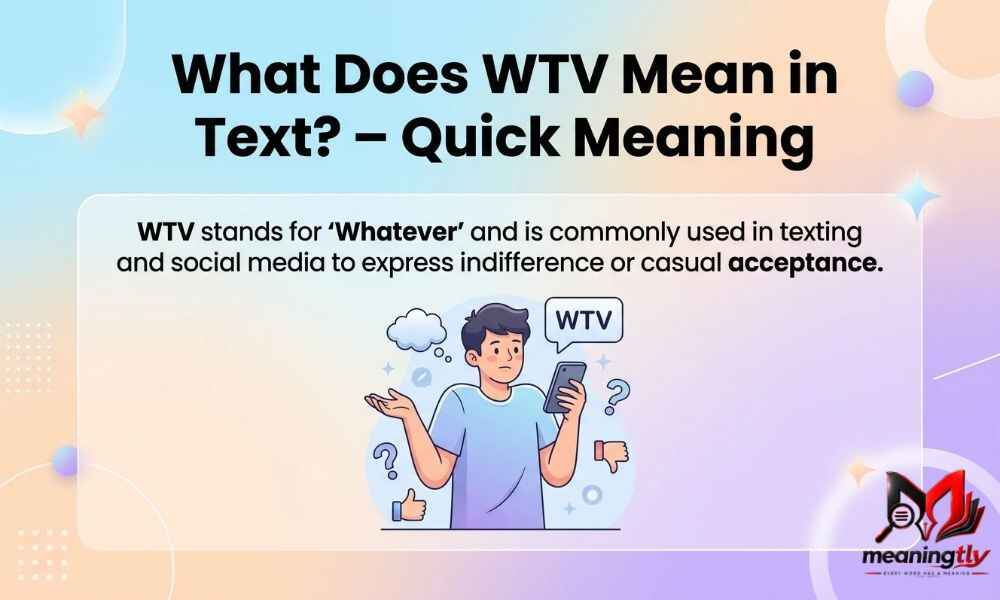
WTV means “whatever.” That is the core wtv meaning in texting. People type it to save time. It takes three letters instead of eight.
The word “whatever” has many moods. So does its short form. The wtv meaning can be “I don’t mind.” It can also be “I don’t care.” The mood depends on the chat.
The simplest definition
WTV = Whatever.
It shows one of these ideas:
- “Anything is fine with me.”
- “I am done with this topic.”
- “I don’t have a strong opinion.”
- “Do what you like.”
That is the quick wtv meaning in one box. Everything else in this guide builds on it.
| Short form | Full form | Common mood |
| WTV | Whatever | Neutral, bored, or annoyed |
| WTVR | Whatever | Same as WTV |
| WTV U WANT | Whatever you want | Easygoing or sulky |
Origin and Background of WTV
The word “whatever” is old English. People used it to mean “anything at all.” Over time, the meaning grew. By the 1990s, “whatever” also meant “I don’t care.” Teen movies made that tone famous.
Then came mobile phones. Early texts had a small character limit. People cut long words into short ones. “Whatever” became “wtv” or “whatev.” It was fast to type. It stayed.
Social media gave it a second life. Twitter, Instagram, and Snapchat love short words. Chat apps made it even more common. Today, the wtv meaning is known across many age groups.
Here is a quick timeline:
- Old English: “Whatever” means “anything.”
- 1990s: It becomes a casual brush-off.
- 2000s: SMS shortens it to “wtv.”
- 2010s onward: Social media spreads it worldwide.
Note that “wtv” has no single inventor. It grew from daily use. That is how most slang is born. People simply type what feels natural.
Also, the wtv meaning never changed fully. It still means “whatever.” Only the way people use it has grown.
Real-Life Conversations: How WTV Is Actually Used
Words on a screen have no voice. So context matters a lot. Let’s look at three real-style chats. Each one shows a different side of the wtv meaning.
WhatsApp Conversation: Casual and Easygoing
Ayaan: Pizza or burgers tonight?
Sana: wtv you like 😊
Ayaan: Pizza then!
Here, wtv is friendly. Sana has no strong choice. She adds an emoji, so the tone is warm. This is the soft wtv meaning: “I’m flexible.”
Another example:
Rida: Should we meet at 6 or 7?
Zain: wtv works for you
Zain is not upset. He just wants to make it easy. The wtv meaning here is “your choice.”
Instagram DM: Slightly Annoyed
Hira: I told you to reply yesterday.
Omar: I was busy.
Hira: wtv.
See the full stop? It changes the mood. There is no emoji. There is no warmth. Hira feels ignored.
In this chat, the wtv meaning is “I’m upset, but I won’t argue.” It is a quiet shutdown. Many people feel hurt by this version.
TikTok Comment: Playful or Casual
User A: This dance is so cringe lol
User B: wtv, I still love it 😂
Here, wtv is playful. User B isn’t angry. They just brush off the comment. The wtv meaning on public posts is often light and funny.
Notice the pattern. Emojis soften the word. Full stops harden it. Lowercase feels relaxed. Capital letters feel loud.
The Emotional and Psychological Meaning Behind WTV
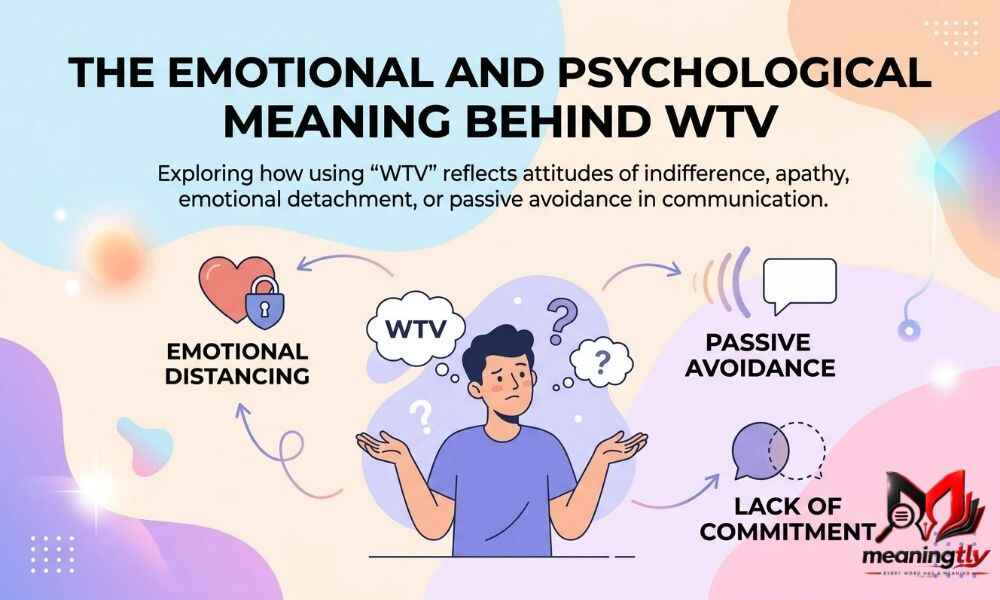
Why do people type wtv? Often, they are not sure how to say a feeling. One short word feels safe. It hides the real emotion.
The wtv meaning can carry many feelings:
- Calm: “I’m okay with any plan.”
- Tired: “I have no energy to decide.”
- Hurt: “I’m upset, but I won’t say it.”
- Defensive: “I won’t show that I care.”
- Playful: “Chill, it’s not a big deal.”
Psychologists call this “emotional shielding.” People guard themselves with short replies. A cold word feels safer than an open feeling.
Some people also use wtv to avoid conflict. They don’t want a long fight. So they type three letters and leave. That is the passive side of the wtv meaning.
Others use it to stay relaxed. They truly don’t mind. For them, wtv is a sign of an easygoing nature. It shows trust in the other person’s choice.
So how do you tell the difference? Look at these clues:
| Clue | Likely mood |
| Emoji added | Friendly |
| Full stop at the end | Annoyed |
| Long gap before reply | Upset or busy |
| Used with “lol” | Playful |
| Used after an argument | Shut down |
Always read the full chat. One word alone can mislead you. The true wtv meaning lives in the context.
How WTV Is Used in Different Contexts
The wtv meaning shifts with the place. A word that works with friends may fail at work. Let’s look at each setting.
Social Media
On social media, wtv is very common. People use it in comments, stories, and captions. It often feels light and funny.
Examples:
- “Haters say wtv, I’m still posting.”
- “Wtv, it’s Friday!”
- “Rain or shine, wtv 😎”
Here, the wtv meaning is bold and carefree. It shows confidence. It tells others, “I don’t mind the noise.”
Friends and Relationships
With friends, wtv is usually safe. Close friends know your tone. They can read it right away.
In relationships, it is trickier. A partner may take “wtv” as a cold reply. If one person is hurt, the word can add fuel.
Try these tips:
- Add an emoji if you feel relaxed.
- Explain your mood if you feel upset.
- Avoid wtv during serious talks.
The wtv meaning between couples needs care. Short words can feel like distance.
Work and Professional Settings
At work, avoid wtv. It can sound rude or lazy. A boss may think you don’t care. A client may feel ignored.
Use clear words instead:
| Instead of | Say |
| “wtv” | “I’m flexible. Either option works.” |
| “wtv you want” | “Happy to go with your choice.” |
| “wtv works” | “That works for me.” |
Even in friendly team chats, keep it light. The wtv meaning is too casual for emails and formal notes.
Casual vs. Serious Tone
Tone is the key. Here is a quick guide:
| Tone | Example | Wtv meaning |
| Casual | “wtv 😂” | Playful, relaxed |
| Neutral | “wtv you prefer” | Flexible |
| Serious | “Wtv.” | Cold or upset |
A casual tone is safe for friends. A serious tone can hurt feelings. Pick the one that fits your mood.
Common Misunderstandings About WTV
Many people misread this word. Here are the top mistakes.
Mistake 1: Wtv always means rude.
Not true. Many people use it kindly. The wtv meaning is often just “I’m fine with anything.”
Mistake 2: Wtv means the person is angry.
Sometimes they are just tired. Or busy. Or typing fast.
Mistake 3: Wtv and idc are the same.
They are close, but not equal. We will compare them soon.
Mistake 4: Wtv has one tone.
It has many. Emojis, punctuation, and timing all change it.
Mistake 5: Everyone understands it.
Older people may not know it. Some may read it as a typo. Always think about your reader.
When You Should Not Use WTV
Skip wtv in these cases:
- During a fight or heated chat
- In job emails or work messages
- When someone shares bad news
- When a person asks for your real opinion
- With elders who may not know slang
- In formal apps or school notes
In such cases, the wtv meaning can sound careless. Say what you feel in clear words. It saves you from drama.
WTV Compared With Similar Texting Terms
Many slang words sound close to wtv. Yet each one has its own flavor. Here is a clear table.
| Term | Meaning | Tone | How it differs from WTV |
| WTV | Whatever | Mixed | Can be kind or cold |
| IDC | I don’t care | Harsh | More direct and blunt |
| IDK | I don’t know | Neutral | Shows uncertainty |
| NVM | Never mind | Soft or hurt | Drops the topic |
| FINE | Okay | Often upset | Sounds forced |
| K | Okay | Cold | Very short, low effort |
| WYD | What are you doing | Friendly | A question, not a brush-off |
| TBH | To be honest | Honest | Opens a real opinion |
Key Insight
Wtv is the most flexible of them all. IDC is almost always cold. IDK shows doubt. NVM closes a topic. But the wtv meaning can sit anywhere between warm and cold.
That is why people misread it. It has no fixed mood. You must read the clues around it.
Variations and Related Forms of WTV
People change wtv in many ways. Each form gives a new shade of meaning. Here are the top ten.
1. WTV
The base form. It means “whatever.” It can be soft or sharp. The basic wtv meaning applies here.
2. Wtv u want
This means “do what you want.” It can be kind: “I trust your choice.” It can also be sulky: “Fine, go ahead.”
Example: “Wtv u want 😊” is warm. “Wtv u want.” is cold.
3. Wtv works
This means “any option is fine.” It is mostly friendly. People use it to plan meals, trips, and timings.
Example: “Wtv works for me.”
4. Wtv happens
This means “let it be.” It shows a relaxed or fatalistic mood.
Example: “If we lose, wtv happens.”
5. Wtv lol
The “lol” softens the word. It sounds playful. The wtv meaning here is “no big deal.”
Example: “Wtv lol, I don’t mind.”
6. Wtv
Sometimes the word is typed alone as a reply. With no extra words, it feels abrupt. Many people read it as a brush-off. Check the earlier messages to judge the wtv meaning in that moment.
7. Wtv bro
Common among friends. It sounds casual and friendly. Often it ends a small debate.
Example: “Wtv bro, you win.”
8. Wtv then
This one often sounds annoyed. It means “fine, if that’s how it is.” The word “then” adds a sharp edge.
Example: “Wtv then, do it your way.”
9. Do wtv
This is a command form. It means “do anything you like.” It can be generous or snappy.
Example: “Do wtv makes you comfortable.”
10. Wtv makes you happy
This is a kind one. It means “I support your choice.” It shows care and trust.
Example: “Wtv makes you happy, I’m with you.”
Here is a quick summary:
| Form | Usual tone |
| Wtv u want | Mixed |
| Wtv works | Friendly |
| Wtv happens | Relaxed |
| Wtv lol | Playful |
| Wtv bro | Casual |
| Wtv then | Annoyed |
| Do wtv | Mixed |
| Wtv makes you happy | Warm |
Each version shifts the wtv meaning a little. Add words, and you add mood.
How to Respond When Someone Uses WTV
Don’t panic when you get a wtv. First, read the mood. Then pick a reply that fits. The right answer depends on the wtv meaning in that chat.
Casual Replies
Use these when the mood is light:
- “Okay, let’s go with pizza then!”
- “Cool, I’ll decide.”
- “Sounds good 👍”
- “Great, see you at 6.”
Funny Replies
Use humor when the mood is playful:
- “Wtv? Whatever is not on the menu 😂”
- “Okay, ‘whatever’ it is then.”
- “That’s a big word for three letters.”
- “I’ll take that as a yes!”
Keep jokes kind. Don’t joke if the person seems upset.
Mature and Confident Replies
Use these when you feel the tone is cold:
- “Is something bothering you?”
- “I felt that reply was short. Are you okay?”
- “I’d like to hear your real opinion.”
- “Let’s talk when you’re ready.”
These replies are calm. They don’t attack. They open the door to a real talk. Understanding the wtv meaning helps you stay steady.
Private or Respectful Replies
When the chat feels sensitive, take it offline:
- “Can I call you later?”
- “Let’s talk in person.”
- “I’ll give you some space.”
- “Message me when you’re free.”
Some feelings don’t fit a chat box. A call or a meeting can clear things fast.
Quick tip: Never reply with anger. Take a breath first. A calm reply stops small fights.
Regional and Cultural Usage of WTV

Slang travels fast. But each region uses it in its own way. The wtv meaning stays the same. Only the tone and habits change.
Western Culture
In the US, UK, and Canada, “whatever” has a long slang history. Teens used it in the 90s as a dismissive reply. So people there often read wtv as slightly rude.
Still, young adults use it lightly today. Friends use it to plan, joke, and chill. In the West, the wtv meaning leans casual and a bit sassy.
Asian Culture
In many Asian countries, people often mix English and local languages in chats. In places like India and Pakistan, “wtv” fits easily into mixed-language texts. For example: “Wtv yaar, chalo kuch bhi kar lo.”
Respect for elders matters here too. People rarely use wtv with parents or teachers. It may seem disrespectful. With peers, it feels normal. The wtv meaning is mostly easygoing among friends.
Middle Eastern Culture
In the Middle East, English slang is common on social apps. Young people use wtv with friends. They may also mix it with Arabic words.
Politeness is highly valued. So a plain “wtv” can feel cold in formal talks. People often add warm words or emojis. Here, the wtv meaning is softened to keep a kind tone.
Global Internet Usage
Online, borders fade. Gamers, streamers, and creators share the same slang. Wtv appears in comments, lobbies, and group chats worldwide.
Because of this, the wtv meaning is now almost universal. Most young users understand it. Still, tone is shaped by local manners. Always think about who is reading.
| Region | Common tone | Tip |
| Western | Casual, sassy | Add an emoji to stay friendly |
| Asian | Easygoing | Avoid with elders |
| Middle Eastern | Polite, mixed | Soften with kind words |
| Global online | Playful | Match the group vibe |
Conclusion
WTV is a short form of the word “whatever.” People use it every day to reply fast in their chats. It looks tiny, but it can carry a big mood. Now you know the WTV text meaning, and you can read it with more confidence.
WTV does not have one fixed meaning. Sometimes it means “I don’t mind, you decide.” Other times it shows boredom, tiredness, or mild anger. The words around it, the emojis, and the punctuation all give clues. A short “wtv.” with a period often feels cold, while “wtv 😂” feels light.
You can use WTV with friends in casual chats. It works well when you are relaxed and do not care about the choice. But it can hurt someone if they share something serious. In those moments, a few kind words are always better than a lone WTV.
When you feel unsure, do not guess too much. Ask a small question like “Are you okay?” or “What do you mean?” That one step can stop a big misunderstanding. Keep your messages clear, and your chats will stay friendly.
FAQs
What does WTV mean in a text?
WTV means “whatever.” It shows you are flexible, bored, or slightly annoyed, depending on the tone.
Is WTV rude?
Not always. It can be friendly or cold. Emojis and context decide the mood.
What does WTV mean from a girl or guy?
The wtv meaning is the same for everyone: “whatever.” Read the tone and chat history, not the gender.
What does WTV mean on Snapchat or Instagram?
It usually means “I don’t mind” or “I’m not bothered.” On a serious chat, it can mean “I’m upset.”
Is WTV the same as IDC?
No. IDC means “I don’t care” and is blunt. WTV is softer and can be friendly.
How should I reply to WTV?
Check the mood first. Reply with a light message if it’s casual, or ask what’s wrong if it feels cold.
Should I use WTV at work?
No. It sounds careless in professional chats. Use clear, polite words instead.
