
OTP stands for One-Time Password. It is a short code you get on your phone or email. You use it only once. It helps prove that you are the real owner. Many apps and banks use it today.
An OTP is usually four to six digits. It comes as a text message or an email. Some apps also create it for you. The code works for a short time only. After that, it expires.
People use OTP in many places. You see it when you log in to an account. You also need it to pay online. Some services ask for it when you reset a password. It adds an extra layer of safety.
Never share your OTP with anyone. Real companies will not ask for it. Scammers often pretend to be bank staff. Keep the code private at all times. A little care keeps your money safe.
OTP Meaning
What Does OTP Stand For?
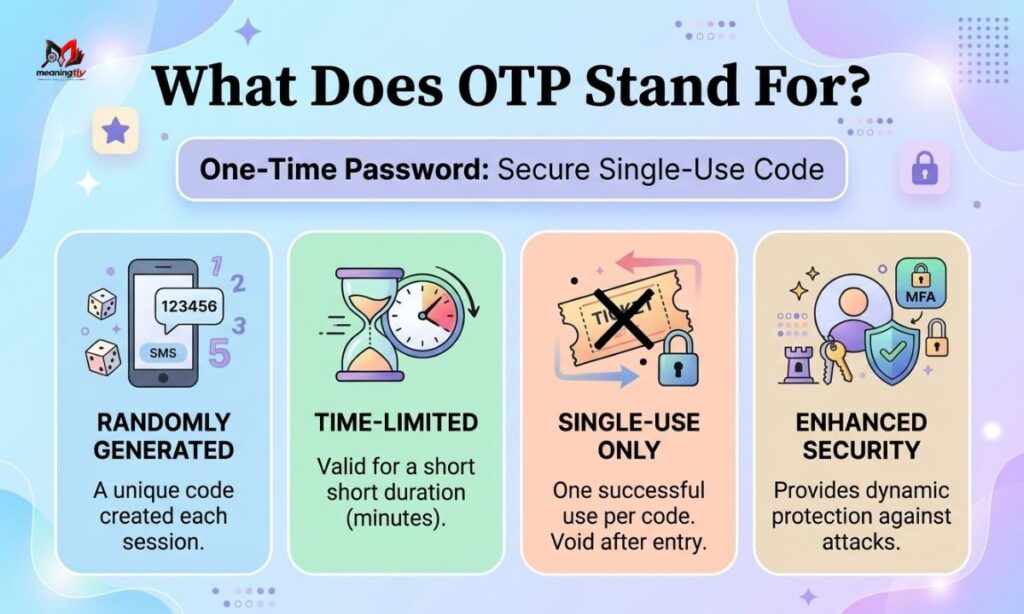
OTP stands for One-Time Password.
It is a short code. It works only once. It expires fast.
Most OTPs have four to eight digits. Some include letters too.
The OTP meaning is simple. It is a temporary password for one login or one action.
OTP Full Form
The OTP full form is One-Time Password.
You may also see these names:
- One-Time PIN
- One-Time Passcode
- One-Time Code
- Verification code
- Dynamic password
They all mean nearly the same thing.
OTP Meaning in One Line
An OTP is a code that proves you are the real user. It cannot be used again.
That is the core OTP meaning in technology.
What Is an OTP in Simple Words?
Think of an OTP as a disposable key.
You use it once. Then it stops working.
A normal password stays the same for months. An OTP changes every time.
This makes it hard for hackers to misuse it. Even if they steal it, it is often useless after a short time.
A Real-Life Example
You open your banking app. You try to send money.
The bank sends a code to your phone. You enter it. The payment goes through.
The bank now knows the person holding the phone is you.
Why the Name Fits
- One-Time: it works for a single use.
- Password: it proves your identity.
The name explains the OTP meaning on its own.
How Does an OTP Work?
The process is quick. It takes only a few seconds.
Here are the basic steps:
- You log in or start a transaction.
- The system creates a random code.
- The code is sent to you.
- You type the code in.
- The system checks if it matches.
- If it matches, you get access.
Behind the Scenes
The server uses a secret key. It also uses an algorithm. The algorithm creates a code that looks random.
Your device or the server compares the codes. If they match, you pass.
The Time Limit
Most OTPs expire in 30 seconds to 10 minutes.
After that, the code is dead. You must ask for a new one.
This short life is a key part of the OTP meaning in security. A stolen code is only useful for a tiny window.
One Use Only
Once you use the code, it is gone. Trying it again will fail.
This stops replay attacks. In a replay attack, a hacker reuses an old code.
Types of OTP
Not all OTPs are the same. They differ in how they are made and sent.
Time-Based OTP (TOTP)
A TOTP depends on the clock.
Your app and the server share a secret. Both use the current time to make a code. The code changes every 30 seconds or so.
Google Authenticator and similar apps use this method.
Counter-Based OTP (HOTP)
An HOTP depends on a counter.
Each time you ask for a code, the counter goes up by one. The code changes with it.
It does not expire by time. It expires when the next one is used.
SMS OTP
The code arrives as a text message.
It is the most common type. It is easy to use. No app is needed.
Email OTP
The code arrives in your inbox.
It is common for sign-ups and password resets.
Voice OTP
A call reads the code to you.
This helps users who cannot receive texts.
Hardware Token OTP
A small device shows the code on a screen.
Some banks and companies give these to staff or clients.
Push Notification OTP
You get a prompt on your phone. You tap “Approve.”
This is not a typed code, but it follows the same idea.
OTP Types Compared
| Type | Delivery | Needs Internet | Security Level |
| SMS OTP | Text message | No (needs network) | Medium |
| Email OTP | Inbox | Yes | Medium |
| TOTP app | Authenticator app | No | High |
| HOTP | Token or app | No | High |
| Hardware token | Physical device | No | Very high |
| Voice OTP | Phone call | No (needs network) | Medium |
| Push approval | App prompt | Yes | High |
Where Is OTP Used?
You meet OTPs almost daily. Here are the main places.
Online Banking
Banks use OTPs to approve payments. They also use them for new device logins.
Card Payments
Many online card payments need a code. This adds a second check.
Mobile Wallets and UPI Apps
Wallet apps send codes when you sign up or change settings.
Social Media
Platforms send codes when you log in from a new place.
E-Commerce
Shopping sites use OTPs to confirm orders. Some use them for cash-on-delivery checks.
Government Portals
Tax and ID services often send codes for safe access.
Email Accounts
Mail services use codes to confirm recovery requests.
Delivery Services
Some delivery apps use a code at your door. You share it with the rider to confirm the drop.
Healthcare Apps
Patient portals use OTPs to protect health records.
Why OTP Matters
The OTP meaning goes beyond a simple code. It is about trust.
Passwords get stolen. They get guessed. People reuse them across sites.
An OTP adds a second lock. Even if your password leaks, the attacker still needs the code.
Key Benefits
- Extra security: a stolen password is not enough.
- Single use: old codes cannot be replayed.
- Short life: codes expire fast.
- Easy to use: no complex rules to remember.
- Wide support: almost every service offers it.
- Fraud reduction: it blocks many account takeovers.
Benefits for Businesses
Companies also gain from OTPs.
- Lower fraud losses
- Fewer account takeover cases
- Stronger customer trust
- Easier compliance with security rules
OTP and Two-Factor Authentication
OTP is often part of two-factor authentication (2FA).
2FA means you prove your identity in two ways.
The Three Factors
| Factor | Meaning | Example |
| Something you know | Knowledge | Password, PIN |
| Something you have | Possession | Phone, token |
| Something you are | Inherence | Fingerprint, face |
An OTP counts as “something you have.” That is because it reaches your phone or device.
How They Work Together
You enter your password first. Then you enter the OTP.
An attacker needs both. That makes the attack much harder.
This link to 2FA is one more reason the OTP meaning matters in cybersecurity.
OTP vs Normal Password
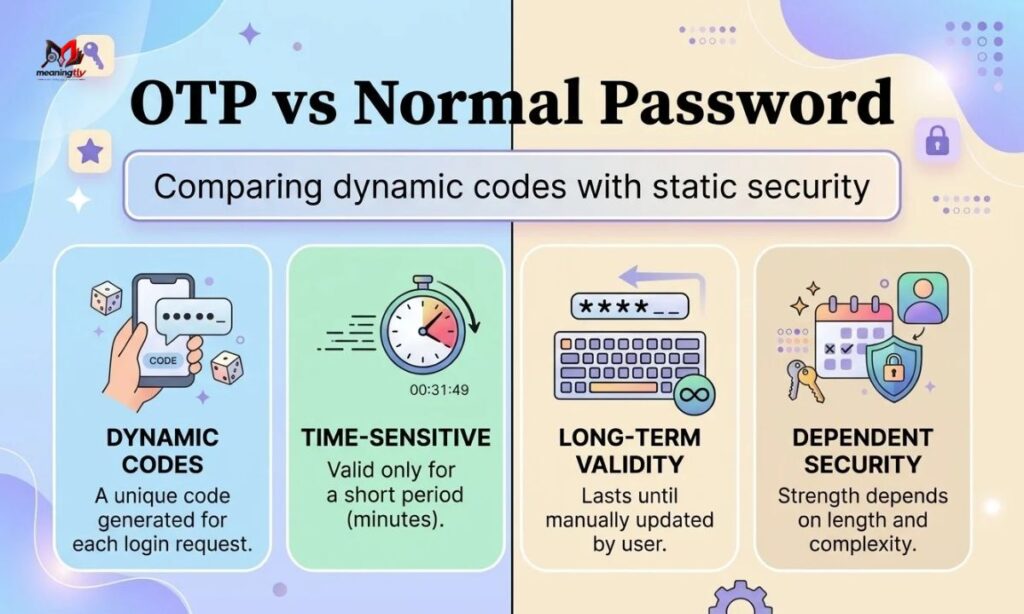
Here is a quick comparison.
| Feature | Normal Password | OTP |
| Reusable | Yes | No |
| Lifespan | Long | Very short |
| Changes each time | No | Yes |
| Can be memorized | Yes | Not needed |
| Risk if stolen | High | Low |
| Used alone | Often | Usually as a second step |
A password is a long-term key. An OTP is a throwaway key.
Using both gives better protection than using one.
Risks and Weak Points of OTP
OTP is strong. But it is not perfect.
Knowing the risks helps you stay safe.
SIM Swap Attacks
A criminal tricks your mobile carrier. They move your number to their SIM card.
Now your SMS codes go to them.
Phishing
Fake sites ask you to enter your OTP. The attacker uses it at once on the real site.
Social Engineering
A caller pretends to be from your bank. They ask you to read out the code.
This is one of the most common tricks.
Malware
Some bad apps read your text messages. They can steal codes.
Interception
Weak networks can leak SMS data. This is rare but possible.
Delivery Delays
Sometimes the code arrives late. It may expire before you see it.
Common OTP Scams
Scammers love OTPs. They know people trust them.
Here are the usual tricks.
The Fake Bank Call
The caller says your account is at risk. They ask for the code “to stop fraud.”
The code actually approves their transaction.
The Fake Delivery Message
You get a text about a parcel. It has a link. The link asks for your code.
The Prize Trick
You are told you won a gift. To claim it, you must share a code.
The Remote App Trick
The caller asks you to install a screen-sharing app. They then read your codes as they arrive.
The Marketplace Scam
A buyer says they need your code to “verify” payment. They are really taking over your account.
Warning Signs
- Pressure to act fast
- Requests to share your code
- Unknown callers
- Links in odd messages
- Promises of money or prizes
How to Use OTP Safely
A few habits can protect you.
Golden Rules
- Never share your OTP with anyone.
- Banks never ask for your OTP by phone.
- Check the sender before you act.
- Read the full message first.
- Use the code only on the site you opened yourself.
Extra Safety Tips
- Use an authenticator app when possible.
- Lock your SIM with a PIN.
- Keep your phone software updated.
- Avoid unknown apps.
- Do not click links in unexpected texts.
- Turn off message previews on your lock screen.
- Report scam messages to your provider.
What to Do If You Shared an OTP
Act fast.
- Call your bank using the official number.
- Freeze the card or account.
- Change your passwords.
- Check recent activity.
- Report the incident to the authorities.
OTP Meaning in Texting and Slang
Now for the fun part.
The OTP meaning changes in casual chats. It depends on who is talking and where.
One True Pairing
This is the most popular slang meaning.
It comes from fan culture. Fans use it for their favorite fictional couple.
Examples:
- “Jim and Pam are my OTP.”
- “That show ruined my OTP.”
It shows strong support for a couple. It can also describe a real-life pair people love.
On The Phone
Some people use OTP to mean “on the phone.”
Examples:
- “Can’t talk, I’m OTP with my boss.”
- “She is OTP with support.”
This use is less common. You mostly see it in quick work chats.
One Trick Pony
This one is rare.
It describes a person or thing with just one skill.
Example: “That singer is an OTP. Every song sounds the same.”
It is often a mild insult.
One-Time Password in Chat
If someone texts “send OTP,” they mean the security code.
Example: “Please send the OTP you received.”
Be careful here. Scammers use this exact request.
How to Know Which Meaning It Is
Look at the context.
| Clue | Likely Meaning |
| Fan talk, shows, books | One True Pairing |
| Work, calls, busy status | On The Phone |
| Codes, apps, banks | One-Time Password |
| Talent, skills, music | One Trick Pony |
OTP Meaning on Social Media
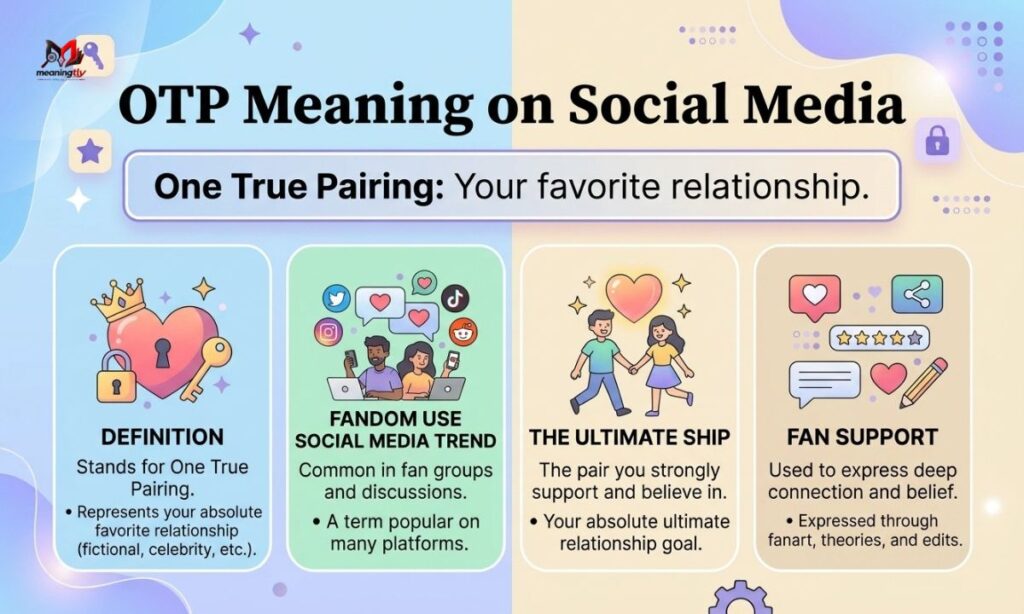
Each platform leans toward certain meanings.
On Snapchat and Instagram
You may see OTP in captions or chats. It usually means One True Pairing.
Security messages from the apps use the One-Time Password meaning.
On TikTok and Tumblr
Fandom talk is common here. OTP almost always means One True Pairing.
On WhatsApp and iMessage
You will see both. Bank codes and friend chats mix together.
Always check who sent the message.
On X (Twitter)
Fans use OTP for ships. Developers use it for code login topics.
Other Meanings of OTP
OTP has more uses outside tech and slang.
| Field | OTP Meaning | Short Explanation |
| Healthcare | Opioid Treatment Program | A clinic that gives medicine for opioid addiction under supervision |
| Real estate | Offer to Purchase | A written offer to buy a property |
| Cryptography | One-Time Pad | An encryption method using a key once |
| Chat | On The Phone | Currently on a call |
| Fandom | One True Pairing | A favorite fictional couple |
| General | One Trick Pony | Someone with a single talent |
One-Time Pad
This is an old encryption method.
The key is random. It is as long as the message. It is used only once.
When done right, it is theoretically unbreakable. But it is hard to use in practice.
Opioid Treatment Program
In health care, OTP is a regulated program. It offers care for people with opioid use disorder.
Staff give approved medicine in a controlled setting.
Offer to Purchase
In property deals, OTP is a legal document. It sets the price and terms between a buyer and seller.
Once accepted, it can become binding.
A Short History of OTP
The idea began in the world of codes.
Early secret messages used a key only once. That is the root of the one-time pad.
Later, banks and tech firms wanted safer logins. Hardware tokens appeared first. They showed codes on small screens.
Then came SMS codes. Phones made OTPs cheap and easy.
Today, apps and push prompts are growing fast.
How OTP Is Created
Let’s look at how codes are made.
Random Generation
The system picks digits using a secure random process. This makes guessing very hard.
Shared Secret Method
The server and your app share a secret key. Both use it to make the same code.
Hash-Based Method
A hash function mixes the secret with a counter or the time. The result is cut down to a few digits.
You do not need to know the math. Just know that the code is not simple or predictable.
OTP Length and Format
Most OTPs are numbers.
| Length | Common Use |
| 4 digits | Basic app checks |
| 6 digits | Banking, 2FA apps |
| 8 digits | High-security needs |
Six digits is the most common. It balances safety and ease.
More digits mean more possible combinations. That makes brute force harder.
What If You Don’t Get Your OTP?
This happens to many people. Don’t worry. Try these fixes.
Quick Checks
- Check your signal strength.
- Confirm the number you entered.
- Wait a minute or two.
- Check your spam or junk folder.
- Make sure your phone storage is not full.
Other Fixes
- Restart your phone.
- Turn airplane mode on and off.
- Clear blocked sender lists.
- Disable Do Not Disturb.
- Ask for the code by voice call.
- Try an authenticator app instead.
Still Not Working?
Contact the service provider. Use official channels only.
If your carrier is the problem, call them.
Tips for Developers and Businesses
If you run a website or app, OTP design matters.
Good Practices
- Use short expiry times.
- Limit retry attempts.
- Block repeated requests.
- Rate-limit code sends.
- Use secure random generators.
- Hash stored secrets.
- Offer an authenticator app option.
- Send clear, branded messages.
Message Tips
A good OTP message is short. It names the service. It states the expiry. It warns users not to share the code.
Example format:
“Your code is 123456. It expires in 5 minutes. Never share it.”
Avoid These Mistakes
- Long expiry windows
- Reusable codes
- Unlimited attempts
- Codes in URLs
- Unclear sender names
OTP vs Other Authentication Methods
| Method | Strength | Convenience | Main Risk |
| Password only | Low | High | Theft, reuse |
| SMS OTP | Medium | High | SIM swap |
| Authenticator app | High | Medium | Lost device |
| Biometrics | High | High | Spoofing, privacy |
| Passkeys | Very high | High | Device loss |
| Hardware key | Very high | Medium | Cost, loss |
OTP is not the only choice. But it remains widely used.
The Future of OTP
Technology keeps moving.
Passkeys are rising. They use device-based cryptography. They avoid typed codes.
Biometrics are also growing. Face and fingerprint checks are fast.
Still, OTP will stay for a long time. It is cheap. It works on basic phones. It is familiar to users.
Expect more app-based and push-based codes. Expect fewer SMS codes in high-risk areas.
The OTP meaning may stay the same. But how we receive OTPs will keep changing.
Myths About OTP
Myth 1: OTP Is Unbreakable
False. Scams and SIM swaps can defeat it.
Myth 2: Only Banks Use OTP
False. Many apps, shops, and portals use it.
Myth 3: Sharing OTP Is Safe If the Caller Sounds Real
False. Never share it with anyone.
Myth 4: OTP Replaces Passwords
False. It usually adds to your password.
Myth 5: Longer Expiry Is Better
False. Shorter expiry is safer.
Quick Summary Table
| Question | Short Answer |
| OTP full form | One-Time Password |
| Main use | Identity check |
| Valid for | One use, short time |
| Common length | 6 digits |
| Slang meaning | One True Pairing |
| Best safety rule | Never share it |
Frequently Asked Questions
What is the OTP meaning?
OTP means One-Time Password. It is a code that works only once to verify your identity.
What is the full form of OTP?
The full form is One-Time Password. Some sites call it a one-time PIN or passcode.
What does OTP mean in texting?
In texting, it often means One True Pairing. It can also mean On The Phone or One-Time Password.
What does OTP mean on Snapchat?
On Snapchat, it usually means One True Pairing in chats. In app alerts, it means a security code.
How long is an OTP valid?
Most last between 30 seconds and 10 minutes. The exact time depends on the service.
Is OTP safe?
OTP adds strong protection, but it is not perfect. Scams and SIM swaps can still cause harm.
Should I share my OTP with anyone?
No. Never share it, even with someone who claims to be from your bank.
What is the difference between OTP and a password?
A password is reusable and long-lasting. An OTP works once and expires fast.
What is a TOTP?
TOTP stands for Time-Based One-Time Password. It changes every 30 seconds or so.
Why am I not getting my OTP?
Check your signal, number, and spam folder. Wait a minute, then request a new code.
Is OTP the same as 2FA?
No. OTP is one way to do 2FA. 2FA is the wider security method.
Can OTP be hacked?
Yes, through phishing, SIM swapping, or malware. Safe habits lower the risk.
Conclusion
OTP stands for One-Time Password. It is a code that works only once. It is usually sent to your phone or email. You enter it to prove who you are. This keeps your account safe.
An OTP lasts for a very short time. Most codes expire in a few minutes. After that, they stop working. A new code must be requested. This makes them hard to misuse.
Never share your OTP with anyone. Banks never ask for it on a call. Scammers often pretend to be helpful. Do not trust such messages. Your code is only for you.
OTP is a simple and smart tool. It adds an extra layer of safety. It protects money and personal data. Use it with care every time. A small code can prevent big trouble.

1 thought on “OTP Meaning: Unique Definition, Uses, and Examples(2026)”