
Words do not carry fixed meanings. Their meaning depends on the situation. A word can mean one thing today and something else tomorrow. This idea is called contingent meaning. It shows that meaning is never fully stable.
Think about the word “cool.” It can describe the weather. It can also mean something is great. The sound is the same, but the sense changes. We understand it by looking at the context. The speaker, the place, and the time all matter.Contingent Meaning
Meaning also shifts with culture and history. A gesture may be polite in one country. It may be rude in another. A word may be harmless in one era. It may become offensive later. People shape meaning through how they use language every day.
This topic matters in many fields. Writers, teachers, and lawyers all deal with it. A small change in context can change the whole message. So we must read with care. Contingent meaning reminds us to listen closely and think before we judge.
Contingent Meaning
What Is the Contingent Meaning?
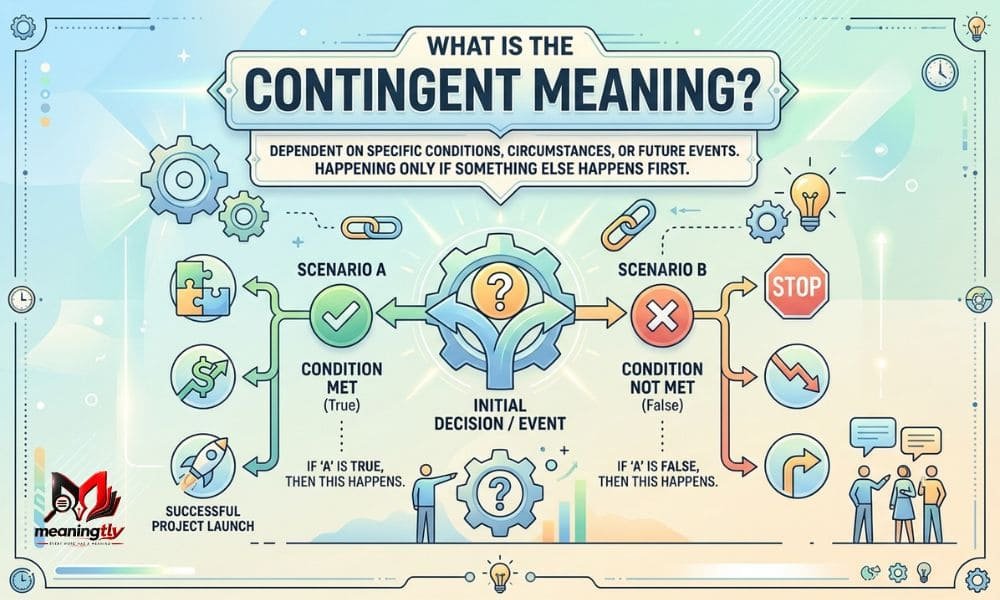
The contingent meaning is “dependent on a condition or event.”
Something contingent may happen. It may not. It all depends.
Dictionaries often describe it as “possible but not certain.” Others say it is “determined by conditions that follow.”
Here is a simple example:
- Your picnic is contingent on good weather.
- If it rains, the picnic is off.
The picnic depends on the weather. That is the core contingent meaning.
Contingent Meaning in One Line
Contingent means “it will happen only if something else happens first.”
Use this line when you need a fast answer. It fits most situations.
Quick Definition Table
| Word Form | Simple Meaning | Example |
| Contingent (adjective) | Depends on something else | The deal is contingent on approval. |
| Contingent (adjective) | Possible but not certain | A contingent event may not occur. |
| Contingent (noun) | A group that is part of a larger group | A contingent of athletes arrived. |
| Contingency (noun) | A possible event you plan for | We have a backup plan. |
Where the Word Comes From
The word comes from the Latin contingere. It means “to touch” or “to happen.”
Think of two things touching. One affects the other. That link is the heart of the contingent meaning.
The word entered English hundreds of years ago. Early on, it meant “liable to happen or not.” The noun contingency appeared in the 1500s.
Over time, the word grew new senses. Today it appears in many fields.
Main Types of Contingent Meaning
The word works in two ways. It can be an adjective. It can also be a noun.
Each one has a different contingent meaning. Do not mix them up.
Contingent as an Adjective
This is the most common use. It has three main senses.
- Depends on a condition. Example: “Her raise is contingent on the budget.”
- Possible but uncertain. Example: “Contingent events are hard to predict.”
- Caused by chance. Example: “It was a contingent outcome, not a planned one.”
In all three, the contingent meaning points to uncertainty.
Contingent as a Noun
As a noun, the word means a group. The group represents or joins a larger body.
Here are some examples:
- A contingent of troops joined the larger force.
- Each nation sent a contingent to the Olympics.
- A small contingent of fans waited outside.
This contingent meaning has nothing to do with conditions. It is about people grouped together.
Compare the Two Uses
| Part of Speech | Contingent Meaning | Sample Sentence |
| Adjective | Dependent on something | Payment is contingent on delivery. |
| Adjective | Uncertain | The plan is still contingent. |
| Noun | A representative group | A contingent of nurses volunteered. |
| Noun | A military unit | One British contingent joined the mission. |
Contingent vs. Contingency vs. Contingently
These words are related. They are not the same.
| Word | Type | Meaning | Example |
| Contingent | Adjective or noun | Dependent, or a group | The offer is contingent. |
| Contingency | Noun | A possible future event or a condition | Plan for every contingency. |
| Contingently | Adverb | In a dependent way | The loan was approved contingently. |
The contingent meaning stays close to “depends on.” The word contingency is the thing you plan for.
Think of it like this:
- A contingency is the “what if.”
- Something contingent is the “only if.”
Synonyms and Antonyms
Knowing similar words helps you grasp the contingent meaning faster.
Synonyms
| Synonym | Best Used When |
| Dependent | Something relies on another thing |
| Conditional | A condition must be met |
| Subject to | A formal or legal tone |
| Provisional | Something is temporary |
| Uncertain | The outcome is not known |
| Accidental | Chance caused it |
Antonyms
| Antonym | Meaning |
| Unconditional | No conditions attached |
| Certain | Sure to happen |
| Independent | Relies on nothing else |
| Necessary | Must happen |
| Guaranteed | Fully assured |
An unconditional offer has no contingent meaning at all. Nothing else needs to happen.
Contingent Meaning in Real Estate
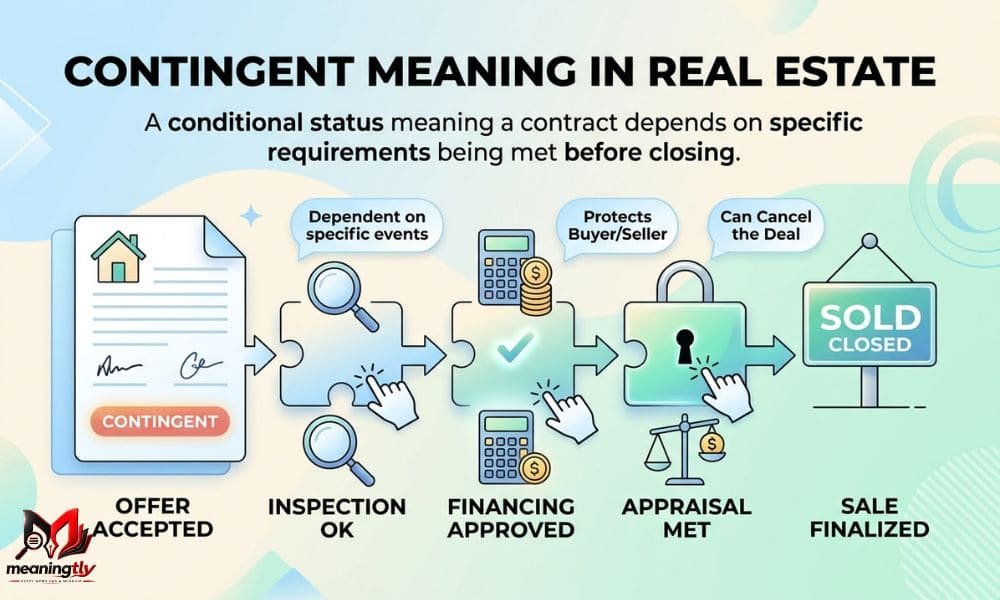
Most people search for this term because of house listings. So let’s cover it well.
In real estate, the contingent meaning is easy. The seller accepted an offer. But the sale is not final yet. Some conditions must be met first.
BDE Meaning in Text: How to Use It in Conversations(2026)
What Does a Contingent Listing Mean?
A contingent listing means the home has a buyer. But the deal depends on one or more conditions.
If the conditions are met, the sale moves forward. If not, the deal can end.
The buyer and seller have passed the offer stage. Yet the agreement still holds open questions.
How a Contingent Offer Works
Here is the usual path:
- The buyer makes an offer with conditions.
- The seller accepts the offer.
- The listing changes to “contingent.”
- The buyer works to meet each condition.
- Each condition is cleared or waived.
- The status moves toward “pending.”
- The sale closes.
If a condition fails, the buyer may walk away. Often, the buyer gets the deposit back.
Common Home Sale Contingencies
Several conditions appear again and again. Each one shapes the contingent meaning in a home deal.
| Contingency | What It Means | Why It Matters |
| Inspection | A pro checks the home | Finds hidden defects |
| Financing | The buyer must get a loan | Protects the buyer’s deposit |
| Appraisal | The home must value at the price | Stops overpaying |
| Home sale | The buyer must sell their own home first | Frees up needed funds |
| Title | The title must be clear | Avoids ownership disputes |
| Attorney review | A lawyer reviews the contract | Allowed in some regions |
Inspection Contingency
This is the most common one. The buyer hires an inspector.
If the report shows big problems, the buyer has choices:
- Ask the seller to fix the issues.
- Ask for a lower price.
- Cancel the deal.
Financing Contingency
Most buyers need a mortgage. This condition protects them if the loan is denied.
Without it, a buyer could lose their deposit. That is a real risk.
Appraisal Contingency
The lender orders an appraisal. It checks the home’s market value.
If the value comes in low, the buyer can renegotiate. They can also leave.
Home Sale Contingency
Some buyers must sell their current home first. The new purchase depends on that sale.
Sellers often dislike this one. It adds delay and risk.
Contingent vs. Pending
These two statuses confuse many buyers. They are close but not equal.
| Feature | Contingent | Pending |
| Conditions left | Yes | Usually none |
| Risk of falling through | Higher | Lower |
| Stage | Earlier | Later |
| Can others still bid? | Sometimes | Rarely |
| Next step | Clear the conditions | Close the sale |
A contingent sale is conditional. A pending sale is closer to done.
Can You Still Make an Offer?
Often, yes. Some sellers accept backup offers on contingent homes.
Your offer would only matter if the first deal fails. Ask the listing agent about it.
Why Contingent Deals Fall Through
Closing a sale is complex. Things can go wrong.
Common reasons include:
- The inspection finds big problems.
- The loan is denied.
- The appraisal is too low.
- The buyer cannot sell their old home.
- The title has legal issues.
So keep an eye on contingent listings. They may return to active status.
Tips for Buyers
- Read every contingency in your offer.
- Note each deadline.
- Never skip the inspection to save money.
- Talk to your lender early.
- Ask your agent about risks.
Tips for Sellers
- Review each contingency before you accept.
- Set clear time limits.
- Consider a “kick-out” clause. It lets you keep showing the home.
- Compare offers with fewer conditions.
- Stay in touch with the buyer’s agent.
Contingent Meaning in Law
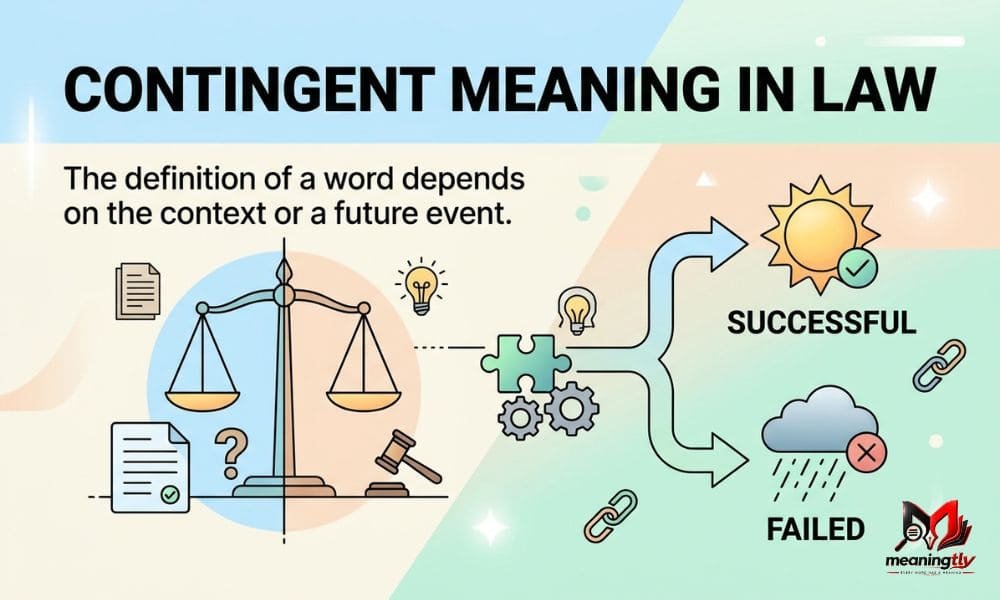
Law uses the word in a precise way. Here, the contingent meaning is tied to conditions and uncertain future events.
What Is a Contingent Contract?
A contingent contract depends on an uncertain event. That event is separate from the deal itself.
Neither side controls it directly. It might be a regulatory approval. It might be a market change. It might be a third party’s action.
In plain terms, the contract only works if the event occurs.
Simple Example
Anna agrees to pay Ben $1,000 if his ship arrives safely. The payment depends on the ship’s arrival.
If the ship sinks, Anna owes nothing. That is a contingent contract.
Key Features
A contingent contract usually has these traits:
- It depends on a future event.
- The event is uncertain.
- The event is outside the main promise.
- Neither party fully controls it.
- The law can enforce it once the event occurs.
Condition vs. Contingency
Lawyers separate these two ideas. They sound alike but differ.
| Term | Meaning | Example |
| Condition | A term that must be met for a duty to start | Pay the deposit before moving in. |
| Contingency | An outside event that affects the deal | Loan approval from a bank. |
The contingent meaning in law leans on contingency. It implies uncertainty and dependence on a future event.
Contingent Fee
Some lawyers work on a contingent fee. They get paid only if you win.
If the case is lost, you owe no legal fee. If it is won, the lawyer takes a share.
This setup is common in injury cases. It helps people who cannot pay upfront.
Contingent Interest
In wills and trusts, a contingent interest depends on an event. For example, a grandchild may inherit only after turning 25.
Until then, the right is not fixed. That is the contingent meaning in estate law.
Contingent Meaning in Insurance
In insurance, the contingent meaning refers to a trigger. Something must happen before coverage starts or pays out.
It works like a switch. No trigger, no payment.
How Insurance Triggers Work
Policies often list events that activate coverage. Examples include:
- A fire damaging your home.
- A covered illness requiring care.
- A death that activates a life policy.
Read the fine print. It tells you which events count.
Contingent Beneficiary
A beneficiary gets the payout from a policy. A contingent beneficiary is the backup.
They only receive money if the main beneficiary cannot. For example, the main person may have died before you.
| Role | Who Gets Paid |
| Primary beneficiary | First in line |
| Contingent beneficiary | Next, if the first cannot |
Always name both. It avoids court delays.
Contingent Business Interruption
Some business policies cover losses caused by a supplier’s problem. If your key supplier shuts down, your sales may drop.
This coverage depends on that outside event. It is another form of the contingent meaning in insurance.
Tips for Policyholders
- Ask your insurer to explain each trigger.
- Keep your beneficiary list current.
- Review policies once a year.
- Keep records of all claims.
Contingent Meaning in Business and Finance
Companies deal with uncertain events all the time. So the contingent meaning shows up often in accounting and planning.
Contingent Liability
A contingent liability is a possible debt. It depends on a future event.
A lawsuit is a good example. The company may owe money. Or it may not.
| Likelihood | Accounting Treatment |
| Probable and measurable | Record it |
| Possible but not probable | Disclose it in notes |
| Remote | Usually no action |
Rules vary by country and standard. Check the rules that apply to you.
Contingent Asset
This is the reverse. It is a possible gain that depends on a future event.
Think of a company expecting a legal settlement. It cannot count the money until it is nearly certain.
Contingent Consideration
This term appears in company purchases. A buyer pays part of the price later. That payment depends on future results.
For example, the buyer may pay more if the company hits a sales target. This is also called an earn-out.
It is close to deferred consideration. The key difference is the uncertainty. Deferred payments are fixed. Contingent ones are not.
Contingency Plan
A contingency plan is a backup plan. It prepares you for things going wrong.
A good plan answers four questions:
- What could go wrong?
- How likely is it?
- What will we do?
- Who is in charge?
Businesses use these plans for outages, storms, and supply issues. Individuals use them too.
Contingency Fund
A contingency fund is saved money for surprises. Some people call it an emergency fund.
Projects often add a contingency line to the budget. It covers costs nobody expected.
Contingent Meaning in Employment
Work also uses this word. Here, the contingent meaning covers a type of worker.
What Is a Contingent Worker?
A contingent worker does not hold a permanent job. Their work is temporary or tied to a project.
Examples include:
- Freelancers
- Contractors
- Consultants
- Temporary staff
- Seasonal workers
Contingent Workforce
The group of such workers is the contingent workforce. Many firms rely on it for flexibility.
| Feature | Contingent Worker | Permanent Employee |
| Contract length | Short or fixed | Open-ended |
| Benefits | Often fewer | Usually more |
| Flexibility | High | Lower |
| Job security | Lower | Higher |
Contingent Job Offer
You may also get a contingent job offer. It is valid only if you pass some checks.
Common checks include:
- Background screening
- Reference calls
- Drug tests
- Proof of work eligibility
Do not quit your current job before the offer becomes final.
Contingent Meaning in Philosophy
Philosophers use the word in a deeper way. Here, the contingent meaning is about what must be true and what only happens to be true.
Modes of Being
Philosophy often lists four modes:
- Necessity
- Contingency
- Possibility
- Impossibility
A necessary thing must exist or be true. A contingent thing could be otherwise.
Contingent vs. Necessary Truths
| Type | Meaning | Example |
| Necessary truth | True in every case | 2 + 2 = 4 |
| Contingent truth | True, but could have been false | It rained in Lahore last Monday. |
A contingent truth depends on facts about the world. A different world could change it.
Contingent Being
A contingent being does not have to exist. It exists because of other causes.
You are a contingent being. Your birth depended on many events.
Some thinkers use this idea in arguments about the origin of the universe. They ask what the final cause might be.
Link to Freedom and Choice
Contingency also ties to choice. If outcomes were fixed, choices would not matter.
Because things are contingent, people can act. The contingent meaning supports the idea of free will for many writers.
Contingent Upon vs. Contingent On
Both phrases are correct. They mean the same thing.
| Phrase | Tone | Example |
| Contingent on | Everyday | Your pay is contingent on results. |
| Contingent upon | More formal | The grant is contingent upon approval. |
Use “on” for most writing. Use “upon” in formal papers.
Avoid “contingent to” or “contingent with.” These are wrong.
Examples of Contingent in Sentences
Seeing the word in action helps. Here are examples across different fields.
Everyday Life
- Our trip is contingent on the weather.
- His success was contingent on hard work.
- The party is contingent upon finding a venue.
Real Estate
- The house is contingent on a clean inspection.
- Their offer was contingent on the sale of their condo.
Business
- The bonus is contingent on sales targets.
- Funding is contingent upon board approval.
Law and Insurance
- The lawyer works on a contingent fee.
- She named her brother as the contingent beneficiary.
Noun Use
- A contingent of students joined the march.
- The country sent a large contingent to the games.
Common Mistakes to Avoid
Many people misuse this word. Watch for these errors.
Mixing Up Contingent and Pending
A contingent home still has open conditions. A pending home is nearly sold. They are not twins.
Confusing Contingent with Continuous
The words look alike. They mean different things.
- Contingent: depends on something.
- Continuous: goes on without a break.
Using the Wrong Preposition
Say “contingent on” or “contingent upon.” Do not say “contingent of” in the adjective sense.
Assuming a Contingent Deal Is Safe
A contingent sale can still fail. Treat it as unfinished business.
Ignoring Deadlines
Contingencies have time limits. Miss one, and you may lose your rights.
Easy Ways to Remember the Meaning
A few tricks make the word stick.
- Link it to “if.” Contingent means “if this, then that.”
- Remember the Latin root. Touching means connected.
- Picture a domino. One falls only if another falls first.
- Use the picnic test. If rain cancels it, it is contingent.
- Say it aloud. “Depends on” is a safe swap in most cases.
Quick Self-Test
Ask yourself two questions:
- Does something else need to happen first?
- Is the outcome uncertain?
If both answers are yes, the contingent meaning fits.
Esoteric Meaning: Powerful Insights & Hidden Truths(2026)
Why Understanding This Word Matters
The contingent meaning affects real decisions. Buying a house is one. Signing a contract is another.
Misreading a contingent clause can cost money. Missing a deadline can end a deal.
Clear understanding gives you power. You can ask better questions. You can protect yourself.
It also improves your writing. You can pick the right word at the right time.
Conclusion
Meaning is not fixed. It changes with the situation. A word can carry one sense in one place and another sense somewhere else. We cannot judge it without its context.
The same idea works in daily life. A smile can mean joy, shyness, or even sarcasm. A silence can show peace or anger. People read these signs through what they know. That is why two people can hear the same thing and understand it differently.
Culture and time also shape meaning. Words that were polite long ago may sound rude today. Gestures change from one country to another. What feels normal to us may feel strange to others. Meaning grows and shifts with the people who use it.
So, contingent meaning teaches us to be careful and kind. We should not rush to judge what we hear or see. Asking questions helps us understand better. In the end, meaning lives in context, and context is always changing.
Frequently Asked Questions (FAQs)
What Is a Synonym of Contingent?
Synonyms of contingent include conditional, dependent, subject to, provisional, and uncertain.
What Is an Example of Contingent?
An example of contingent is a job offer that depends on passing a background check.
What Is the Legal Definition of Contingent?
Legally, contingent means something that depends on a future event or condition before it becomes effective.
What Is a Contingent Offer?
A contingent offer is an offer that depends on certain conditions being met before it becomes final.
What Is a Contingent Contract?
A contingent contract is an agreement that becomes enforceable only when a specified uncertain future event occurs.
Is a Contingent Offer Binding?
Yes, a contingent offer can be legally binding once accepted, depending on its terms and applicable law.

1 thought on “Contingent Meaning: Powerful Definition & Examples (2026)”