“Nefarious” is an adjective. It describes something very wicked or evil. People use it for actions that are criminal or deeply immoral. The word sounds serious, and it is. It carries a strong sense of wrongdoing.
The word comes from Latin. It began as “nefarius,” which meant impious or wicked. It was formed from “ne” (not) and “fas” (divine law). So it once meant going against what was right and lawful. Over time, English borrowed it in the 1600s. Today it still keeps that dark meaning.
You can use it in daily life. A villain in a movie has a nefarious plan. A hacker may carry out a nefarious scheme. A dishonest person may have nefarious motives. It is mostly used for plots, plans, and intentions.
Some words are close in meaning. These include evil, wicked, villainous, and sinister. Opposites are good, honest, and virtuous. Use “nefarious” when you want a stronger tone. It makes your writing sound bold and vivid.
Nefarious Meaning
Nefarious Meaning in Simple Words

Nefarious meaning extremely wicked, evil, or criminal. It is an adjective. It tells us that something is deeply wrong or immoral.
Think of a villain in a comic book. He plans to harm a whole city. His plan is nefarious.
Now think of a real case. A group steals money from old people. Their scheme is also nefarious.
The word always points to bad intent. A nefarious act is not an accident. Someone chose to do wrong.
Here is a simple way to see it:
- It describes actions, plans, people, and motives.
- It suggests serious wrongdoing.
- It often hints at secrecy or planning.
- It carries a strong, negative tone.
Quick Facts About Nefarious
This table gives you the key points at a glance.
| Feature | Details |
| Word | Nefarious |
| Part of speech | Adjective |
| Simple meaning | Very wicked or evil |
| Pronunciation | nih-FAIR-ee-us |
| Adverb form | Nefariously |
| Noun form | Nefariousness |
| Origin | Latin (nefarius) |
| Tone | Strong and negative |
| Common use | News, books, films, daily talk |
How to Pronounce Nefarious
The word has four syllables. Say it as nih-FAIR-ee-us. The stress falls on the second syllable.
In American English, many people say /nɪˈfɛriəs/. In British English, it sounds closer to /nɪˈfeəriəs/. Both are fine.
Some speakers say “nih-FAR-ee-us.” You may hear this too. Dictionaries list more than one way to say it.
Here is a simple breakdown:
- ne sounds like “nih”
- far sounds like “fair”
- i sounds like “ee”
- ous sounds like “us”
A good tip helps here. Say the word slowly first. Then say it faster, with the beat on “fair.”
What Dictionaries Say
Major dictionaries agree on the core nefarious meaning. They use slightly different words.
Merriam-Webster describes it as flagrantly wicked or corrupt. Its kids edition keeps it short: very wicked, evil. Dictionary.com calls it extremely wicked or villainous. It also links the word to the term iniquitous.
The British sense is just as clear. It means evil, wicked, or sinful.
All sources share three ideas:
- The act is very bad.
- The act is morally wrong.
- The person behind it means harm.
No dictionary treats nefarious as a mild word. It always sits at the heavy end of the scale.
Origin of the Word Nefarious
Every word has a story. The story of nefarious is short and interesting.
The word comes from Latin. The Latin form is nefarius. That word grew from nefas.
Nefas meant a crime or a sin. More exactly, it meant something against divine or moral law.
Breaking Down the Roots
Nefas has two parts:
- ne- means “not”
- fas means “right” or “divine law”
So nefas simply means “not right.” It points to acts that break sacred or moral rules.
When It Entered English
The word entered English around the start of the 1600s. Dictionary records place its first use between 1595 and 1605. Writers of that time loved strong, dramatic Latin words.
Over time, the religious sense faded. Today the word is used for any serious wrongdoing. It no longer needs a sacred setting.
A Short Timeline
| Stage | What happened |
| Ancient Latin | Nefas meant a crime against divine law |
| Latin adjective | Nefarius meant wicked or vile |
| Early 1600s | English writers adopted nefarious |
| Modern era | Used for crime, schemes, and villains |
Word Forms of Nefarious
One root gives us three useful forms. Each one has its own job.
| Form | Type | Example |
| Nefarious | Adjective | The thief had a nefarious motive. |
| Nefariously | Adverb | He acted nefariously for years. |
| Nefariousness | Noun | The nefariousness of the plot shocked everyone. |
The comparative forms are “more nefarious” and “most nefarious.” We do not add -er or -est to this word.
Example: “This was the most nefarious plan of all.”
ASMR Meaning: Fascinating Facts You Should Know(2026)
Synonyms of Nefarious
A synonym is a word with a similar meaning. Many words match the nefarious meaning closely.
Here are the most common ones:
- Evil
- Wicked
- Villainous
- Sinister
- Heinous
- Iniquitous
- Vile
- Corrupt
- Malicious
- Depraved
- Infamous
- Atrocious
No two synonyms are identical. Each has its own shade. The next table shows the difference.
| Synonym | Shade of meaning |
| Evil | Deeply bad, often moral or spiritual |
| Wicked | Morally wrong, often used in stories |
| Villainous | Like a villain, fits plots and schemes |
| Sinister | Hints at hidden danger |
| Heinous | Shockingly cruel, often for crimes |
| Iniquitous | Grossly unfair and unjust |
| Malicious | Done to hurt someone on purpose |
| Corrupt | Dishonest, often tied to power or money |
Antonyms of Nefarious
An antonym is the opposite. If nefarious meaning very bad, its opposites mean good.
Common antonyms include:
- Virtuous
- Moral
- Ethical
- Honest
- Noble
- Righteous
- Decent
- Upright
Look at the pair “nefarious” and “noble.” One describes a harmful plan. The other describes a selfless one.
Example: “The nefarious baron ruined the village. The noble doctor saved it.”
Nefarious vs Similar Words
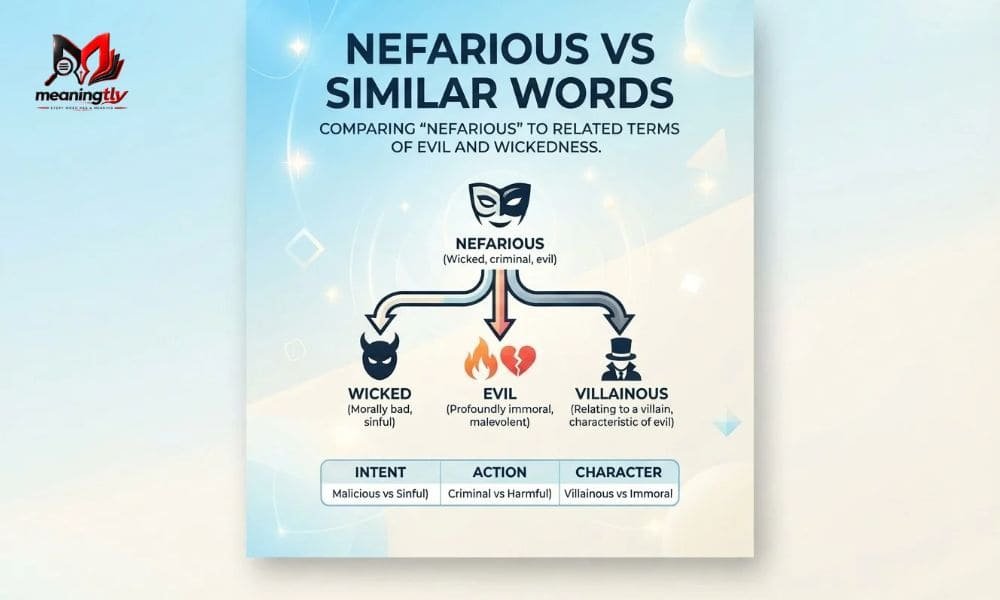
Many learners mix nefarious with other strong words. This is normal. Let us clear it up.
Nefarious vs Evil
Evil is broad. It can describe a force, a person, or an idea. Nefarious is narrower. It usually describes plans, acts, or schemes.
You can say “an evil king.” You can also say “a nefarious plot.” The second feels more planned.
Nefarious vs Notorious
These two sound a bit alike. They are not the same. Notorious means widely known for something bad.
A notorious thief is famous for stealing. A nefarious thief is wicked in what he does. Fame is not required.
Nefarious vs Villainous
Both words suit stories well. Villainous focuses on the character. Nefarious often focuses on the deed or the aim.
Nefarious vs Malicious
Malicious means wanting to hurt others. It can be small. A cruel rumor can be malicious. Nefarious is heavier and usually involves serious wrongdoing.
Side-by-Side Comparison
| Word | Main focus | Strength |
| Nefarious | Wicked plans and acts | Very strong |
| Evil | Deep moral badness | Very strong |
| Notorious | Fame for bad deeds | Medium |
| Malicious | Intent to hurt | Medium to strong |
| Sinister | Hidden threat | Medium |
| Heinous | Shocking cruelty | Very strong |
Nefarious Meaning in Urdu and Hindi
Many readers like to link English words to their own language. This helps memory.
In Hindi, the word is often shown as kutil. It points to someone crafty and wicked.
In Urdu, close matches are badkaar, shareer, and bad-niyat. They describe a person with bad aims. For a scheme, you could say mujrimana saazish, which means a criminal plot.
In simple Roman Urdu: nefarious ka matlab hai “bohat bura aur gunah se bhara hua.”
Note that no single word fits every case. The best translation depends on the sentence.
Nefarious Example Sentences
Examples make the nefarious meaning easy to feel. Here are sentences from different settings.
Everyday Life
- The neighbor had a nefarious plan to steal our parcels.
- I do not trust him. His smile hides something nefarious.
- She uncovered a nefarious trick in the contract.
News and Crime
- Police stopped a nefarious ring that sold fake medicine.
- Hackers used the app for nefarious purposes.
- The report exposed nefarious deals between two officials.
- Investigators linked the money to nefarious activities abroad.
Stories and Films
- The nefarious wizard wanted the crown for himself.
- In the last scene, the hero foils the nefarious scheme.
- The queen’s nefarious motives were clear from the start.
Business and Tech
- The firm denied any nefarious intent behind the data leak.
- Nefarious actors can misuse weak passwords.
- The audit found no nefarious behavior, only poor training.
Light and Playful
- My cat had a nefarious look before she knocked the glass off the table.
- He laughed in his most nefarious voice and stole the last biscuit.
Words That Go With Nefarious
Some words appear next to nefarious again and again. These pairs are called collocations. Learning them makes your English sound natural.
| Pair | Example |
| Nefarious purposes | The tool was used for nefarious purposes. |
| Nefarious plot | Agents stopped the nefarious plot. |
| Nefarious scheme | A nefarious scheme cost them millions. |
| Nefarious activities | The group hid its nefarious activities. |
| Nefarious actors | Nefarious actors target weak systems. |
| Nefarious intent | There was no nefarious intent. |
| Nefarious means | He gained power by nefarious means. |
| Nefarious deeds | The villain’s nefarious deeds were many. |
Nefarious in News and Politics
Journalists use the word often. It adds weight to stories about crime and corruption.
You may read about nefarious actors in online security reports. These are people who misuse systems. You may also read about nefarious activity in finance stories.
A good writer uses care here. The word accuses someone of real wrongdoing. It should not be used without proof.
In news, the word often appears in phrases like:
- “for nefarious reasons”
- “nefarious activity”
- “no evidence of nefarious intent”
That last phrase is very common. It shows that the word is also used to clear someone’s name.
Nefarious in Books, Films and Games
Fiction loves this word. Villains need big plans, and nefarious fits them well.
Comic books are full of nefarious plots. Heroes stop them in the last pages. Cartoons use the word too, often with a funny twist.
Video games use it for evil bosses and dark armies. Fantasy novels use it for dark lords and cruel rulers.
Why does it work so well in stories?
- It sounds dramatic.
- It hints at secret planning.
- It paints a clear picture of evil.
- It is fun to say out loud.
This fictional use has also shaped how people see the word. Many now link it to masterminds and big schemes.
ALR Meaning: Complete Guide to Its Use, Slang & Examples (2026)
Is Nefarious Always Serious?
Mostly yes. But people also use it with a wink.
Imagine a friend who sneaks the last slice of cake. You might say, “That was a nefarious move.” Everyone laughs. Nobody thinks it is a crime.
This is called ironic or playful use. You blow a small thing up on purpose. The humor comes from the gap between the strong word and the tiny act.
Here is a simple rule:
- In serious writing, keep it for real wrongdoing.
- In casual chat, you can use it as a joke.
- Make sure the tone is clear to your reader.
When to Use Nefarious
Use nefarious when you want a strong, dark word. It fits best in these cases:
- Crime and fraud: “The company ran a nefarious scam.”
- Secret plans: “They met to plan something nefarious.”
- Villains in stories: “The nefarious count locked the gates.”
- Online threats: “Nefarious users spread harmful links.”
- Jokes: “My nefarious plan is to nap all day.”
It works well in essays, news, fiction, and speeches. It also helps in exam writing. A strong word like this can lift your vocabulary score.
When Not to Use Nefarious
Skip it when the matter is small. A late bus is not nefarious. A rude comment is usually not nefarious either.
Avoid it when you lack facts. Calling someone nefarious without proof is unfair. In some places, it can even cause legal trouble.
Also skip it when plain words work better. “Bad” or “harmful” may be clearer for a simple message. Use the strong word only when it adds value.
Common Mistakes With Nefarious
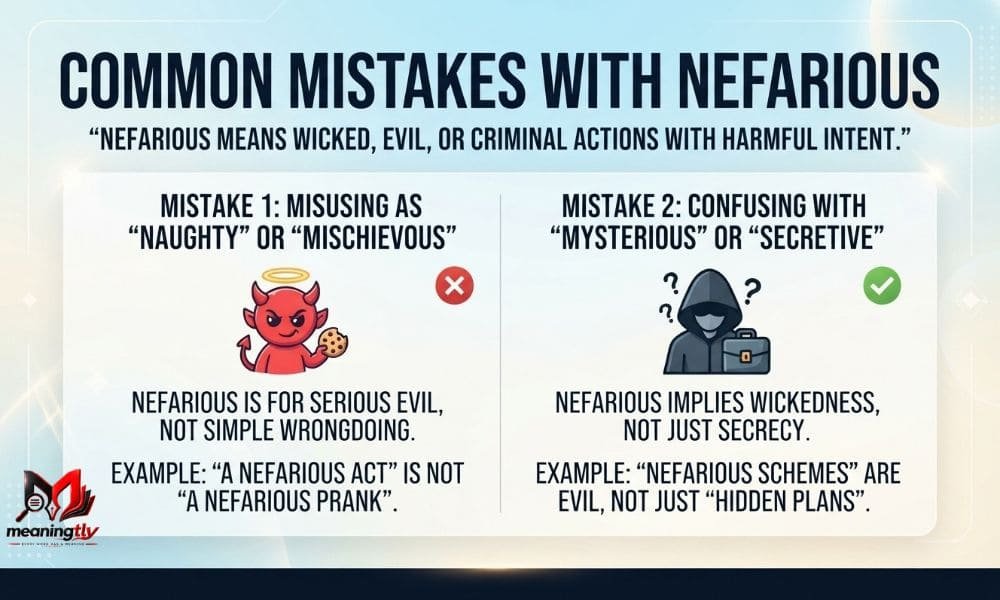
Watch out for these errors.
Wrong Spelling
The correct spelling is nefarious. Some people write “nefarius,” “nefarous,” or “neferious.” All of these are wrong.
Mixing It With Notorious
Notorious means famous for bad things. Nefarious means wicked. They are cousins, not twins.
Using It for Small Things
Calling a spilled drink “nefarious” sounds odd. Unless you are joking, save it for serious cases.
Wrong Word Form
Do not say “nefariousity.” The noun is nefariousness. The adverb is nefariously.
Wrong Pronunciation
Some learners say “nee-FAR-ious” with a long first sound. The first syllable is short, like “nih.”
Easy Tricks to Remember Nefarious
A memory trick can lock the word in your mind.
Trick 1: Sound it out. Say “nih-FAIR-ee-us.” Then think: “not fair at all.” Nefarious deeds are never fair.
Trick 2: Use the roots. Remember ne- means “not.” Fas means “right.” So nefarious means “not right.”
Trick 3: Picture a villain. Draw a cartoon villain with a long cape. Write “nefarious plan” above his head.
Trick 4: Write your own line. Make one sentence about your own life. A personal line sticks better than a copied one.
Quick Quiz: Test Yourself
Try these five questions. Answers follow right after.
- Which word is closest to nefarious: kind, wicked, or funny?
- Is nefarious a noun, verb, or adjective?
- What does the Latin root ne- mean?
- Which is the correct noun form: nefariousness or nefariousity?
- Fill in the blank: The spy had a ____ plan to steal secrets.
Answers: 1) wicked. 2) adjective. 3) not. 4) nefariousness. 5) nefarious.
CLFS Meaning: Complete Definition, Uses & Texting Examples (2026)
Why Learn This Word?
Good vocabulary helps in school, work, and daily life. Nefarious is a useful mid-level word. It appears in exams, articles, and novels.
Knowing the nefarious meaning also helps you read news with care. You can tell when a writer is making a strong claim. You can judge whether that claim is fair.
It also makes your own writing sharper. One precise word often beats three weak ones.
Conclusion
The word “nefarious” means very wicked or evil. It describes actions that are deeply wrong. People use it for bad plans and bad deeds. It is a strong word. It is not used for small mistakes.
The word comes from the Latin word “nefarius.” That word means against the law of God. Over time, it grew to mean any evil act. Today, we use it in books, news, and daily talk. It still carries a heavy, dark feeling.
You can use “nefarious” in many ways. A thief may have a nefarious plan. A villain in a movie may have nefarious goals. Hackers may do nefarious things online. The word always points to bad intent.
In the end, “nefarious” is a powerful word. It helps us describe true wrongdoing. Knowing it makes our language richer. Use it with care, and use it well.
FAQs About Nefarious Meaning
What is the meaning of nefarious?
Nefarious means extremely wicked, evil, or criminal. It describes bad acts, plans, or people.
What is the simple nefarious meaning for kids?
It means very bad and evil. A villain with a mean plan is nefarious.
How do you pronounce nefarious?
Say it as nih-FAIR-ee-us. The stress is on the second syllable.
What part of speech is nefarious?
Nefarious is an adjective. Its adverb is nefariously and its noun is nefariousness.
Where does the word nefarious come from?
It comes from the Latin word nefarius. That grew from nefas, meaning a crime against divine law.

1 thought on “Nefarious Meaning: Powerful Definition, Origin & Examples (2026) ”