“Habibi” is an Arabic word that means “my love” or “my dear.” People use it for a man or a boy they care about. For a woman or a girl, the word is “Habibti.” The word comes from the Arabic root “hubb,” which means love.
Habibi is used in many ways. Couples say it to show love. Friends use it to greet each other. Parents say it to their children with warmth. Even shopkeepers may call you habibi to be friendly.
The word is popular across the Arab world. You will hear it in Egypt, Lebanon, Saudi Arabia, and many other countries. Songs and movies use it a lot too. Because of this, people outside the Arab world now know it well.
The meaning can change with the tone. It can be soft and romantic. It can also be playful or just polite. Sometimes it is even said in a joking way. It is a small word with a big feeling.
Habibi Meaning
Habibi Meaning at a Glance
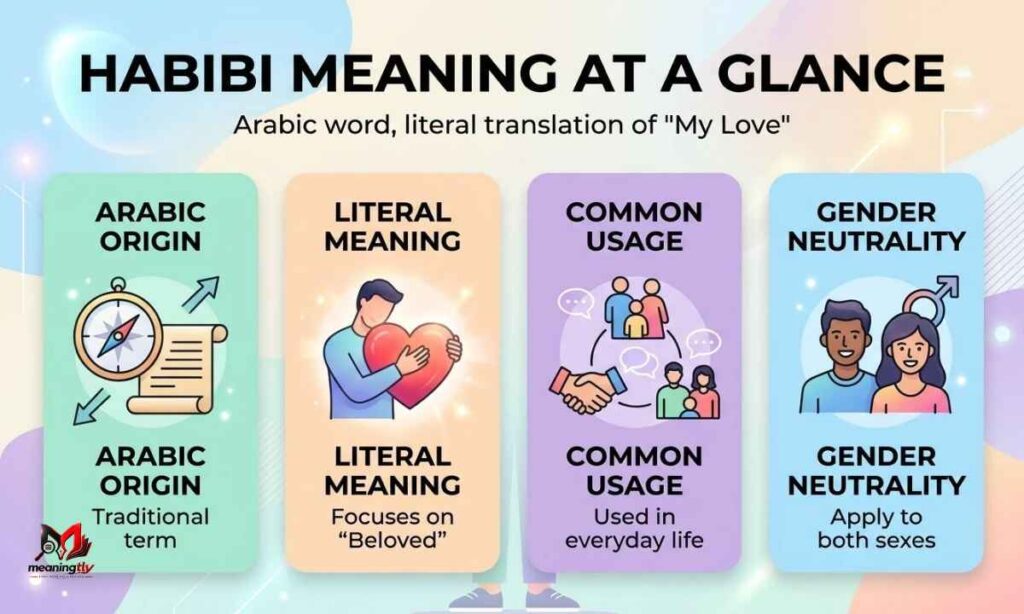
Habibi meaning: Habibi is an Arabic term of endearment. It means “my beloved,” “my love,” or “my dear.” People use it for romantic partners, friends, and family.
| Word | Arabic | Sounds like | Meaning | Used for |
| Habibi | حبيبي | ha-BEE-bee | My beloved, my dear | Males (and casually, anyone) |
| Habibti | حبيبتي | ha-BEEB-tee | My beloved, my dear | Females |
| Habib | حبيب | ha-BEEB | Beloved, dear one | Males; also a given name |
What Is the Habibi Meaning in English?
The Literal Translation
Literally, habibi means “my beloved.” It is built from “habib,” which means “beloved.” The ending “-i” means “my.”
So the habibi meaning is close to “my loved one.”
The Natural Translation
English has no perfect match. The best match depends on the situation.
- With a partner: “my love,” “darling,” “sweetheart”
- With a friend: “buddy,” “mate,” “dear friend”
- With a stranger: “my friend,” “pal,” “dear”
The Feeling Behind the Word
Habibi carries warmth. It is softer than “dude” and lighter than “darling.”
Many Arabic speakers use it all day without thinking. It works like a verbal smile.
Habibi Origin and Root
The Root H-B-B
Habibi comes from the Arabic root ح-ب-ب (h-b-b). This root is tied to love and affection.
Many Arabic words share it. “Hubb” means love. “Yuhibb” means he loves. “Mahabba” means affection.
So the habibi meaning sits inside a large family of love words.
What the Ending -i Does
The final “-i” is a possessive. It turns “beloved” into “my beloved.”
Arabic uses this trick all the time. The same ending appears in “qalbi” (my heart) and “hayati” (my life).
Habib vs Habibi
“Habib” means “beloved” or “dear one.” It is also a common given name.
“Habibi” adds the “my.” That makes it personal. It is something you say to someone, not just about someone.
Habibi vs Habibti
Arabic is a gendered language. So the word changes with the person you are talking to.
| Feature | Habibi | Habibti |
| Arabic | حبيبي | حبيبتي |
| Spoken to | A man or boy | A woman or girl |
| Core meaning | My beloved | My beloved |
| Romantic use | Yes | Yes |
| Friendly use | Yes | Yes |
Using Habibi for Everyone
In casual speech, some people say habibi to anyone. This is common in some Levantine and Egyptian settings.
Still, the careful rule is easy. Use habibi for men. Use habibti for women.
Talking to a Group
For a group, many speakers say “habaybi” (حبايبي). It means “my loved ones.”
You may hear it from a host, a teacher, or a streamer greeting an audience.
How Is Habibi Used in Daily Life?
The habibi meaning stays the same. The feeling changes with the person and place.
Between Couples
Partners use habibi as a pet name. It is the Arabic version of “babe” or “my love.”
Here it carries real romance. The tone is soft. The words around it are often tender too.
Between Friends
Friends use it to show closeness. It can be playful.
A friend might say, “Thanks, habibi,” after you help them. It means “thanks, dear friend.” Nothing more.
Within Families
Parents call their children habibi or habibti. Children say it back. Siblings use it too.
In families, the word is full of care. It is not romantic at all.
With Strangers
Shopkeepers, drivers, and neighbors often say it. It works like a friendly “my friend.”
In this case, the habibi meaning is light. It is polite warmth, not deep love.
In Texts and Online
Many people write it in Latin letters. You might see “habibi,” “hbibi,” or “7abibi.”
The number 7 stands in for the Arabic letter ح. This style is often called Arabizi.
Habibi Meaning in Arabic Dialects
Arabic has many dialects. Habibi is understood in all of them. Small details change.
| Region | Common form | Notes |
| Egypt | ya habibi | “Ya” is often added. Very common. |
| Levant (Lebanon, Syria, Jordan, Palestine) | habibi / ya habibi | Used warmly with friends and family. |
| Gulf (UAE, Saudi, Kuwait, Qatar) | habibi / ya habibi | Common in daily talk. Some speakers prefer other pet names. |
| Maghreb (Morocco, Algeria, Tunisia) | hbibi | Shorter sound. Friends may also say “sahbi.” |
What “Ya” Adds
“Ya” is a calling word. It works like “O” or “hey.”
So “ya habibi” means “hey, my dear.” It sounds a bit more direct and lively.
A Word on Modern Standard Arabic
Modern Standard Arabic is the formal version of the language. It is used in news and books.
Habibi feels more at home in spoken Arabic. That is where you hear it most.
Habibi Meaning in Hindi and Urdu
Many readers from South Asia search for the habibi meaning in Hindi and Urdu. There is no single perfect match. Several words come close.
| Language | Close words | Rough meaning |
| Hindi | प्रिय, प्यारे, जान | Dear, beloved, my life |
| Urdu | پیارے, جان, دوست | Dear, my life, friend |
| Roman Urdu/Hindi | pyare, jaan, yaar, mehboob | Dear, my life, buddy, beloved |
Habib in Urdu
Urdu borrowed “habib” from Arabic. People use it as a name. It also appears in poetry and religious speech.
So many Urdu speakers already feel the root. The word is not foreign to them.
Habibi in Hindi
In Hindi, “हबीबी” is mostly a loan from Arabic pop culture. People know it from songs and reels.
Hindi speakers often translate it as “mere pyare” or “meri jaan.” The tone depends on who is speaking.
Is Habibi Romantic?
Sometimes. Often not.
The habibi meaning includes love. But love in Arabic is wide. It covers family, friends, and partners.
When It Is Romantic
It feels romantic when:
- The speaker is a partner.
- The voice is soft or teasing.
- It comes with other loving words.
When It Is Just Friendly
It feels friendly when:
- It comes from a friend or relative.
- It appears in a joke or a thank-you.
- It is said to many people in a group.
Is It Flirting?
It can be. Context decides.
A stranger who says “habibi” in a warm, lingering way may be flirting. A shopkeeper saying it fast is not. Look at the tone, the setting, and the body language.
Habibi in the Islamic Context
The root of habibi also appears in religious speech. Muslims use “habib” with deep respect.
The Prophet Muhammad ﷺ is known as “Habibullah.” It means “the beloved of God.”
You may hear “ya habibi ya Rasulallah” in devotional poetry and naats. In that setting, the word is sacred and full of reverence.
This is very different from casual street talk. The same root stretches across both worlds.
Habibi in Music, Film, and Pop Culture
Habibi has traveled far from the Arab world. Music did a lot of that work.
Songs
Arabic pop stars have used the word for decades. Amr Diab’s hit “Habibi Ya Nour El Ain” helped carry it to listeners across the world.
Since then, artists in many languages have dropped “habibi” into their songs. It is catchy and easy to sing.
Books and Film
Writers and filmmakers use habibi to signal warmth and place. A character who says it often sounds friendly and close to others.
Craig Thompson even titled a graphic novel “Habibi.”
Social Media
On social media, the word shows up in captions, comments, and memes. Many people use it as a fun, friendly tag.
That wide use makes the habibi meaning popular. It also leads to misuse, which we cover below.
Habibi vs Other Arabic Terms of Endearment
Habibi is not the only sweet word in Arabic. Here are some close ones.
| Term | Arabic | Meaning | Feel |
| Hayati | حياتي | My life | Deep, romantic or family |
| Qalbi | قلبي | My heart | Tender, loving |
| Rouhi | روحي | My soul | Very close, intimate |
| Ayouni | عيوني | My eyes | Warm, caring |
| Azizi | عزيزي | My dear | A bit more polite |
| Omri | عمري | My life/lifetime | Romantic |
Which One Is Strongest?
Words like “rouhi” and “hayati” often feel deeper than habibi. They suggest “you are my soul” or “you are my life.”
Habibi is the everyday option. You can use it with almost anyone close to you.
Azizi vs Habibi
“Azizi” means “my dear.” It can sound a little more formal and polite.
Habibi is warmer. It is also more common in casual speech.
How to Use Habibi Correctly
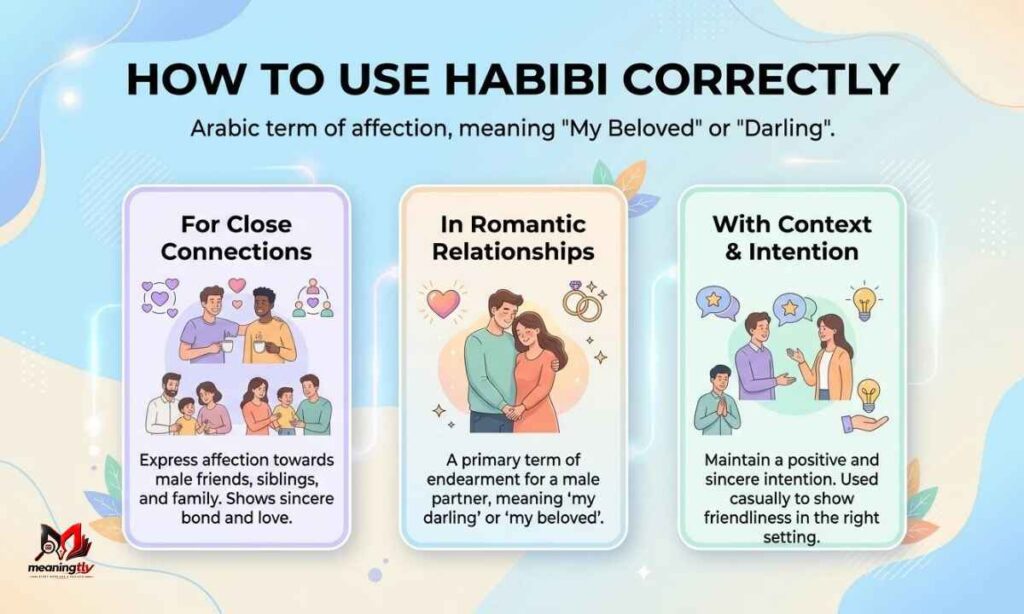
Follow these simple steps.
- Pick the right form. Use habibi for a man. Use habibti for a woman.
- Read the relationship. Is this a partner, friend, family, or a stranger?
- Match the tone. Keep it light with friends. Make it soft with partners.
- Check the setting. Avoid it in formal emails and serious meetings.
- Listen first. If locals say it, you can use it more freely.
- Pronounce it well. Say ha-BEE-bee, with the stress in the middle.
Do’s
- Use it with close friends who use it too.
- Use it with partners and family.
- Say it kindly.
Don’ts
- Do not use it to be sarcastic or mean.
- Do not use it in a formal business message.
- Do not use it with people who may find it too personal.
Pronunciation Tips
The first sound in Arabic is “ḥ.” It is a breathy “h” made deep in the throat. English has no exact match.
A plain English “h” is fine for most chats. Native speakers will still understand you.
Example Sentences With Habibi
Here are simple examples. Each shows a different mood.
| Situation | Example | Meaning |
| Thanking a friend | “Shukran, habibi.” | Thank you, dear friend. |
| Greeting a friend | “Ahlan habibi!” | Hello, my friend! |
| Telling someone to hurry | “Yalla, habibi!” | Come on, my friend! |
| To a partner | “Habibi, I miss you.” | My love, I miss you. |
| To a daughter | “Habibti, come here.” | My dear, come here. |
| Casual agreement | “Tamam, habibi.” | Okay, my friend. |
| Strong promise | “Wallah, habibi.” | I swear, my friend. |
What Yalla Means
“Yalla” means “let’s go” or “come on.” It is a very common Arabic word.
What Wallah Means
“Wallah” means “I swear by God.” It adds emphasis to a statement.
What Shukran Means
“Shukran” means “thank you.” Pair it with habibi for a warm thanks.
Common Mistakes With Habibi
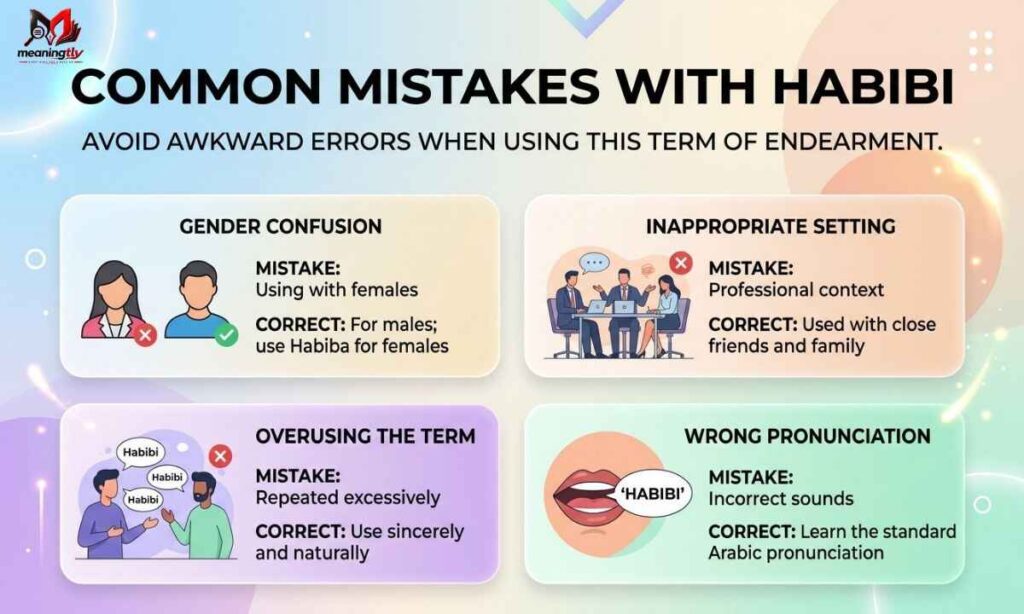
Many learners misuse the word. Here are the usual errors.
Mistake 1: Using the Wrong Gender
Calling a woman “habibi” may sound odd to some speakers. In more careful speech, use habibti.
Mistake 2: Thinking It Is Always Romantic
Habibi is often friendly, not romantic. Reading it as flirting can cause awkward moments.
Mistake 3: Using It in Formal Settings
Habibi is casual. It does not belong in a formal letter or a legal contract.
Mistake 4: Using It Without Context
Do not drop it on people you do not know. Some may feel it is too forward.
Mistake 5: Using It as a Joke
A mocking “habibi” can sound disrespectful. Many Arabic speakers find this annoying.
Can Non-Arabs Say Habibi?
Yes, in the right setting. Many Arabic speakers enjoy hearing it.
Still, be thoughtful.
When It Works
- You are among Arabic-speaking friends.
- You are saying it kindly.
- You know what it means.
When to Hold Back
- You are in a formal setting.
- You are mocking an accent or culture.
- You barely know the person.
A Simple Rule
If you would say “my friend” or “dear” in that situation, habibi probably fits. If not, skip it.
Habibi on Social Media and in Texts
Online, habibi often shows up as a quick sign of warmth.
Common Forms
- habibi
- hbibi
- 7abibi
- habibti
- ya habibi
What It Signals
In a comment, it can mean “dear friend” or “buddy.” In a private chat, it may be romantic.
The words around it help. A heart emoji and soft words point toward love. A joke and a laugh point toward friendship.
Keep It Respectful
Public posts are read by many people. Use the word kindly. Avoid using it to stereotype or tease.
Fun Facts About Habibi
- Habibi sits in a large family of Arabic love words.
- Many people learn it first from music.
- It is used in several countries across the Middle East and North Africa.
- The same root appears in names such as Habib and Habibullah.
- Other languages have borrowed it too, including everyday speech in some places.
Why Does the Habibi Meaning Matter?
Words carry culture. The habibi meaning shows how Arabic speakers value warmth and closeness.
In many Arabic-speaking communities, it is normal to show care out loud. A single word can say “I see you and I like you.”
Learning the habibi meaning also helps you avoid mistakes. You will know when to say it. You will know when to wait.
It also builds respect. When you learn a word properly, people notice.
Habibi Meaning: Quick Summary Table
| Question | Short answer |
| What does habibi mean? | My beloved, my dear |
| Which language? | Arabic |
| Who is it for? | Men (habibti for women) |
| Romantic? | Sometimes |
| Friendly? | Very often |
| Formal? | No |
| Hindi match | Pyare, jaan |
| Urdu match | Pyare, jaan, dost |
Conclusion
Habibi is an Arabic word that means “my beloved” or “my dear.” It comes from the root word “hubb,” which means love. People use it to show care and warmth. It is one of the most popular Arabic words in the world today.
The word is not only for lovers. Friends use it to greet each other. Parents say it to their children. Even shopkeepers may call customers habibi to be friendly. This shows how flexible and kind the word really is.
Habibi is used for men, while habibti is used for women. The meaning stays the same in both cases. The tone of voice can also change the feeling. Sometimes it sounds sweet, and sometimes it sounds playful.
Today, habibi has spread far beyond Arab countries. It appears in songs, movies, and social media. Many people who do not speak Arabic still know it. They enjoy its soft sound and warm meaning.
In the end, habibi is a small word with a big heart. It brings people closer in a simple way. It reminds us that kindness can be shared in a single word. That is why it remains loved by so many people.
Frequently Asked Questions About Habibi Meaning
Is habibi for male or female?
Habibi is for males (habibti is the female form), though in casual speech it’s often used for anyone.
What does habibi mean to a guy?
It means “my beloved” or “my dear,” and between guys it’s usually just a friendly term like “buddy” or “bro.”
Is habibi flirty?
It can be, depending on tone and context, but it’s often a casual, affectionate word with no romantic meaning.
Do Muslims say habibi?
Yes, Arabic speakers of all faiths, including Muslims, say it, but it’s an Arabic word, not a specifically Islamic one.
How do Muslims say “I love you”?
In Arabic it’s “Ana uhibbuk” (to a male) or “Ana uhibbuki” (to a female), and many Muslims also say it in their own language, like “Mujhe tumse mohabbat hai” in Urdu.
Can I call my boyfriend Habibi?
Yes, it’s a sweet and common pet name for a boyfriend.

1 thought on “Habibi Meaning: Beautiful Definition, Origin & Usage Guide (2026) ”