Kismet is a word that means fate or destiny. It comes from the Arabic word “qisma,” which means portion or lot. The word later passed into Turkish and then into English. People use it when they feel life is guided by something bigger.
Many people believe kismet decides what happens in our lives. They say some meetings and events are meant to be. A lucky chance can feel like kismet. So can a hard moment that teaches us something.
In daily life, we hear this word in stories, songs, and movies. A person might say, “It was kismet that we met.” It often points to love or a perfect timing. The word feels warm and a little magical.
Not everyone sees kismet in the same way. Some think we still shape our own path. Others feel that fate leads the way. Either way, the word reminds us to trust life and stay hopeful.
Kismet Meaning
What Is the Kismet Meaning?
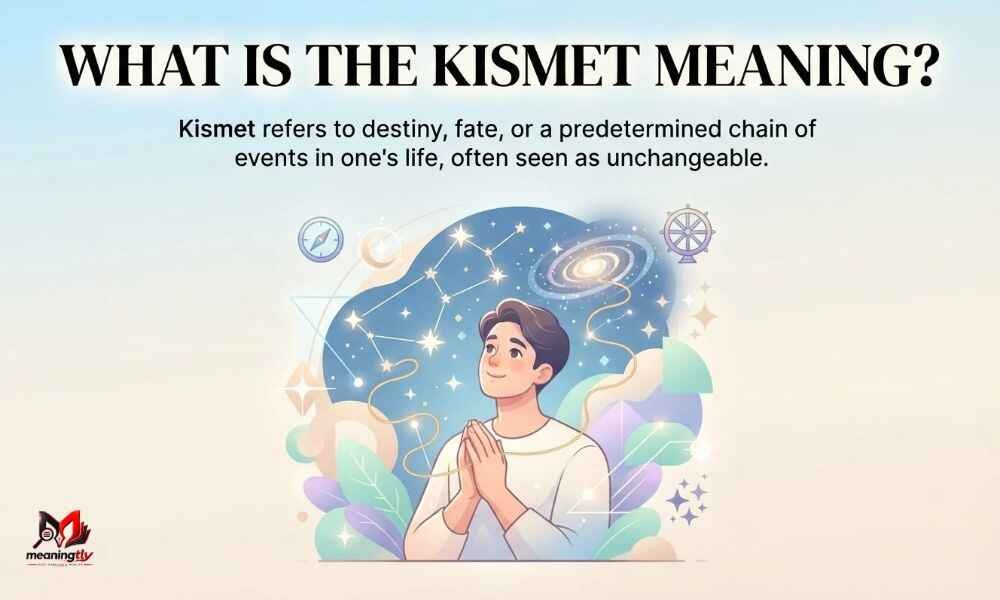
Kismet is a noun. It means fate, destiny or a person’s lot in life. Many people use it for a lucky event that feels pre-arranged.
The kismet meaning has two layers:
- Religious sense: In Islamic usage, it refers to the will of Allah.
- Everyday sense: It describes a chance event that feels meant to be.
Most English speakers use the second sense. They say it when life lines up in a surprising way.
Quick Definition
Kismet (noun): fate or destiny. Something that was meant to happen.
Kismet Meaning in One Line
Kismet is the idea that certain events are written in advance.
Simple Example
“We both missed our trains and ended up on the same bus. It felt like kismet.”
How to Pronounce Kismet
Say it like this: KIZ-met. Some speakers say KISS-met. Both are heard in English.
The first syllable is stressed. The second is soft.
Pronunciation Guide
| Feature | Detail |
| Syllables | 2 |
| Stress | First syllable |
| Common sound | KIZ-met |
| Alternate sound | KISS-met |
| Part of speech | Noun |
| Plural form | Kismets |
Spelling Variants
You may see several spellings. They all trace back to the same root.
- Kismet (English)
- Kısmet (Turkish)
- Qismat (Urdu and Persian)
- Kismat (Hindi)
- Qismah (Arabic transliteration)
Where Does Kismet Come From?
The word has a long journey. It began in Arabic. It then passed through Turkish. Finally, it entered English.
The Arabic root is qasama. It means “he divided.” From it came qisma. That term means a portion, share or lot.
So the original kismet meaning was quite practical. It described the share given to a person.
The Arabic Root
In Arabic, the root word dealt with dividing things. Think of sharing out food or property. Over time, the sense widened.
A “portion” became a “lot in life.” That shift is the heart of the word.
The Turkish Step
Turkish speakers borrowed the Arabic term. They shaped it into kısmet. In Turkish, it took on a firmer sense. It meant the lot that is destined for every person.
English picked up the word from Turkish. That happened in the early 1800s. Dictionaries record the first known use in English around 1828.
The English Arrival
The word came into English through contact with the Ottoman world. Travelers, traders and writers carried it west. English readers found it exotic and poetic.
Since then, it has stayed in our language. It now feels natural in everyday talk.
Word Journey Table
| Stage | Language | Form | Sense |
| 1 | Arabic | qasama | To divide |
| 2 | Arabic | qisma | Portion, lot |
| 3 | Turkish | kısmet | Destined lot |
| 4 | English | kismet | Fate, destiny |
Kismet Meaning in Islam
In Islamic thought, the word links to divine will. It refers to what Allah has decreed for a person.
Many Muslims use related terms such as qadar for divine decree. Kismet sits close to that idea. It speaks of a portion assigned by God.
Faith and Acceptance
The concept offers comfort. Believers often accept hardship with patience. They trust that a larger plan exists.
This view does not erase effort. Islamic teaching also stresses action, duty and responsibility.
Why It Matters
Understanding this context helps you read the word properly. In its religious sense, kismet is not about luck. It is about trust in a higher plan.
Kismet in Turkish Culture
In Turkey, kısmet is a common word. People use it in daily speech. It covers luck, opportunity and fate.
A Turkish speaker might say a job came as kısmet. Or they may say a marriage match is kısmet. It fits both happy and sad news.
Common Turkish Uses
- Talking about marriage prospects
- Explaining a lucky break
- Accepting a loss calmly
- Describing a meal or chance gift as one’s share
A Fun Detail
In Turkish, a stranger’s unexpected visit may be called one’s kısmet. The word can even mean the portion of food that fate sends your way.
Qismat in Hindi and Urdu
In South Asia, the word is everywhere. Hindi and Urdu speakers say kismat or qismat. It means luck, fate or fortune.
You hear it in songs, films and daily speech. People say it when luck turns for better or worse.
Everyday Phrases
| Phrase | Rough Meaning |
| Qismat ka khel | A game of fate |
| Qismat achi hai | Luck is good |
| Qismat mein likha hai | It is written in fate |
| Qismat badalna | To change one’s fortune |
Kismet and Bollywood
The word has a strong place in Indian cinema. A 1943 Hindi film titled Kismet became a famous box office hit. It starred Ashok Kumar.
That film helped cement the word in popular culture.
Kismet and Names
In this region, Qismat and Kismat are also used as personal names. The meaning stays the same: fate or destiny.
Kismet vs Fate vs Destiny

These words overlap. Yet each has its own flavor. Many writers use them as synonyms. Still, small differences exist.
Let’s compare them.
Comparison Table
| Word | Core Idea | Tone | Typical Use |
| Kismet | Meant to be | Warm, hopeful | Chance meetings, lucky timing |
| Fate | Fixed outcome | Neutral to grim | Life events, endings |
| Destiny | A purpose or path | Grand, inspiring | Careers, big goals |
| Luck | Random chance | Light | Games, small wins |
| Fortune | Wealth or chance | Mixed | Money, success |
Kismet vs Fate
Fate often sounds heavy. It can suggest doom. Kismet sounds softer and friendlier.
You might say, “It was her fate to lose.” You would rarely say, “It was her kismet to lose.” The second sounds odd.
Kismet vs Destiny
Destiny points to a grand purpose. It suits big dreams. Kismet is more personal and often smaller in scale.
A chance meeting at a cafe feels like kismet. Becoming a great leader feels like destiny.
Kismet vs Luck
Luck is random. Kismet implies design. That is the key gap.
Winning a raffle is luck. Meeting your future partner on the day you took a new route feels like kismet.
WS Meaning: Complete Definition, Uses & Examples (2026)
Kismet in Love and Romance
The word is a favorite in love stories. People use it for soulmate moments. It frames love as something arranged by the universe.
The kismet meaning in romance is about timing. Two people meet when both are ready. Everything lines up.
Signs Couples Call Kismet
- Meeting at an unplanned event
- Sharing the same dreams or values
- Crossing paths again after years
- Feeling instantly at ease
- Seeing small coincidences repeat
Romantic Examples
- “Meeting you in that bookstore felt like kismet.”
- “Call it kismet, but we both chose the same quiet cafe.”
- “Our paths crossed twice before we ever spoke. That’s kismet.”
A Word of Balance
Feeling kismet is lovely. But strong relationships need care. Love grows with effort, honesty and respect.
Kismet in Daily Life
The word is not only for romance. It also fits work, travel and friendship. Any lucky coincidence can qualify.
Kismet at Work
Maybe you heard about a job from a stranger. Or you met a mentor at a random event. Many people call such moments kismet.
Kismet in Travel
Travelers love the word. A missed flight leads to a great friendship. A wrong turn reveals a hidden gem.
Kismet in Friendship
Some friendships begin by accident. A shared seat, a shared joke, a shared project. Years later, it feels meant to be.
Kismet in Tough Times
The word can also bring comfort during loss. Some people say, “It was kismet,” to find peace. It helps them accept what they cannot change.
Kismet Examples in Sentences
Seeing the word in context makes the kismet meaning clearer. Here are simple examples.
Positive Examples
- “It was kismet that we found the same apartment.”
- “She believes kismet brought her to this town.”
- “Meeting my old teacher on the train was pure kismet.”
- “Some call it luck. I call it kismet.”
- “The timing was so perfect it felt like kismet.”
Neutral Examples
- “He accepted the news as his kismet.”
- “Do you believe in kismet?”
- “They left the outcome to kismet.”
- “Kismet is a common word in Turkish and Urdu.”
Examples From News Style
Writers often use it for sports or film. A reporter might say two teammates joined by kismet. Another might say a movie’s cast came together by kismet.
Synonyms of Kismet

Synonyms help you vary your writing. Choose based on tone.
Common Synonyms
- Fate
- Destiny
- Fortune
- Providence
- Lot
- Portion
- Karma (in a loose sense)
- Doom (negative tone)
- Serendipity (close in feel)
- Predestination
Words Close in Feeling
Serendipity is a close cousin. It means a happy accident. Yet it does not imply a plan. Kismet does.
Antonyms
True opposites are few. Still, these ideas stand against it:
- Free will
- Choice
- Chance
- Randomness
- Self-determination
Kismet in Other Languages
The word travels well. Many languages hold a version of it.
Translation Table
| Language | Word | Meaning |
| Turkish | Kısmet | Fate, luck, one’s share |
| Urdu | Qismat | Fate, fortune |
| Hindi | Kismat | Fate, luck |
| Persian | Qesmat | Fate, destiny |
| Albanian | Kismet | Fate |
| Kurdish | Qismet | Fate, lot |
| Bosnian | Kismet | Fate, destiny |
Why So Many Languages?
Trade and empire spread the word. The Ottoman world touched many regions. Local languages kept it and shaped it.
Kismet in Pop Culture
The word shows up in books, music, film and technology. Each use adds a new shade to the kismet meaning.
The Stage Musical
Kismet is a well-known musical. It premiered on Broadway in 1953. The score borrowed melodies from the composer Alexander Borodin.
The story is set in old Baghdad. It follows a poet who rises by fate.
The Original Play
The musical was based on an earlier play. Edward Knoblock wrote it in 1911. It carried the same theme of fate shaping a life.
Hindi Cinema
As noted, a 1943 Hindi film named Kismet was a major hit. Its success made the word feel familiar to millions.
The Robot Kismet
In technology, Kismet is also a robot. It was built at MIT to show simulated emotion. Its name comes from the Turkish word for fate.
The Wireless Tool
Another Kismet is software. It is used to analyze wireless network traffic. Do not confuse it with the word’s classic meaning.
Music and Brands
Bands, cafes and shops use the name too. It suggests luck, charm and connection.
Kismet as a Baby Name
Parents choose Kismet for its beauty. The sound is soft. The meaning is hopeful.
It is most often a girl’s name. Occasionally, it is given to boys. The masculine form Qismat also appears.
Name Facts
| Detail | Information |
| Origin | Arabic, via Turkish |
| Meaning | Fate, destiny |
| Gender | Mostly female |
| Variants | Kismat, Qismat, Kismet |
| Feel | Unique, romantic |
Is It Popular?
No. The name is rare in the United States. That makes it special for parents seeking something unusual.
Similar Names
- Destiny
- Fortuna
- Serena
- Nasib
- Saadat
Signs You Feel Kismet
How do you know when it happens? There is no test. But many people describe the same signs.
Common Signs
- Perfect timing
- Repeated coincidences
- A strong gut feeling
- A sense of calm
- A path that opens with little effort
The Inner Feeling
People often describe a sense of rightness. It feels like a quiet “yes” from within.
Do Not Rush Meaning
Not every coincidence is a sign. Some are just coincidence. Use thought as well as feeling.
LYT Meaning in Texting: Best Definition, Uses, and Examples(2026)
Does Kismet Mean No Effort?
No. This is a common mistake. Believing in fate does not mean doing nothing.
Most thoughtful believers combine both views. They trust the plan. They also work hard.
Fate and Free Will
This debate is old. Philosophers have argued about it for centuries. Some say life is fixed. Others say we shape it.
Many people sit in the middle. They believe opportunity may be given. They believe action decides the result.
A Healthy View
- Be open to chance meetings
- Act when a door opens
- Accept what you cannot change
- Keep learning and growing
Why It Helps
The idea can lower stress. It reminds us that not everything is in our control. That can bring peace.
Common Mistakes With Kismet
Learners often misuse the word. Avoid these slips.
Mistake 1: Using It for Random Luck
Winning a coin toss is not kismet. The word needs a sense of meaning.
Mistake 2: Using It for Bad Events Only
It can describe bad news. Yet it leans warm and hopeful in English.
Mistake 3: Wrong Spelling
The standard English form is kismet. Do not write “kizmet” in formal text.
Mistake 4: Confusing It With the Software
Context matters. Check whether the writer means fate or the tool.
How to Use Kismet in Writing
Use the word with care. It adds charm when placed well.
Writing Tips
- Use it for meaningful coincidences.
- Keep the tone warm.
- Do not overuse it.
- Pair it with clear context.
- Use “fate” or “destiny” when the mood is serious.
Good Places to Use It
- Fiction and romance
- Personal essays
- Travel stories
- Social media captions
- Wedding speeches
Caption Ideas
- “Right place, right time. Pure kismet.”
- “Some things are just meant to be.”
- “Trust the timing of your life.”
Quotes About Kismet and Fate
You can write your own lines too. Here are original ideas to inspire you.
- Kismet is the quiet hand that moves two paths together.
- Not every meeting is chance. Some are written.
- Trust your portion. It was measured just for you.
- When timing aligns, call it kismet.
Why the Word Still Matters
People love stories of meaning. Kismet gives them a simple word for it. It turns a coincidence into a story.
In a busy world, that feels comforting. It says life has a pattern. It says you are where you need to be.
The Emotional Pull
The kismet meaning speaks to hope. It tells us good things can arrive without force. It also helps us accept the unexpected.
A Word That Travels
Few words cross so many cultures. It links Arabic, Turkish, South Asian and English speakers. That shared use shows how universal the idea of fate truly is.
Conclusion
Kismet is a word that means fate or destiny. It comes from the Turkish word “kısmet,” which came from Arabic. In Arabic, it means “portion” or “lot.” People use it to talk about things that are meant to happen.
Many people believe in kismet. They think life has a plan. When something big happens, they say it was written. A lucky meeting or a lost chance can feel like kismet. It gives comfort when things are hard.
In daily life, kismet shows up in small ways. You meet a friend at the right time. You get a job you did not expect. Someone says, “It was kismet.” They mean it was just meant to be.
Kismet is also a popular word in songs, books, and films. It sounds soft and a little magical. Some people even use it as a name. The word adds a feeling of mystery to any story.
In the end, kismet reminds us that life is full of surprises. We cannot control everything. Still, we can make good choices. Maybe fate and effort work together. That is how many people see it.
Frequently Asked Questions
Is Kismet an English Word?
Yes, Kismet is an English word that means fate or destiny.
Is Kismet a Turkish Word?
Yes, Kismet comes from the Turkish word kısmet, meaning fate, fortune, or destiny.
What Is a Synonym for Kismet?
Synonyms for Kismet include fate, destiny, fortune, providence, and luck.
Is Kismet a Positive Word?
Yes, Kismet is generally a positive or neutral word associated with destiny and good fortune.
Why Do Americans Say Kismet?
Americans use Kismet to describe something that feels destined to happen or is meant to be.

1 thought on “Kismet Meaning: Powerful Meaning, Origin & Symbolism (2026)”