A skink is a type of lizard. It belongs to the family called Scincidae, which has more than 1,500 species. These reptiles live in many parts of the world, from hot deserts to green forests. People often notice them because of their smooth, shiny skin.
Skinks look a bit different from other lizards. Their bodies are long and slim, and their scales are smooth like polished stones. Some have tiny legs, and a few have no legs at all. Many can drop their tails when they feel in danger, and the tail grows back later.
The word “skink” has an old history. It comes from the Greek word “skinkos,” which was used for a kind of lizard. Over time, the word moved through Latin and into English. Today, it simply means a small, smooth-scaled lizard.
Skinks are mostly harmless to people. They eat insects, spiders, and snails, so they help keep gardens healthy. Most of them are shy and run away when they see humans. Some people even keep certain skinks as pets because they are calm and easy to care for.
Best Skink Meaning
What Is the Skink Meaning?
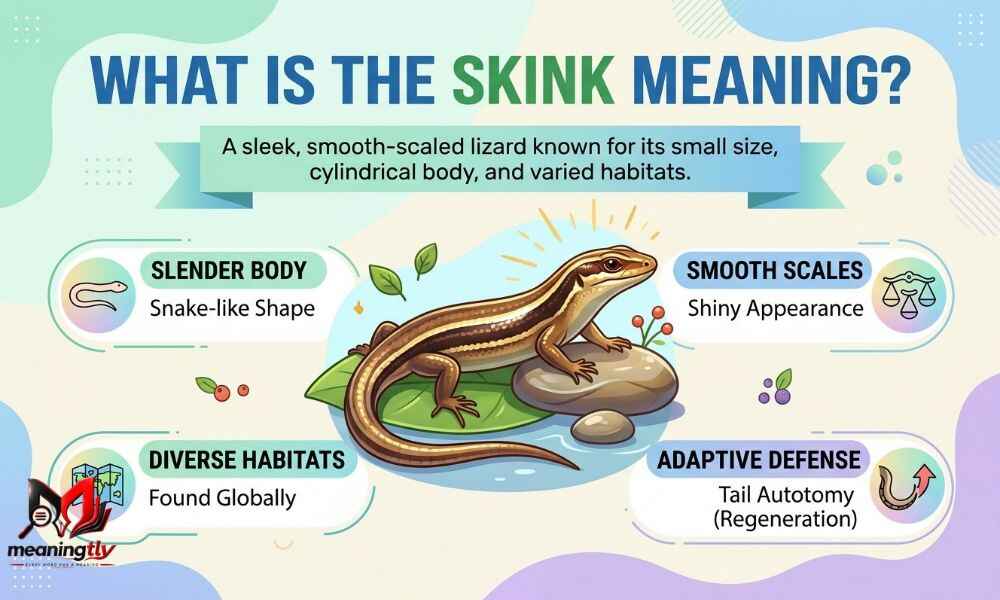
The main skink meaning is a type of lizard. It belongs to the family Scincidae.
These lizards have smooth, shiny scales. Their bodies are long and slim. Many have short legs. Some have no legs at all.
Here is the quick answer:
- Noun: a small, smooth-scaled lizard
- Family: Scincidae
- Pronunciation: /skɪŋk/ (rhymes with “think”)
- Also means: a Scottish soup, a shin of beef, or a drink
That is the core skink meaning in one list.
Skink Definition in One Line
A skink is a smooth, shiny lizard with a long body and small or tiny limbs.
Skink Pronunciation
Say it like “skingk.” It rhymes with link and drink.
All Skink Meanings at a Glance
One word can carry many senses. The table below shows each one.
| Skink Meaning | Part of Speech | Where It Is Used |
| Smooth-scaled lizard | Noun | Worldwide, science and daily use |
| Shin of beef | Noun | Northern England and Scotland |
| Soup made from beef shin | Noun | Scotland (old use) |
| Soup made with other items | Noun | Scotland, broad use |
| A drink | Noun | Old English (obsolete) |
| To pour or serve a drink | Verb | Dialect (rare) |
Today, the lizard is by far the most common skink meaning. The others are rare or old.
Skink Meaning as a Lizard
Most people mean the animal when they say the word.
Skinks are reptiles. They are part of the lizard group. The family Scincidae is one of the largest lizard families in the world.
There are well over a thousand species. Some are tiny. Some are heavy and thick.
How Skinks Look
You can spot a skink by a few clear signs:
- Shiny, smooth scales
- Long, tapering body
- Short legs (or none)
- Slim head that blends into the neck
- A tail that can break off
Their scales feel almost polished. That is why many people think they look wet.
How Big Are Skinks?
Size varies a lot.
| Type | Approx. Length |
| Small ground skinks | 3–4 inches |
| Common garden skinks | 4–6 inches |
| Blue-tongued skinks | 18–24 inches |
| Giant skinks (rare species) | Over 2 feet |
Most skinks you see in a yard are small.
Where Skinks Live
Skinks live on almost every continent. Antarctica is the exception.
They love warm places. Many also like moisture. You will find them in forests, deserts, grasslands and gardens.
Common Skink Habitats
- Leaf litter in forests
- Sandy soil in dry regions
- Rocky areas with cracks to hide in
- Gardens with mulch and logs
- Wetlands and damp edges
Why Skinks Hide So Much
Skinks are quick and shy. They dart under rocks and leaves. This keeps them safe from birds and snakes.
What Do Skinks Eat?
Most skinks eat insects. That makes them insectivores.
Common foods include:
- Crickets
- Beetles
- Spiders
- Worms
- Snails
- Small grubs
Some larger skinks also eat plants and fruit. Blue-tongued skinks are a good example.
Are Skinks Good for Gardens?
Yes. They eat pests. They help keep bug numbers down.
A skink in your garden is a helper, not a threat.
Skink Meaning in Science
In biology, the word names a whole family. Scientists call it Scincidae.
The word “scincid” is a close synonym. You may see it in books and papers. “Scincid lizard” means the same as skink.
Skink Classification
| Level | Name |
| Kingdom | Animalia |
| Class | Reptilia |
| Order | Squamata |
| Family | Scincidae |
This is the simple scientific frame behind the skink meaning.
Skink Types You Should Know
Many species have well-known names. Here are a few.
| Species | Key Trait |
| Blue-tongued skink | Bright blue tongue, thick body |
| Five-lined skink | Stripes on the back, blue tail in young |
| Broad-headed skink | Large head, strong jaws |
| Shingleback skink | Rough, pinecone-like scales |
| Prehensile-tailed skink | Grips branches with its tail |
| Sand skink | Lives in loose sand, tiny limbs |
Each one fits the core skink meaning, yet each looks different.
Skink Meaning in Old English and Dialect
Here the word gets unusual. It has nothing to do with lizards.
Skink as a Verb
In old dialect, to skink meant to pour or serve a drink. The word links to old Germanic words for cup-bearing and pouring.
A cup-bearer once “skinked” wine for guests. You will rarely hear this today.
Skink as a Drink
The noun also named a drink. Often it meant a weak or thin one.
This sense is now obsolete. Still, it shows how old the word is.
Why Dictionaries Still List It
Dictionaries keep old senses. They help readers of old books. So the full skink meaning list is long.
Skink Meaning as Beef Shin
Another sense is food-related. In parts of northern England and Scotland, skink meant a shin of beef.
That is the lower leg cut. It is tough but full of flavor. Slow cooking makes it tender.
From Cut of Meat to Soup
A soup made from boiled beef shin was also called skink. Over time, the term spread to other soups too.
That leads us to the most famous food use.
Cullen Skink Meaning
Many people first meet the word through food. They see “Cullen skink” on a menu.
Cullen skink is a thick Scottish soup. It comes from the town of Cullen in northeast Scotland.
What Is in Cullen Skink?
The classic recipe has a short list:
- Smoked haddock
- Potatoes
- Onions
- Milk or cream
- Butter
- Salt and pepper
It is creamy, warm and smoky.
Does Cullen Skink Contain Lizard?
No. Not at all.
Here the skink meaning is the older one. It points to a soup, not a reptile. The name came from the old beef-shin soup tradition. Smoked fish later took the place of beef.
Cullen Skink vs. Chowder
| Feature | Cullen Skink | Fish Chowder |
| Origin | Scotland | North America |
| Main fish | Smoked haddock | Varied white fish |
| Base | Milk and potatoes | Milk or cream, often with bacon |
| Texture | Thick, mashed potato style | Chunky |
| Flavor | Smoky | Mild, savory |
Both are comforting. The smoke makes Cullen skink stand out.
Where Does the Word Skink Come From?
The word has a long history. It reaches back more than 400 years in English.
Origin of the Lizard Sense
The lizard sense comes from Latin scincus. That word came from Greek skinkos. Both named a type of lizard.
English records show the word in use in the late 1500s.
Origin of the Drink Sense
The drink and pouring sense has a different root. It comes from Germanic words. Dutch schenken is a close relative. It means to pour or serve.
Origin of the Beef Sense
The beef shin sense also has Germanic roots. It links to the word shank.
So the word has several separate family trees. They just ended up with the same spelling.
Quick Origin Table
| Sense | Root |
| Lizard | Latin scincus, Greek skinkos |
| Pour a drink | Germanic, like Dutch schenken |
| Beef shin | Germanic, linked to shank |
This explains why the skink meaning varies so much.
Skink Synonyms and Related Words
Few words replace “skink.” The closest are:
- Scincid
- Scincid lizard
For general terms, you can use:
- Lizard
- Reptile
- Saurian (formal)
Words People Confuse with Skink
| Word | Meaning | Not the Same Because |
| Skunk | A smelly mammal | It is not a reptile |
| Skank | Slang term | Unrelated |
| Gecko | A different lizard family | Has sticky toe pads |
| Salamander | An amphibian | Has moist skin, no scales |
| Slow worm | A legless lizard | Belongs to another family |
Knowing these helps you use the right word.
Skink Meaning in a Sentence
Examples make the meaning clear.
Lizard Examples
- A blue-tailed skink ran across the porch.
- The children found a tiny skink under a rock.
- Skinks shed their tails to escape danger.
Food Examples
- We ordered a bowl of Cullen skink.
- The cook simmered the skink with haddock and potato.
Old Verb Example
- The servant would skink wine for the guests.
Each line shows a different skink meaning.
Fun Facts About Skinks
Skinks are full of surprises. Here are some favorites.
- They drop their tails. This trick distracts predators.
- Tails grow back. The new tail often looks slightly different.
- Some give live birth. Others lay eggs.
- Some have no legs. They move like snakes.
- Some have blue tongues. The color can scare enemies.
- Some live in sand. They seem to “swim” through it.
- They love the sun. Basking keeps their bodies warm.
The Tail Trick Explained
When grabbed, a skink can release its tail. The tail keeps moving for a short time. This draws attention away from the body.
The lizard then runs off. Later, it grows a new tail.
Why It Matters
This skill is a big part of the skink meaning in nature. It shows how these lizards survive.
Skink Behavior and Life Cycle
Skinks are active in the day. They are fast, alert and curious.
Daily Habits
- Warm up in the morning sun
- Hunt in the afternoon
- Hide at night or in heat
How Skinks Breed
Breeding often happens in spring. Females lay small clutches of eggs. They hide them in soil or under logs.
Some species keep the eggs inside the body. They give birth to live young.
Lifespan
| Setting | Typical Lifespan |
| Wild small skinks | 3–6 years |
| Wild larger skinks | 6–10 years |
| Captive blue-tongued skinks | 15–20 years |
Care and safety make a big difference.
Are Skinks Dangerous?
No. Skinks are harmless to people.
Most are shy. They run when they see you. They are not venomous.
Can a Skink Bite?
Yes, but rarely. A bite usually happens when the animal feels trapped. Larger skinks can bite harder, but the harm is minor.
Quick Safety Tips
- Do not grab a wild skink
- Wash hands after contact
- Keep pets away from them
- Let them go on their way
Skinks as Pets
Some skinks make friendly pets. The blue-tongued skink is the most popular.
Why People Like Them
- Calm nature
- Easy handling
- Long life
- Simple diet
Basic Pet Needs
| Need | Details |
| Enclosure | Large tank with floor space |
| Heat | Warm basking spot |
| Light | UVB lighting |
| Substrate | Soil mix or bark |
| Food | Insects, greens and some fruit |
| Water | Fresh bowl, always clean |
Before buying, check local laws. Some places limit certain species.
Skink Symbolism and Spiritual Meaning
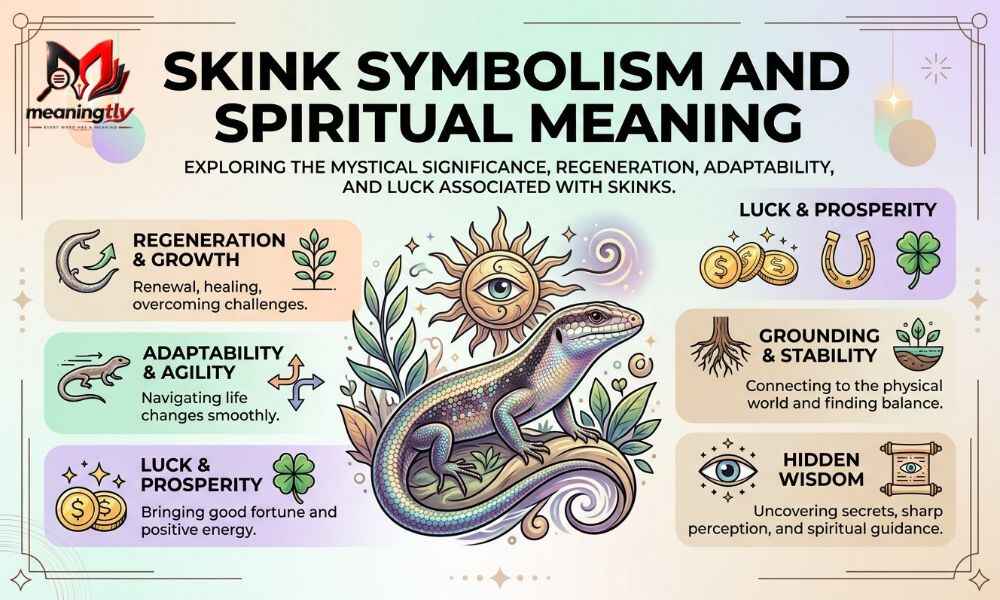
People also search for the spiritual skink meaning. This is cultural, not scientific.
Many traditions link lizards with change and survival. Skinks add one extra idea: they regrow their tails.
Common Symbolic Ideas
- Renewal: a new tail shows a fresh start
- Adaptability: skinks fit many habitats
- Awareness: they react fast to danger
- Letting go: they drop the tail to survive
Skink in Dreams
Dream meanings vary by person. Many dream guides say a skink points to quick thinking or a need to let go of something.
Treat these as folk ideas. They are not facts.
Skink Meaning in Pop Culture
The word also shows up in stories.
Skink in Books
Author Carl Hiaasen created a famous character named Skink. He is a wild, eco-minded former governor who lives in the Florida wilds. The name fits his hidden, outdoorsy life.
Skink in Names
Brands, games and teams sometimes use the name. It sounds sharp and quick, like the animal.
Skinks and Conservation
Some skinks are in trouble. Habitat loss is a major cause.
Main Threats
- Land clearing
- Invasive predators like cats and rats
- Wildfires
- Climate change
- Illegal pet trade
Example: Rare Species
Some island and coastal skinks have tiny ranges. A single event can harm a whole group.
How You Can Help
- Plant native shrubs
- Leave logs and rocks in the yard
- Keep cats indoors
- Avoid harsh pesticides
- Support local wildlife groups
Small steps matter.
How to Attract Skinks to Your Garden
Want to see one up close? You can invite them in.
Simple Steps
- Add rocks and logs
- Keep leaf litter in some corners
- Offer a shallow water dish
- Plant native ground cover
- Skip chemical sprays
Skinks will reward you by eating pests.
How to Tell a Skink from Other Lizards
New observers often mix them up. Use this guide.
| Feature | Skink | Gecko | Anole |
| Scales | Smooth, shiny | Soft, bumpy | Small, rough |
| Toes | Small, no pads | Sticky pads | Slight pads |
| Body | Long, tapered | Flat | Slim |
| Activity | Day | Often night | Day |
| Legs | Short or none | Strong | Long |
Shiny scales are the best clue.
Common Misunderstandings
Some beliefs about skinks are wrong. Let’s fix them.
- Myth: Skinks are poisonous. Fact: They are not.
- Myth: Skinks are snakes. Fact: They are lizards.
- Myth: Cullen skink has lizard in it. Fact: It is fish soup.
- Myth: Their tails never grow back. Fact: They usually do.
Clear facts make the skink meaning easier to grasp.
Quick Summary of Skink Meaning
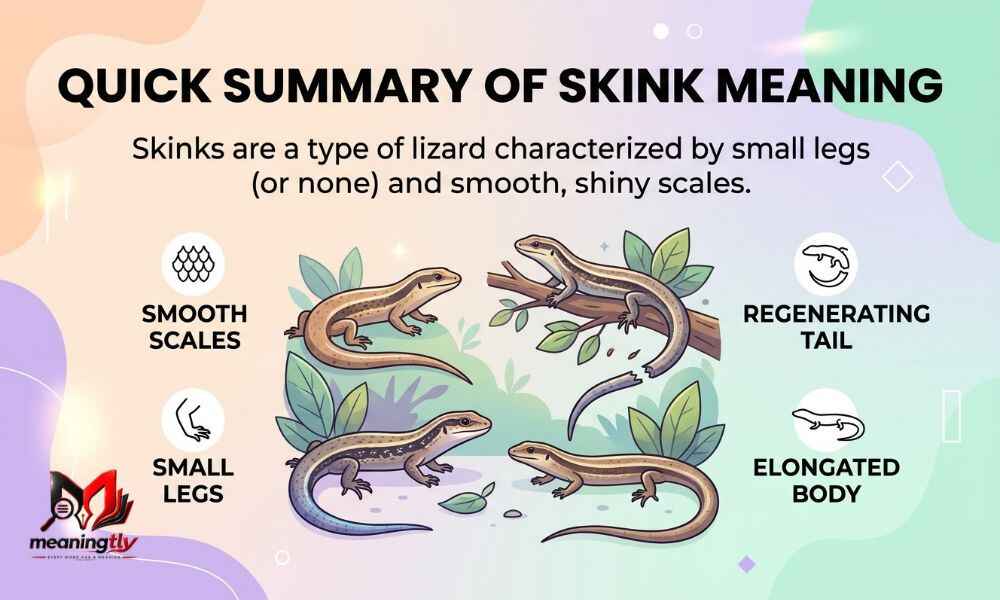
Here is the full picture in short form.
- The main skink meaning is a smooth, shiny lizard.
- It belongs to the family Scincidae.
- In Scotland, it can mean a soup, as in Cullen skink.
- It can also mean a shin of beef.
- Old dialect used it for pouring or serving a drink.
- The lizard sense comes from Latin and Greek.
- The other senses come from Germanic roots.
Conclusion
A skink is a type of lizard. It has a smooth, shiny body and short legs. Some skinks even have tiny legs or none at all. The word “skink” comes from the Greek word “skinkos,” which was used for a kind of lizard.
Skinks live in many parts of the world. You can find them in forests, deserts, and even gardens. They like warm places and often rest in the sun. Most of them are small and shy. They run away fast when they feel scared.
Skinks eat insects, worms, and small bugs. This makes them helpful to people and farmers. They keep pests under control. Some larger skinks also eat fruits and plants. Their diet depends on where they live.
In short, the meaning of skink is simple. It is a smooth, quick, and harmless lizard. It plays a useful role in nature. Next time you spot one, remember that it is a friend to your garden.
Frequently Asked Questions
What is the skink meaning in simple words?
A skink is a small, smooth, shiny lizard with a long body and short legs.
What does skink mean in Scotland?
It often means a soup, like Cullen skink, or an old term for beef shin.
What does Cullen skink mean?
It is a creamy Scottish soup made with smoked haddock, potatoes and onions.
Is a skink a snake or a lizard?
A skink is a lizard, even though some species have no legs.
Are skinks poisonous?
No. Skinks are not venomous or poisonous to people.
What is the spiritual meaning of a skink?
Many see it as a sign of renewal, adaptability and letting go.
What is the origin of the word skink?
The lizard sense comes from Latin scincus and Greek skinkos.
What do skinks eat?
Most eat insects, spiders and worms. Some also eat plants and fruit.
Can skinks regrow their tails?
Yes. Most skinks can drop a tail and grow a new one.
Is a skink the same as a gecko?
No. They are different families with different scales and toes.
Do skinks make good pets?
Yes, some do. Blue-tongued skinks are calm and easy to handle.
What is another word for skink?
The closest synonyms are “scincid” and “scincid lizard.”

1 thought on “Best Skink Meaning: Definition, Facts & Examples(2026)”