Pedantic meaning is a word we use for people who care too much about small rules. They love tiny details. They want everything to be exactly right. Sometimes this feels helpful. Sometimes it feels annoying.
A pedantic person often corrects others. They fix a small grammar mistake. They point out a wrong date or word. They may do it even when nobody asked. Others can feel judged by this.
The word is mostly used in a negative way. It suggests showing off knowledge. It means caring about rules more than the real point. A teacher can be pedantic. So can a friend or a boss.
Being careful is not always bad. Details matter in some jobs. But too much fuss can hurt a talk. Know when to let small things go. A little kindness makes facts easier to hear.
Pedantic Meaning
What Is the Pedantic Meaning?
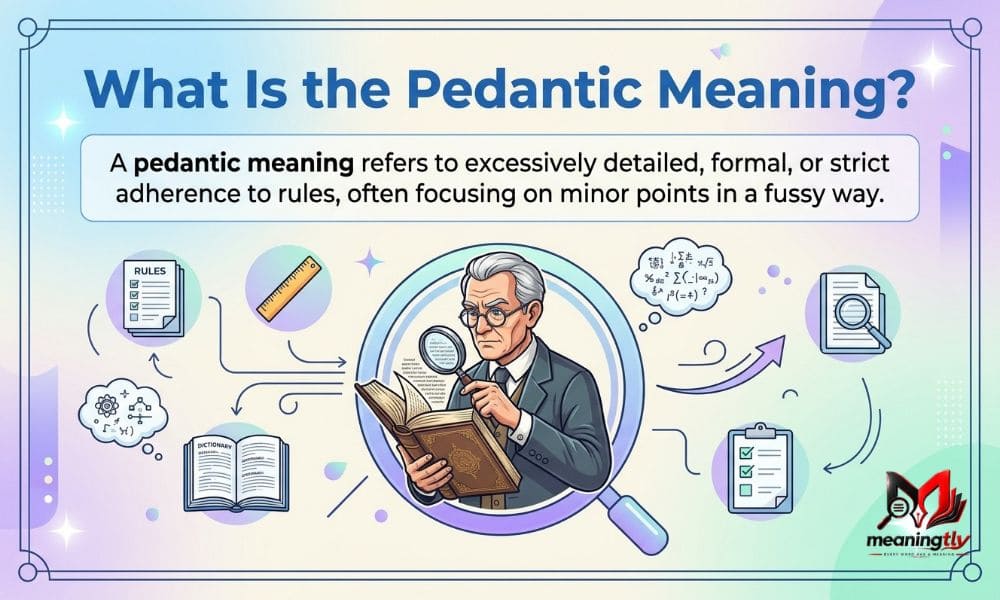
Pedantic is an adjective. It describes someone who focuses too much on minor details, formal rules, or displays of knowledge. Most dictionaries treat it as a negative word.
Merriam-Webster marks it as disapproving. It ties the word to a pedant, a person who is overly concerned with minor points. Dictionary.com adds another angle. It says the word can also mean ostentatious about one’s learning.
So the pedantic meaning has two parts:
- An obsession with tiny details and rules.
- A show-off style when sharing knowledge.
The two parts often appear together. A pedantic person fixes small errors and wants everyone to notice.
Pedantic Meaning in Simple Words
Here is the easy version. Pedantic meaning “too fussy about small things.”
Imagine a friend says, “I’ll see you at 5.” Another person replies, “You mean 5:00 p.m., not 5:00 a.m.” That reply is pedantic. Everyone already knew what the friend meant.
The key idea is this. The detail does not matter to the point. The speaker pushes it anyway.
Quick Dictionary Snapshot
This table sums up the core facts about the word.
| Feature | Details |
| Word | Pedantic |
| Part of speech | Adjective |
| Core meaning | Overly concerned with minor details or rules |
| Second meaning | Showing off one’s knowledge |
| Tone | Negative or disapproving |
| Noun form | Pedant, pedantry |
| Adverb form | Pedantically |
| Common fields | Teaching, writing, grammar, law |
How to Say Pedantic
Getting the sound right matters. A wrong stress can make the word hard to follow.
The word has three syllables. The stress falls on the middle one. Say it like this: pih-DAN-tik.
| Dictionary style | Sound |
| Simple | pih-DAN-tik |
| Merriam-Webster style | pi-ˈdan-tik |
| IPA (British) | /pɪˈdæntɪk/ |
Tip: Say “pedal” first, then swap the ending. It helps many learners.
Where Does Pedantic Come From?
The word has a school-based past. It grows out of the noun pedant. English took “pedant” from French, and French took it from Italian.
The Italian word is pedante. It meant a teacher or schoolmaster. Over time, the word picked up a sour tone. People used it for teachers who loved rules more than ideas.
Sources give slightly different dates. Dictionary.com places the first use in the late 1500s. Merriam-Webster lists 1628 for its main sense. Either way, the word is old.
From Teacher to Insult
The shift in meaning is easy to follow. A schoolmaster drills facts and rules. A bit of that is good. Too much of it is boring.
So people began to mock the habit. The word moved from a plain job title to a jab. Today, calling someone pedantic is rarely a compliment.
Supersummary notes that the word has carried negative shades since the 1600s. That long history shows how stable the pedantic meaning has been.
Word Forms You Should Know
The word has a small family. Knowing the family helps you read and write better.
| Word | Type | Plain meaning |
| Pedant | Noun | A person who obsesses over small details |
| Pedantic | Adjective | Like a pedant |
| Pedantically | Adverb | In a pedantic way |
| Pedantry | Noun | The habit of being a pedant |
| Pedantocrat | Noun (rare) | One who rules by a pedantic system |
Most people use only the first four. The last one is rare and mostly for fun.
Signs of a Pedantic Person
How can you spot one? Look for repeated habits. One small correction does not make someone pedantic. A pattern does.
Common signs include:
- They correct grammar in casual talk.
- They fix words even when the meaning is clear.
- They quote rules nobody asked about.
- They say “technically” very often.
- They enjoy proving others wrong.
- They miss the big idea because of a small error.
- They lecture instead of listen.
If three or more fit, the label may apply.
Pedantic Examples in Sentences
Examples make the pedantic meaning stick. Read each one slowly.
Everyday Examples
- “Don’t be so pedantic. Everyone knows what I meant.”
- “He gets pedantic about how to load the dishwasher.”
- “She was pedantic about the spelling of every name on the list.”
Work Examples
- “The manager was pedantic about margin widths in the report.”
- “His pedantic edits delayed the launch by two days.”
- “Let’s not turn this into a pedantic debate over one label.”
School Examples
- “The teacher’s pedantic marking cost me points for a missing comma.”
- “The essay felt pedantic and dull.”
- “Her pedantic tone made the lecture hard to enjoy.”
Notice the pattern. In each case, the detail is small and the reaction is large.
Pedantic Synonyms
Synonyms help you vary your writing. They also help you pick the right shade of meaning.
| Synonym | Shade of meaning |
| Nitpicky | Hunting for tiny faults |
| Fussy | Hard to please over small things |
| Hairsplitting | Splitting ideas into needless parts |
| Persnickety | Overly particular |
| Doctrinaire | Stuck to a fixed rule or belief |
| Bookish | Too attached to books and theory |
| Donnish | Like a stiff university teacher |
| Scholastic | Rigid in academic method |
| Punctilious | Careful about fine points of behavior |
Not every synonym is a perfect match. “Punctilious,” for example, can sound softer. “Nitpicky” is more casual.
Pedantic Antonyms
Antonyms show the opposite side. They help you see the limits of the word.
- Easygoing
- Relaxed
- Flexible
- Casual
- Lenient
- Practical
- Broad-minded
A pedant sweats the small stuff. An easygoing person lets small stuff pass. Most people sit somewhere in the middle.
Pedantic vs. Didactic
These two words are often mixed up. Both relate to teaching. But they do not mean the same thing.
Didactic means meant to teach a lesson. Vocabulary.com explains that didactic teaches while pedantic mainly shows off the facts. Thesaurus.com also notes that didactic things carry a message along with their main purpose.
| Point | Pedantic | Didactic |
| Goal | Show off or stress details | Teach a lesson |
| Tone | Negative | Neutral or mildly negative |
| Focus | Small facts and rules | A message or moral |
| Example | A teacher who marks every comma | A fable with a clear moral |
A fable can be didactic without being pedantic. A grammar rant can be pedantic without teaching anything.
Pedantic vs. Precise
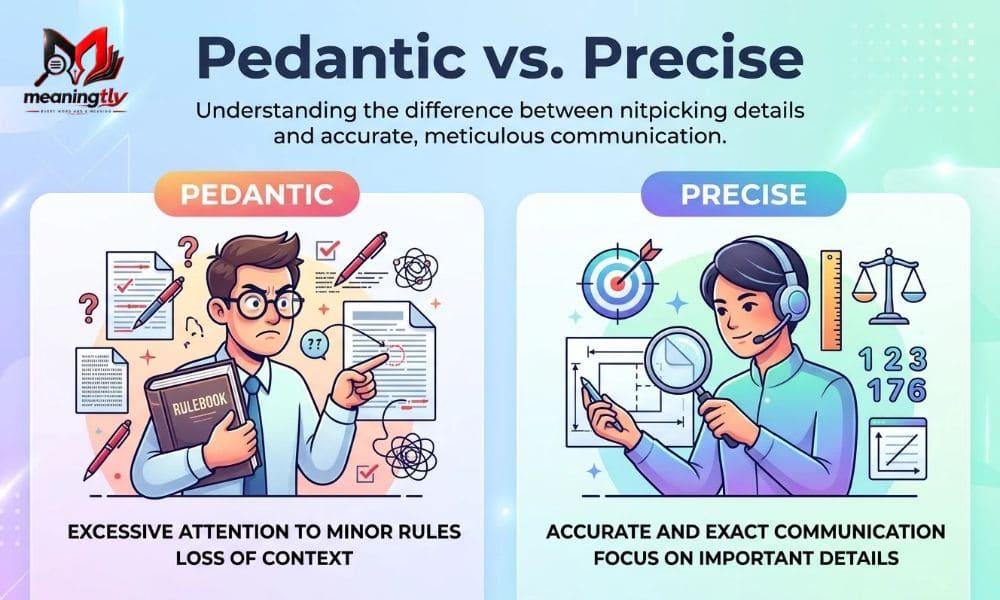
This is the most important contrast. Precision is a strength. Pedantry is precision gone too far.
Precise people give details that matter. Pedantic people give details that do not matter. The test is simple. Ask if the detail changes the outcome.
| Question | Precise | Pedantic |
| Does the detail matter? | Yes | Rarely |
| Does it help the listener? | Yes | Not really |
| Is the timing right? | Yes | Often wrong |
| What is the motive? | Clarity | Showing off |
A pilot who checks every item is precise. A passenger who corrects the pilot’s accent is pedantic.
Pedantic vs. Picky and Perfectionist
Three more words sit close to this one. Each has its own flavor.
Pedantic vs. Picky
A picky person has strong likes and dislikes. This is about taste. A pedant is about rules and facts. So picky is personal, while pedantic is technical.
Pedantic vs. Perfectionist
A perfectionist wants their own work to be flawless. A pedant often corrects other people’s work. One looks inward. The other looks outward.
Pedantic vs. Nitpicky
These two are nearly twins. “Nitpicky” is more casual and common in speech. “Pedantic” sounds more formal and often hints at show-off knowledge.
Is Pedantic Always Negative?
Mostly, yes. Writers note that it is almost always a criticism. You would rarely praise a speaker by calling the style pedantic.
But some modern writers use the word with a wink. They may say, “Call me pedantic, but that is a rowboat, not a canoe.” Here the speaker admits the habit and smiles at it.
So the pedantic meaning leans negative. Context and tone can soften it. Yet it never becomes a true compliment.
Good Pedantry vs. Bad Pedantry
Some situations reward a strict eye. Others do not. Context decides.
When It Helps
- Legal contracts, where one word can change a deal.
- Medical dosing, where small errors can harm.
- Science and data work, where units must match.
- Safety checklists, where every step counts.
- Code reviews, where one symbol breaks a program.
When It Hurts
- Casual chats with friends.
- Brainstorming sessions.
- Early drafts of any work.
- Emotional talks, where people need support.
- Texts and social posts.
In the first group, attention to detail is a skill. In the second, it is noise.
Pedantic at Work
The office is a common home for this habit. Meetings are full of small wording issues. A pedant can slow them all down.
Imagine a team debating a slide title. One person argues about “affect” versus “effect” for ten minutes. The deadline slips. Nobody learns anything useful.
That said, a careful reviewer is valuable. The skill lies in timing. Raise real errors in the review stage. Skip style fights in the brainstorm stage.
Pedantic Meaning in School
Schools have a long link to this word, since it began with teachers. Even today, students use it to describe strict marking.
A teacher who fines a missing comma may be seen as pedantic. A teacher who ignores all errors may be seen as lazy. Good teaching sits between the two.
There is a useful rule for teachers. Fix the errors that block meaning first. Leave the tiny ones for later.
Pedantic Meaing in Writing
The word also describes a style. A pedantic text loads the reader with needless facts and rules. It sounds like a lecture.
Signs of pedantic writing include:
- Long footnotes on side points.
- Heavy jargon with no need.
- Rigid rules stated as laws.
- A tone that talks down to readers.
To fix it, cut the extras. Keep only what helps the reader. Short sentences help a lot.
Pedantic Online
The internet is full of grammar police. Comment sections love a good correction. A single typo can spark a long thread.
Most of these replies add nothing. They change the topic from ideas to spelling. People then feel judged, and the talk turns sour.
There is one exception. Correct facts when a wrong claim could mislead others. Skip the correction when it is only a typo.
Pedantic Meaning in Relationships
This habit can strain close bonds. A partner who corrects your stories at dinner may seem rude. A friend who fact-checks every joke may seem tiring.
The damage grows over time. People stop sharing. They fear the correction more than they enjoy the chat.
If this sounds familiar, try a simple test. Ask, “Will this fix help us, or only me?” That one question can save many evenings.
Why Do People Act Pedantic?
There is no single cause. Several common reasons appear again and again.
- Love of accuracy. Some people truly value being right.
- Habits from training. Editors, lawyers, and coders learn to spot tiny faults.
- A wish to look smart. Showing knowledge feels good.
- Need for control. Rules give a sense of order.
- Stress or anxiety. Fixing small things can feel calming.
Knowing the reason helps you respond with more patience.
How to Handle a Pedant
You will meet one sooner or later. A calm plan helps.
- Stay calm. Do not take the correction as an attack.
- Say thanks, briefly. It ends the loop fast.
- Return to the point. Say, “Right, and my main idea is…”
- Set a boundary. Ask for notes later, not during the talk.
- Use humor. A light joke often lowers tension.
- Know when to walk away. Not every debate deserves your time.
Keep your tone kind. A harsh reply only feeds the fight.
How to Stop Being Pedantic
What if the pedant is you? Good news: the habit can change. Awareness is the first step.
Try these simple moves:
- Pause before you correct. Count to three.
- Ask if it matters. If not, let it go.
- Pick the right time. Share notes in private, not in public.
- Focus on the main idea. Listen for meaning first.
- Ask before you fix. Say, “Want my feedback?”
- Praise first. Good points deserve notice too.
With practice, you keep your sharp eye and lose the sting.
Common Mistakes With This Word
Learners often trip over a few points. Here are the usual ones.
| Mistake | Fix |
| Using it as praise | Use “meticulous” or “thorough” instead |
| Mixing it with “pedagogic” | Pedagogic relates to teaching methods |
| Mixing it with “didactic” | Didactic means meant to teach a lesson |
| Misspelling it as “pedentic” | The correct spelling is p-e-d-a-n-t-i-c |
| Using it for any strict person | It needs a focus on small details |
The “pedagogic” mix-up is common because both words share a teaching root.
Pedantic Meaning for SAT, GRE, and Exams
This word shows up on many vocabulary lists. It appears in GRE word lists and SAT prep guides. Test writers like it because it has a clear core idea.
One exam resource defines it as excessive focus on minor details, often to the point of being irritating or boring. That fits the main sense well.
A quick exam tip: when a question describes someone fussy about tiny rules, think “pedantic.” Match the tone too. Exams treat it as a negative word.
Easy Tricks to Remember It
Memory aids make new words stick. Try one of these.
- Link it to “pedal.” A pedant keeps pedaling on tiny points.
- Link it to “ped” (teacher). The word started with schoolmasters.
- Picture a red pen. A pedant is always holding one.
- Use the phrase “fussy fact-checker.” It captures the idea.
Pick the trick that feels funniest. Humor sticks best.
Pedantic Words in Pop Culture

You will see this word in book reviews, news pieces, and film critiques. Writers use it to describe stiff styles, fussy experts, and dull lectures.
A recent dictionary entry even shows it in a grading context, describing rubrics and exams. Another shows it describing cleaning habits. That range proves the word is alive today.
It also lives in the phrase “pedantic about X.” You can fill the gap with almost any topic.
Useful Phrases With Pedantic
These phrases are common. Learn a few and use them naturally.
| Phrase | Meaning |
| Pedantic about | Too strict about a topic |
| Pedantic tone | A lecturing, show-off voice |
| Pedantic style | A dull, rule-heavy way of writing |
| Don’t be pedantic | Stop fussing over small things |
| Call me pedantic, but… | I admit I’m being picky here |
| Pedantic argument | A debate over trivial points |
Quick Recap
Here is the whole idea in a short list.
- Pedantic is an adjective.
- It means overly focused on small details or rules.
- It can also mean showing off knowledge.
- It comes from the noun pedant, from French and Italian.
- It is mostly negative.
- Precision helps when it matters. Pedantry hurts when it does not.
Conclusion
Being pedantic means caring too much about small details. A pedantic person loves rules and exact words. They often correct others over tiny mistakes. They may also show off what they know. The word is usually not a compliment.
A little care is good. Small details can matter. But too much of it becomes annoying. People feel judged or unheard. The point of the talk gets lost.
So balance is the key. Ask yourself if the correction is needed. Pick your moments wisely. Be kind when you share facts. Not every error needs a fix.
In the end, being careful is a strength. Being pedantic is a habit to watch. Know when to speak and when to let go. Keep the focus on the bigger picture. That is how you stay wise and well liked.
Frequently Asked Questions
What is the pedantic meaning in one line?
It means being too concerned with small details or rules, often to show off knowledge.
Is pedantic a bad word?
Usually, yes. Most dictionaries mark it as disapproving.
What is a pedant?
A pedant is a person who obsesses over minor details and formal rules.
What is the noun form of pedantic?
The noun forms are pedant and pedantry.
What is the origin of pedantic?
It comes from pedant, taken from French and Italian words meaning teacher.
What is a good synonym for pedantic?
Nitpicky and fussy are the most common synonyms.
What is the opposite of pedantic?
Easygoing, relaxed, and flexible are good opposites.
Can pedantic be positive?
Rarely. It can sound playful in phrases like “call me pedantic,” but it is not real praise.
What is the difference between pedantic and didactic?
Didactic means meant to teach a lesson. Pedantic means overly focused on details or showing off facts.
How do you use pedantic in a sentence?
Example: “His pedantic edits slowed the whole team down.”
How do you pronounce pedantic?
Say it as pih-DAN-tik, with stress on the middle syllable.

1 thought on “Pedantic Meaning: Best Definition, Examples, and Usage(2026) ”